

Returning home isn’t often cited as an option when a college student transfers to a new law school, but it was a factor for Kiara Jones (J.D. ’28).
Jones is a part-time, third-year law student at Georgia State University College of Law. She is also a mother and the Law Review staff editor. About 20 percent of the College of Law’s most recent incoming class are part-time students so they can balance their studies with full-time jobs, families other commitments. Jones shared her approach to being an active member of the Georgia State Law community and her path to becoming a litigator after law school.
Q: What aspects of Georgia State University College of Law prompted your transfer from Faulkner University?
As an Atlanta native, the prospect of studying law in the heart of the city, surrounded by the very people and communities I hope to serve, has been a guiding motivation throughout my academic journey. Atlanta is more than the place I call home; it is where I envision building my legal career and making a meaningful contribution. Transferring to Georgia State University College of Law felt like an opportunity to bring my legal education closer to the purpose that inspired me to pursue it.
While Faulkner provided a strong foundation for my legal studies, I wanted to continue my education in the community where I hope to practice. Georgia State offered the opportunity to connect my academic growth with my long-term commitment to Atlanta. I was drawn to the prospect of developing relationships with local attorneys, learning from the experiences of those serving the city, and gaining a deeper understanding of the legal needs of my community.
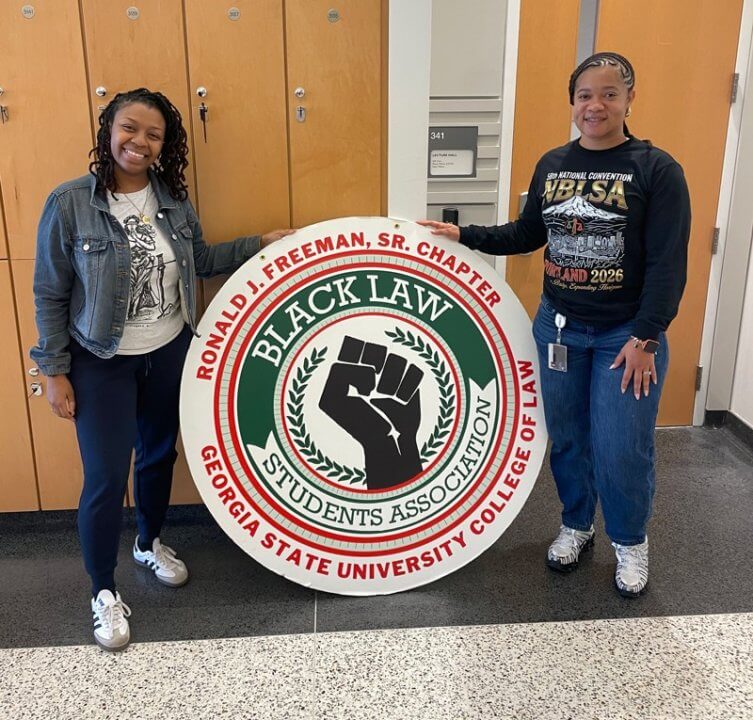
Q: Is there anything in particular that you've done to feel more at home at the College of Law?
Through Georgia State University Law Review, the Black Law Students Association, the Philip C. Cook Low-Income Taxpayer Clinic and my volunteer work with the Atlanta Volunteer Lawyers Foundation, I have had opportunities to work alongside people who share my interests and commitment to the legal profession. I have also tried to make room for smaller, everyday connections, talking with classmates before or after class, asking questions and getting to know the people around me. Those interactions make a difference, especially as a part-time student whose schedule may not always allow for every campus event.
Q: How do you manage your time between your duties as a law student and an active member of several legal communities?
Going into this academic year, I knew that participating in the Tax Clinic and serving on Law Review would require a significant commitment alongside my coursework. I wanted to be intentional about what I took on rather than spread myself too thin, so I decided not to add employment to those responsibilities at this time. That decision has allowed me to focus on developing my legal skills, contributing meaningfully to those organizations and making the most of the practical experience they offer.
Balancing those commitments requires planning and being realistic about my time. I try to look ahead at deadlines, prioritize responsibilities that require the most preparation and leave room for unexpected demands. I also recognize that being an active member of a community does not mean attending every event or saying yes to every opportunity. For me, it means being dependable, staying engaged and following through on the commitments I make. Being a part-time student has reinforced the importance of choosing opportunities thoughtfully and giving them the attention they deserve.
Q: What habits do you attribute to your academic success?
Consistency, preparation and a willingness to adjust my approach have been central to my academic success. I treat studying as an ongoing process rather than something that begins shortly before exams. I schedule time to review material, use active recall to test my understanding and practice applying legal rules rather than simply rereading them.
I also try to identify gaps in my understanding early and ask questions before those gaps become larger obstacles. As a part-time student and a mother, I have to be purposeful with my time. That has taught me to focus on the quality of my studying, not just the number of hours I spend doing it.
Q: Are there particular practice areas that you gravitate towards?
I am interested in litigation, but I am still exploring which practice area would be the best fit for me. I had the opportunity to intern with a federal judge in the Northern District of Georgia, which strengthened that interest. I was excited to be in the courtroom and observe how attorneys present their arguments, respond to the judge’s questions and adapt their approaches as proceedings unfolded. Watching different advocacy styles helped me appreciate how preparation, clarity and the ability to think on your feet can shape an attorney’s effectiveness. It also made me eager to develop my own skills as an advocate.
Q: What has been your most impactful experience or class since joining the College of Law?
One of my most impactful classes since joining the College of Law was Property with Professor Rowberry. He made learning about estates in land, a topic that can initially feel technical and intimidating, genuinely fun and engaging. I appreciated his ability to make complex concepts approachable while encouraging us to think carefully about how the rules work together.
The class also helped me recognize my interest in how property rights are created, transferred and passed down over time. It connected with my growing interest in wills, trusts and estates and gave me a foundation I am excited to build on. More than anything, Professor Rowberry showed me how much an engaging professor can shape both your understanding of a subject and your enthusiasm for learning it.
Q: What is the best piece of advice that you would give to an incoming or current part-time student?
Build a routine that fits your actual life, not an idealized version of what you think a law student’s schedule should look like. Part-time students often have significant responsibilities outside the classroom, and those responsibilities do not make us any less committed or capable.
Plan ahead, ask for help early and be intentional about building relationships, even when your time on campus is limited. Most importantly, do not measure your progress against someone whose circumstances are different from yours.
Georgia State University College of Law’s mission is to promote an innovative, equitable and inclusive vision of the law through high-quality, accessible education, impactful research and service to its communities. The Georgia State Law part-time program, clinics, faculty and staff are all integral in ensuring that this mission is carried forward.
-Written by Laura Osnard (J.D. ’27)