
THE GOLDEN OPPORTUNITY — PART II

THE GOLDEN OPPORTUNITY — PART II
By Charles McNair
Read Part I of The Golden Opportunity
When Atlanta won its bid for the Centennial Olympic Games, Georgia State University was already part of the legacy plan: an Olympic Village designed to transform, after the athletes left, into a new generation of student housing in the heart of downtown.
The commuter college in the historic heart of Atlanta would be no more. A university would emerge where students lived, shopped and dined, and enjoyed downtown entertainment.
Predictably, new classrooms and more residence halls, research facilities and offices would spring up to support the first on-campus settlement. In fact, the boomtown growth of GSU since the Olympic Games reshaped the university and its image and, indeed, the face of downtown Atlanta.
Today, about 5,000 students live on GSU’s Atlanta Campus.
“You can draw a straight line from housing built for the Olympic Games to GSU today,” says Michael L. Sanseviro (Ph.D. ’06), now Georgia State’s vice president for Student Engagement. Sanseviro was the complex director for University Housing during the 1996 Olympics and lived at the Olympic Village where he helped support services for the athletes.
At the time, plans to transition Olympic Village residences to GSU student living after the Games didn’t thrill everyone.
“Some were not in favor of making GSU a residential university,” Sanseviro says. “They resented a foray into residential housing. Plus, in some ways, it wasn’t a good location for GSU. It was located on Georgia Tech’s campus. We didn’t have transportation then, and we would have so many students living so far away from the core around Hurt Park that we ended up giving them MARTA cards to get to classes.
“But those of us who believed in a residential mission drank the Kool-Aid. We needed housing.”
On-campus housing would quickly stimulate GSU’s growth and reputation.
“When you’re a residential university,” Sanseviro says, “you attract a broader population. Almost overnight, the average age of GSU’s student population dropped. We saw the development of after-hours life around the university.
“We added diversity. On-campus residences brought different types of students from different backgrounds. And we started to see many more international students.”
But that was all still to come. Before any GSU students moved in, Sanseviro had to manage Olympic Village housing through the Games.
That summer would be the madcap adventure of a lifetime.
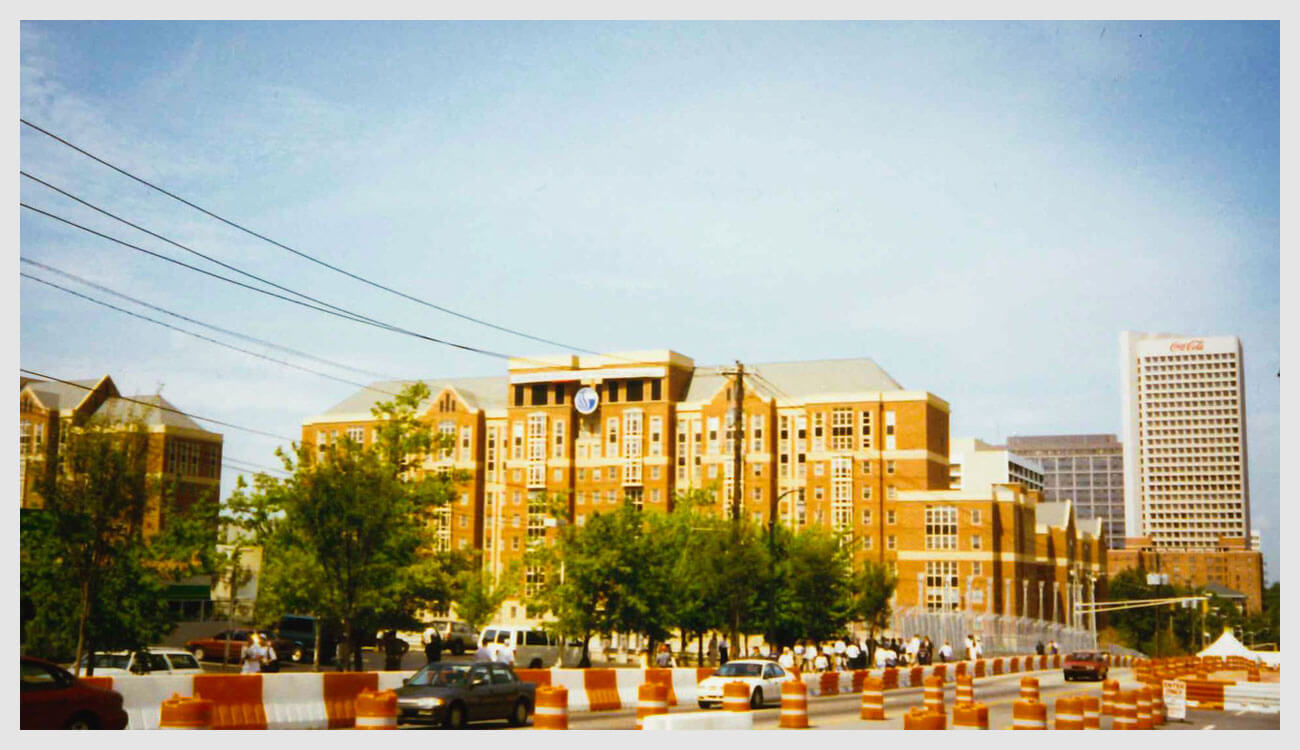
THE WILD WEST
Sanseviro and one other GSU complex director were on call 24 hours a day, taking 12-hour shifts, six days a week. The Gold Zone of the Olympic Village was designed to house 2,000 future GSU students, but for the Games, bunk beds were installed to accommodate 4,000 athletes from a record 197 nations. In all, more than 10,000 athletes would rotate in and out of the entire Village.
Ah, the problems!
The Village, at the corner of North Avenue and Centennial Olympic Park Drive, was a four-building multistory complex, each with a Greek name — Sparta, Ithaca, Athena and Olympia. At Sparta, contractors didn’t have time to finish the ground-level flooring. The Village staff laid down plywood and indoor-outdoor turf.

Michael L. Sanseviro, now Georgia State's vice president for Student Engagement, was the complex director for University Housing during the 1996 Olympics.
“At Athena, the building was settling,” Sanseviro recalls. “Because of that, deadbolts on the doors wouldn’t close. As each contingent of athletes arrived, we’d rush to rooms with old-fashioned files and grind down the strike plates to make sure the doors locked.”
Sheila Hula, the wife of radio production company owner and early Olympic torch bearer Ed Hula (their son, Ed Hula III (B.A. ’09), was a GSU 40 Under 40 honoree in 2023), took time off from her job as executive producer of a CNN travel show to be a high-level volunteer. One of her assignments wasn’t so high-level.
“In new residences built near the Downtown Connector, I flushed every single toilet to make sure plumbing worked,” she says. “Every single one.”
It got better for Sheila.
She shepherded the small Olympic team from Vanuatu, a dreamy Pacific island nation. Circumstances required Vanuatu athletes and staff to leave Atlanta on the morning of the closing ceremonies.
“Nobody was left to carry their nation’s flag,” Sheila says. “So, they asked if I would do it for them.
“It’s an experience that can’t be replicated — waiting with gold medalists, then walking into a stadium carrying a national flag with thousands of people cheering.
“It was just a dream.”
Deniece Griffin, now the marketing manager for Georgia State's Entrepreneurship & Innovation Institute, was tasked with helping to create the look of the Games. As an assistant art director for the Atlanta Committee for the Olympic Games' creative services team, Griffin worked to find artists locally and nationally who could create an aesthetic for the competition — no small feat.
Six firms were selected out of a pool of 490 to create a visual identity for the Centennial Games.
“We had to make sure everything was on brand,” she says. “From the pictograms to the posters, we had to make sure the Games were represented in a fun and exciting way, and I’m very happy we were able to secure those artists to fulfill our vision.”

VODKA? DA!
For Sanseviro, the harrowing schedule did have perks. He had access to tickets (when he had energy and time to go to events), and he dined alongside the greatest athletes on Earth.
Mostly, though, he and the team solved problems on the fly.
“There was a housing fee to live in Olympic Village, and some poor countries didn’t have enough money to pay for a bed for each athlete,” Sanseviro explains. “So, some had doubled up and slept in shifts. Some rooms had athletes swapping shifts for morning and afternoon sleeps — 12 athletes and only six beds.”
Other services for healthy young athletes stayed largely under the radar.
“We distributed a lot of condoms,” Sanseviro confesses.
With so many different cultures in tight corners, Olympic competition extended to partying.
“As soon as a team finished competition, they threw a full-on party,” Sanseviro says. “There was a lot of alcohol and smoking. United States laws didn’t apply inside the Olympic Village. As soon as the fence went up around it, we became an international enclave. Public nudity in the residence halls was not an issue. Nor public drinking.”
A large contingent of Russians in the Village turned their noses up at the local liquor.
“They wouldn’t drink our vodka,” Sanseviro remembers. “They shipped in their own. And we were carefully coached that it was a deep insult to Russians to turn down a drink of their vodka if offered.
“They always offered. Whenever we got a service call to the Russian residences, somebody met us with a shot.”
Were the generous, potent, 100-proof shots accepted?
“We successfully avoided causing any international incidents,” Sanseviro confesses.
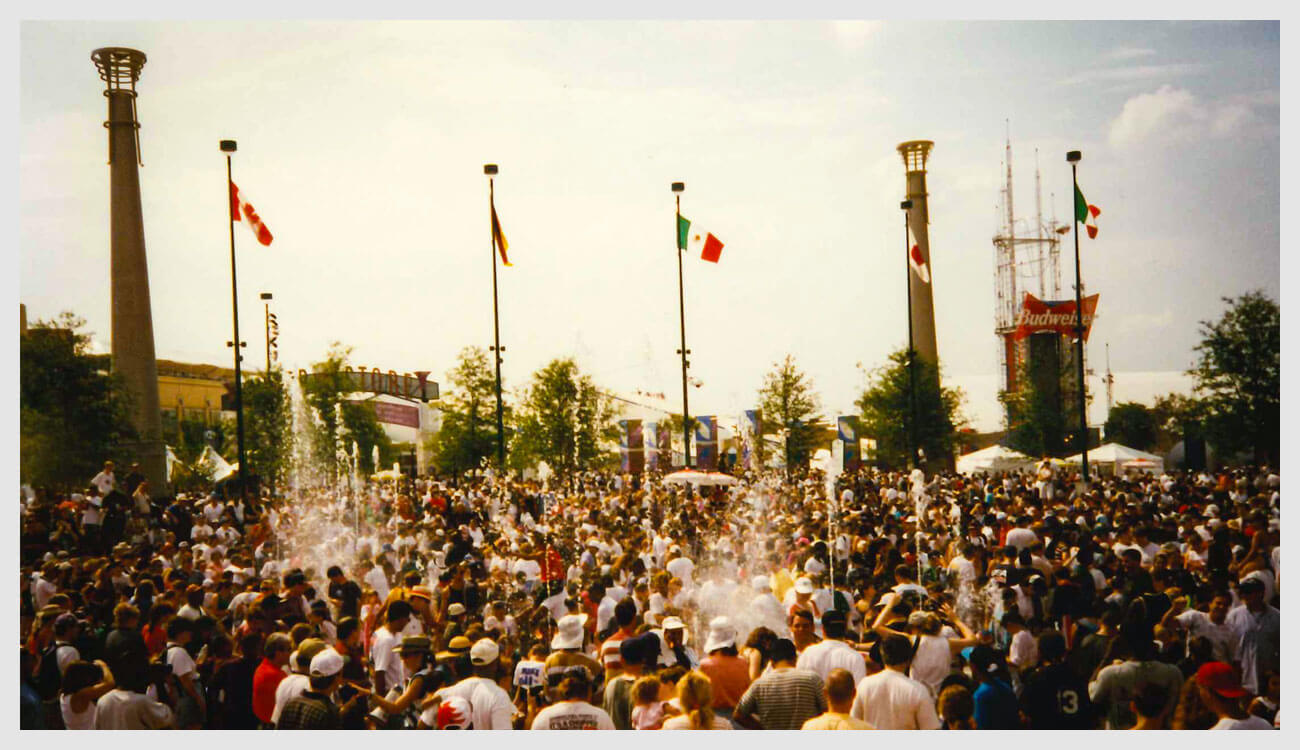
GSU AND OLYMPIC MARKETING
Ken Bernhardt, Regents’ Professor Emeritus of Marketing, was already nationally known as a marketing expert at the time of the Centennial Games.
Atlanta pressed him and GSU into Olympics service.
“In 1993,” Bernhardt remembers, “with students and a colleague, we did a study for the Atlanta Committee for the Olympic Games (ACOG) on merchandising with its logo. We came up with so many ideas. We got them the right way, too: We interviewed people on the streets where stores were going to be. We gathered up a huge number of ideas — everything from apparel and mascot merchandise to pins, badges, coffee mugs, souvenir coins and even baby bibs.”
A second project for Bernhardt’s marketing research yielded results that seemed counterintuitive.
“We did a bunch of focus groups on Olympic license plates,” he says.
“Los Angeles in ’84 priced license plates at $250 each. They didn’t do any research, and they sold just 10 percent of what they’d hoped. With our focus groups, we set prices at $35 per plate, and we sold a huge number during and after the Games. I had two of them myself.”
Bernhardt has made it his business to understand the business of the Centennial Olympics.
“The 1996 Atlanta Olympics delivered a substantial economic boost in the short term — through visitor spending, job creation and construction,” he says. “And long term, the Games helped catalyze downtown revitalization, including GSU’s, and raise Atlanta’s global profile.”
Strictly adhering to guidelines that brought in minority vendors and contractors, Atlanta undertook major new construction:
- Centennial Olympic Stadium hosted the opening and closing ceremonies, along with track and field events. After the Games, it became Turner Field, home to the Atlanta Braves. In 2017, it became home to the GSU Panthers football team and is now known as Center Parc Credit Union Stadium.
- Centennial Olympic Park, the 22-acre centerpiece and gathering spot for Games visitors, replaced warehouses and industrial eyesores downtown. (A July 27 pipe bombing in the park caused one fatality and injured more than 100, marring the Games. Despite the blow, Atlanta officials had activities back on course in just two days.)
- Olympic Village, as reported, housed athletes for the three weeks of the Games, then was converted to residences for students of GSU and later those of Georgia Tech.
- Georgia International Horse Park in Conyers, about 30 miles from downtown Atlanta, hosted equestrian, mountain biking and pentathlon events.
- Other new venues included the Wolf Creek Shooting Complex (now Tom Lowe Shooting Grounds) and Atlanta Beach (beach volleyball) that is today a water park (Clayton County International Park).
- Aquatic facilities for swimming and diving events were converted for use by Georgia Tech.
These projects, plus upgrades to 14 existing facilities, had two purposes designed into them from the start: Long-term urban revitalization and a strengthening of Atlanta’s sports infrastructure.

ECONOMIC IMPACT
Bernhardt is still amazed by the financials of 30 years ago.
“The 1996 Olympics generated a significant economic windfall for the city and region,” Bernhardt says. “A commonly cited figure for the overall economic impact is $5.1 billion, including direct, indirect and induced effects like visitor spending, construction, job creation, etc.”
The Games created jobs across Georgia (as many as 77,000), particularly in construction, hospitality, retail and business services. Atlanta’s business services and construction employment were especially robust.
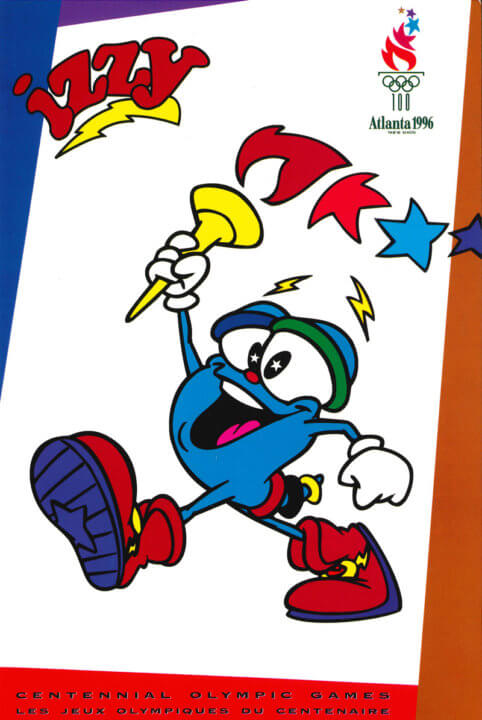
The infamous Centennial Games mascot, Whatizit?, also came to be known as Izzy.
Visitors — delighted and amazed that the Olympics had come to the Deep South — poured into Atlanta. More than 2 million guests spent heavily on lodging, food and entertainment.
“An after-effect of this influx of tourists and the global exposure was the elevation of Atlanta as a destination and business hub,” Bernhardt says. “Not many people know that Atlanta today ranks fourth in the U.S. in convention business.”
Atlanta also invested heavily in sprucing up for the Games.
The city improved roads, made transit upgrades, expanded the airport, and gussied up streetscapes and public parks. Centennial Olympic Park became a lasting focal point for downtown revitalization, spurring construction of hotels, condominiums, offices and new cultural attractions such as the Georgia Aquarium, World of Coke, the National Center for Civil and Human Rights and the College Football Hall of Fame.
A faded jewel of the city, GSU’s Rialto Center for the Arts, got a makeover, as did the surrounding Fairlie-Poplar historic district. A few years after the Games, GSU started work on the Helen M. Aderhold Learning Center, a five-story academic building on Luckie Street. Its modern classrooms, lecture halls and technology resources make it a hub for GSU students today.

GOLD, SILVER, BRONZE … MEMORIES
The athletes of the 1996 Centennial Olympic Games made all the plots and plans of nearly a decade worth the effort, breaking 24 world records and more than 100 Olympic records with their performances. Olympic achievements outshone the pin-trading and street vending and ticket frenzies on the streets of Atlanta.
Remember?
- In one of the most emotional moments in sports history, a trembling Muhammad Ali, suffering from Parkinson’s disease, which would take his life in 2016, lit the cauldron to start the Centennial Games. Atlanta was special for Ali, a gold medalist in boxing at age 18 in the Rome Games of 1960. In 1970, Mayor Sam Massell (B.S. ’51) had given the heavyweight champion his first boxing venue after Ali was exiled from the sport (1967–1970) for refusing the Vietnam War draft. After his conviction was overturned in 1971, Ali defeated Jerry Quarry in Municipal Auditorium, which is today Georgia State’s Dahlberg Hall. He went on to become the first fighter to win the heavyweight championship three times.
- Sprinter Michael Johnson, wearing trademark golden shoes, dominated his track events, winning the 200-meter and 400-meter men’s races. Johnson’s blazing Centennial Stadium 200-meter sprint in 19.32 seconds set a world record.
- Despite tearing ligaments in her ankle on a first vault attempt, gymnast Kerri Strug became a household name when she landed her second one, securing a gold medal for the U.S. women’s gymnastics team — The Magnificent Seven. It was the first-ever team all-around gold for U.S. women’s gymnastics.
- Canadian Donovan Bailey set a world record in the 100-meter dash with a time of 9.84 seconds.
- A French woman, Marie-Jose Perec, matched Michael Johnson’s double gold in track, winning the 200-meter and 400-meter races.
- Swimmer Amy Van Dyken became the first U.S. athlete to win four gold medals in a single Olympics.
- Legendary track star Carl Lewis, competing in his final Olympics, won a fourth consecutive gold medal in the long jump.
- Finally, Dream Team III — the U.S. men’s basketball team led by Shaquille O’Neal and Charles Barkley — overpowered opponents to win a gold medal.
These Olympic experiences proved powerful enough to make current GSU Director of Athletics Charlie Cobb a true believer.
Cobb worked in 1996 as sales manager for the Georgia Dome, entertaining clients with events at the facility and at the Georgia World Congress Center.
“Honestly, I was never a huge fan of the Olympics before Atlanta,” Cobb confesses. “But I became one during the Centennial Games.
“Now, I see the Olympics as a major event in life.”

MEMORIES TO GO AROUND
Ed and Sheila Hula have collected Olympic memorabilia through the years. They’ve loaned some of their pieces for an exhibit at GSU that commemorates the 30th anniversary of the Games.
One item on display is deeply personal for Ed.
It’s the Olympic torch — a symbol of peace, unity and friendship — that he carried at Cocoa Beach, Fla., as part of the Olympic flame’s journey across the U.S. to its final stop in Muhammad Ali’s hands.
“My father had died a couple of weeks before I carried the torch,” Ed says. “He and mom lived near Cocoa Beach. He almost made it to the Olympics. He almost got to see me run with the torch.”
Deniece Griffin also had the honor of carrying the Olympic torch during its journey to Atlanta. Twenty-five years after the Centennial Games, she wondered whether the torch could still burn.
The answer was yes.
“My brother was able to get it working,” she said. “It still had fuel in it!”
Thirty years after the Games, the memories linger for Deniece, Ed and Atlanta. But the Games also left much more.

Check out The Phoenix Rises: Atlanta’s Olympic Journey, an exhibit at the Georgia State Library showcasing imagery, artifacts, programs, buttons and keepsakes from the 1996 Olympic Games.
The Centennial Olympics pumped golden adrenalin into Atlanta and Georgia State. Outpacing all expectations, the Games gave the city and university a boost onto the world podium.
Today, 30 years later, Andrew Young’s prophetic words about the Games ring more true than ever.
It will bring people together.
Photos courtesy of Michael L. Sanseviro (Ph.D. '06), Deniece Griffin and the Georgia State Library's Digital Collections.