
Outsmarting Superbugs: From Brewing to Biofilms
Outsmarting Superbugs: From Brewing to Biofilms
Nearly a century ago, antibiotics transformed medicine, making surgeries safer and once-deadly infections treatable. But as antibiotic resistance continues to rise, researchers are looking beyond simply developing the next antibiotic — they’re exploring new ways to coexist with microbes.
“We’re not going to defeat microorganisms in a war,” says Georgia State Associate Professor of Biology Eric Gilbert. “What we need to do is manage our relationship with them.”
The stakes are high. It’s not just serious infections like pneumonia or sepsis that are a risk. A routine surgery, a dental procedure or even a scraped knee could become more dangerous — or even deadly — if the antibiotics used to prevent or treat infections stop working. The World Health Organization recognizes antimicrobial resistance as one of the world’s leading public health threats, and that danger is driving researchers to seek new approaches.
Gilbert, who joined Georgia State’s faculty in the Department of Biology in 2000, has spent his career exploring the hidden world of microorganisms and the surprising ways they influence our lives. During his postdoctoral research at the University of California, Berkeley, he became fascinated by microbial biofilms — communities of microorganisms that live and work together.
Over the years, his research has explored everything from beneficial microbes that help break down environmental pollutants to disease-causing bacteria that form resilient biofilms. Today, his lab is investigating an emerging antivirulence strategy that seeks to prevent harmful bacteria from organizing into those protective communities in the first place.
The work recently led to a U.S. patent for compounds inspired by gesho, an East African plant traditionally used in brewing and folk medicine. But the discovery itself began with something much simpler: an unexpected knock on the laboratory door from a graduate student with an intriguing research question.
Below, Gilbert discusses the journey behind the discovery, the students who are making it possible and what comes next.
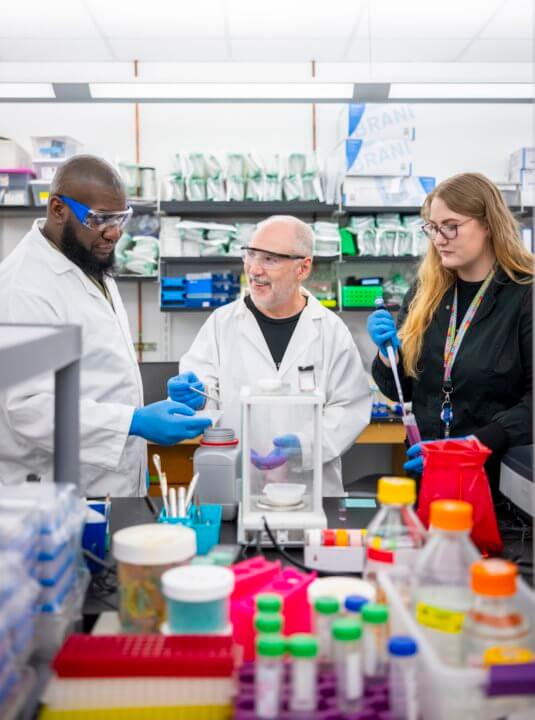
Associate Professor of Biology and Graduate Program Director Eric Gilbert works in the lab with undergraduate student Malique Joseph (B.S. '27), left, and doctoral candidate Caroline Taylor (B.S. ’20, M.S. ’22).
You’ve been at Georgia State for more than two decades. Tell us about your path into microbiology and how your research evolved.
This is my 26th year at Georgia State. My research is in microbiology, specifically microbial biofilms. I first became interested in biofilms during my postdoctoral work, where we were studying beneficial biofilms made up of microorganisms that break down hazardous chemicals.
When I came to Georgia State, I began thinking about how those same interactions among microbes could work in disease-causing settings. I became increasingly interested in how bacteria cooperate inside biofilms to resist antibiotics and, more importantly, what we can do to prevent those biofilms from forming in the first place.
For readers who may not know the term, what exactly are biofilms and why are they such an important area of study?
Biofilms form when microbes stack together, almost like bricks in a wall, and surround themselves with a sticky material they produce themselves — like mortar holding the bricks together. Everyone has biofilms associated with them, and many are beneficial. For example, the microbes in our gut and on our skin live in these surface-attached communities, and they help protect us from disease-causing organisms.
The problem comes when harmful bacteria form biofilms. Once they’re established, they become much more resistant to antibiotics and much harder to remove.
That’s why biofilms are such a concern in chronic wounds, on implanted medical devices like artificial joints or pacemakers and in persistent infections. If we can keep microbes from establishing a biofilm in the first place, they're much easier to treat.
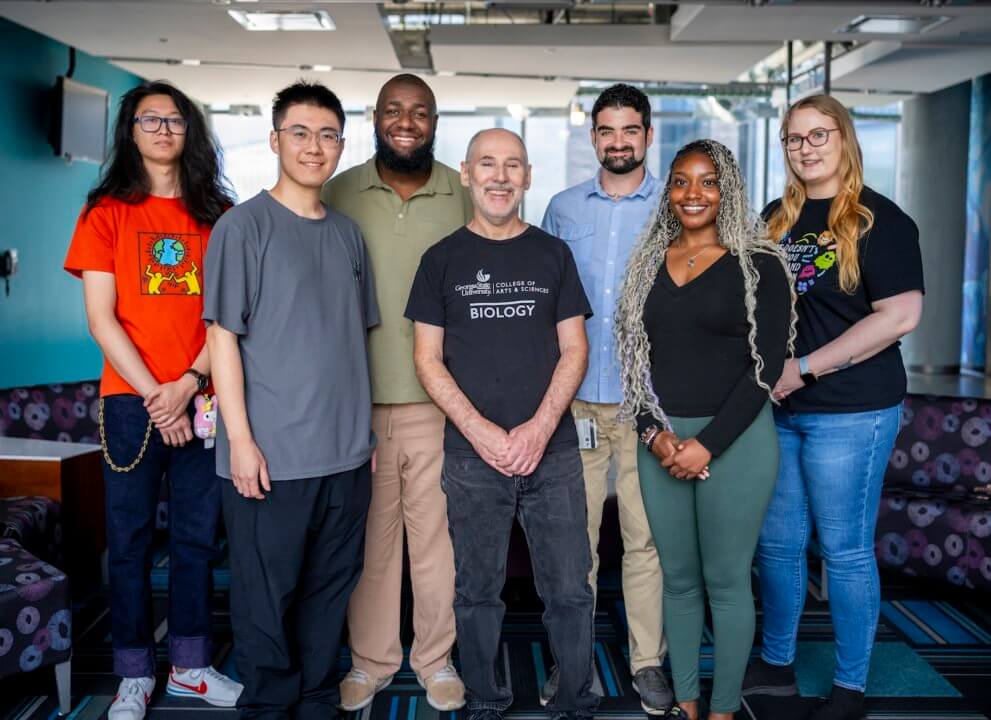
Students in Eric Gilbert's microbiology lab at Georgia State University collaborate on research exploring microbial biofilms and antibiotic resistance. Pictured are Junfei Pang (B.S. '27), from left, Zihan Cao (B.S. '27), Malique Joseph (B.S. '27), Gilbert, Ph.D. candidate Alexander Marchesani, Tiffany James (M.S. '26) and Ph.D. candidate Caroline Taylor (B.S. ’20, M.S. ’22).
One of your discoveries began with an unexpected knock on your door. What happened?
Around 2015, one of my Ph.D. students was studying Staphylococcus aureus biofilms when Dr. Jenail Marshall — then an anthropology undergraduate student from Dr. Bethany Turner-Livermore’s lab and now a doctor of Anthropology — stopped by the lab. She introduced herself and explained she was studying gesho, this East African plant traditionally used for skin infections and in fermented beverages. She asked if she could evaluate its antimicrobial potential in our lab.
We were happy to help. My student, Dr. Mariya Campbell, who is a now a Laboratory Leadership Service officer at the Centers for Disease Control and Prevention, decided to see whether the plant extract affected Staphylococcus aureus biofilms. What happened next surprised us. The extract didn’t kill the bacteria, but it dramatically reduced their ability to form biofilms.
That combination immediately caught our attention because it matched exactly the antivirulence strategy we had been thinking about — reducing biofilm formation without being highly toxic to the bacteria. That chance collaboration became the foundation for nearly a decade of research.
Your research doesn’t focus on killing bacteria. Instead, it focuses on preventing them from becoming dangerous. Why is that such an important shift?
One of the biggest issues we’re facing is antibiotic resistance. Every time antibiotics are overused or used when they aren’t necessary, we create conditions that allow resistant bacteria to thrive.
For a long time, scientists thought we’d simply develop stronger and stronger antibiotics. What’s become evident is that’s probably not a sustainable strategy. The idea behind antivirulence is that if we can persuade bacteria not to produce the harmful compounds and enzymes that make us sick — and prevent them from forming biofilms — our immune systems can often clear the infection on their own. It also helps preserve antibiotics for the times we truly need them.
How did that discovery lead to a patented technology, and where could it eventually have the greatest impact?
Once we identified the active compounds in gesho, we began looking at closely related molecules and eventually identified one called 4-ethoxybenzoic acid, or 4EB, which showed particularly promising antibiofilm activity.
That work ultimately led to a U.S. patent covering the compound’s biological application. Right now, we’re especially interested in topical uses, such as helping prevent biofilm formation in wounds or other surface infections. Ultimately, we think compounds like this could be used together to interrupt multiple stages of biofilm formation and make infections much easier to treat.
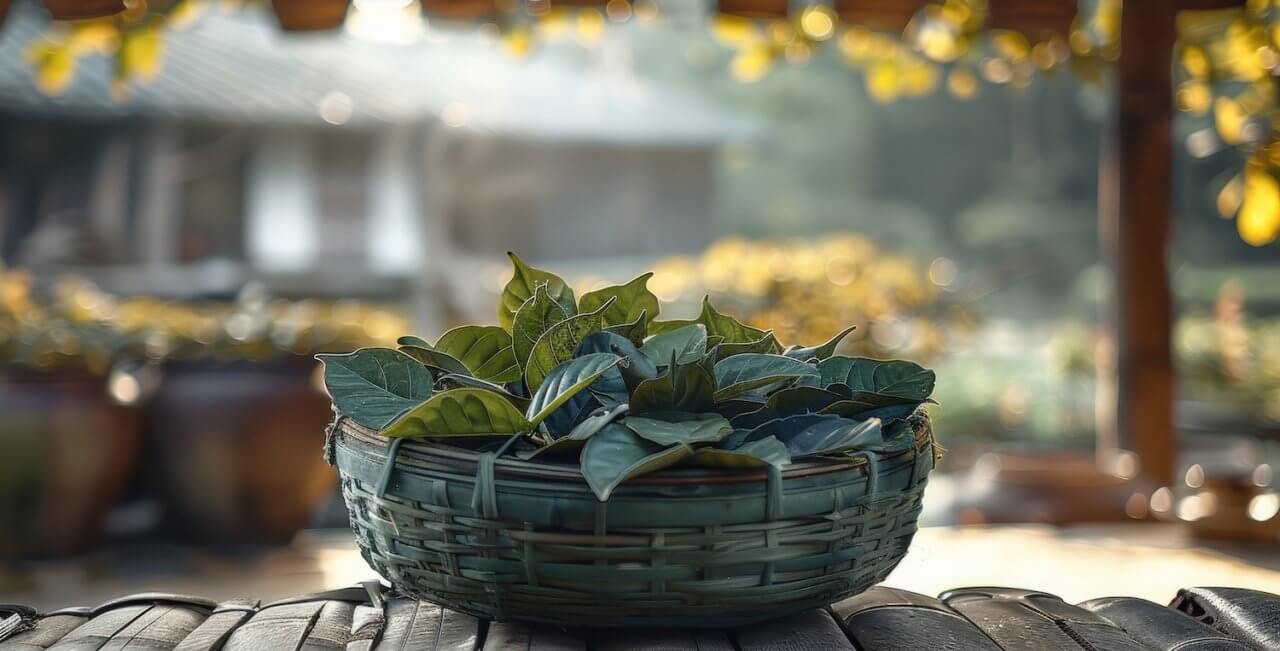
The East African plant gesho (Rhamnus prinoides) has long been used in traditional fermented beverages and folk medicine. Compounds derived from the plant inspired Associate Professor of Biology Eric Gilbert’s patented research on preventing bacterial biofilm formation.
Earlier in your career you also investigated microbes that could help break down plastics. Although that work is on hold, do you hope to return to it someday?
I think most scientists have projects they’d love to return to. The plastics work is certainly one of those. It’s an important problem, and I’d like to revisit it when the opportunity is right.
Right now, though, we’re making exciting progress understanding how these antibiofilm compounds work. Every answer leads to another question, and that’s one of the things I enjoy most about science.
What questions are you and your students trying to answer now?
Right now, we’re focused on understanding exactly how 4EB works at the molecular level. We know it disrupts two of the four stages involved in Staphylococcus aureus biofilm formation. The next question is, what other compounds might target the remaining stages?
Once you understand how something works, it’s much easier to improve it.
Students have played an important role in this discovery. What has that collaboration meant to you?
The students in our biology program actively conduct research alongside their faculty mentors. We interpret the data together, and they’re integral to the discovery process.
We’ve been working on the gesho project for about 10 years. Undergraduate, master’s and Ph.D. students have all contributed. Two of my senior doctoral students, Alex Marchesani and Caroline Taylor (B.S. ’20, M.S. ’22), have played important roles in advancing the research, and this fall we’ll welcome another Ph.D. student who will continue building on that work. Watching students become independent scientists while contributing to discoveries like this is one of the most rewarding parts of my job.
Your research has taken you from a microbiology lab in Atlanta to a plant that’s been used for generations in East African brewing and traditional medicine. What has that journey taught you?
One of the things I am enjoying most about this project is that it took us into a field that was completely new to me. Our first paper on this work was published in the Journal of Ethnopharmacology, which was very different from anything I’d done before. What was exciting was being able to provide laboratory evidence supporting the traditional use of gesho. It suggests there may be scientific reasons why these practices have endured for generations.
I’d also love to visit Ethiopia someday to see where gesho is grown, meet the farmers and learn from the people who have used it in their daily lives. Science often begins with curiosity, and this project reminds me that valuable discoveries can come from unexpected collaborations and from paying attention to knowledge that’s been around for centuries.
GROWING SCIENTISTS
As graduate program director in the Department of Biology, Associate Professor Eric Gilbert believes the best way to learn science is to do it. In his lab, students don’t just support research, they take ownership of it.
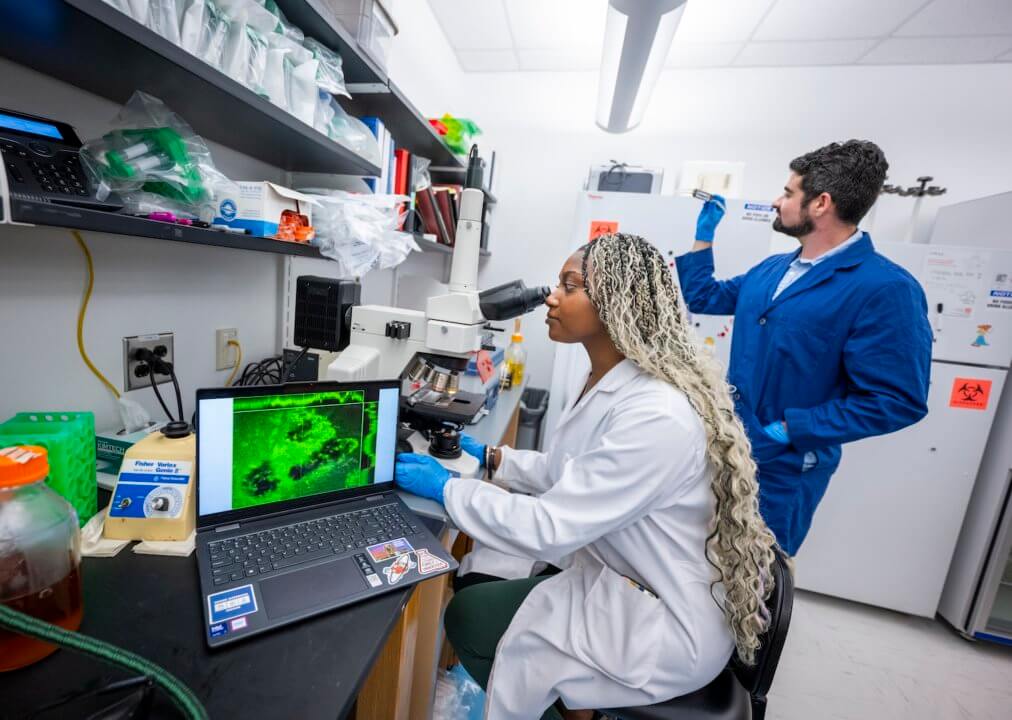
When Associate Professor of Biology Eric Gilbert talks about his research, he rarely says “I.” Instead, he talks about “we.”
That’s because many of the discoveries emerging from his Georgia State laboratory — including the research that led to a recent U.S. patent — have been driven by students who take ownership of major research questions and follow them wherever the evidence leads. As graduate program director for the Department of Biology, Gilbert mentors students at every stage of their academic careers, from undergraduates gaining their first research experience to doctoral candidates leading sophisticated investigations.
“Students are integral to the discovery process,” Gilbert says. “They actively conduct research alongside their faculty mentors. We interpret the data together, and they’re integral to the discovery process.”
That philosophy is reflected in the work of doctoral candidates Caroline Taylor (B.S. ’20, M.S. ’22) and Alexander Marchesani, who have each helped advance the lab’s decade-long investigation of compounds derived from gesho, an East African plant traditionally used in brewing and folk medicine.
Taylor, a Ph.D. candidate in microbiology who expects to graduate in spring 2027, first joined Gilbert’s lab as a master’s student after earning her bachelor’s degree at Georgia State. Nearly six years later, she has helped answer one of the project’s most important questions: how the compound 4-ethoxybenzoic acid (4EB) prevents Staphylococcus aureus from forming biofilms.
After ruling out the pathways researchers expected to find, Taylor discovered the compound was acting through a different set of bacterial virulence regulators, opening an entirely new line of investigation.
“Identifying a compound’s mechanism of action is the first and arguably the most critical step toward transforming a promising plant-derived chemical into a real treatment for infection,” she says.
Marchesani, a biology Ph.D. candidate expected to graduate next year, tackled the project from another angle. Using advanced microscopy and image analysis, he created three-dimensional views of bacterial biofilms to measure exactly how 4EB changes the way they grow and mature. Developing the analysis took hundreds of hours, but the effort paid off, contributing to his first-author publication and revealing that the compound delays key stages of biofilm development.
Rather than pointing students toward predetermined answers, Gilbert encourages them to let the evidence shape the science.
“The data is the data,” Taylor says, recalling one of Gilbert’s favorite reminders. “A negative result doesn’t mean the experiment failed. That is the result.”
Marchesani says the lesson changed the way he approaches research. “Good science is driven by asking the right question, not by trying to prove you’re right,” he says.
The lab also includes undergraduate researchers working alongside graduate students, creating an environment where newer scientists learn from more experienced peers while contributing to active research with real-world impact.
For Gilbert, watching students become independent scientists is one of the most meaningful aspects of academic science. As students graduate and new researchers join the lab, each project helps prepare the next generation of scientists while moving the research forward.
For more information about Georgia State Research, visit research.gsu.edu.
Photos by Carolyn Richardson