
THE GOLDEN OPPORTUNITY
THE GOLDEN OPPORTUNITY
By Charles McNair
Read Part II of The Golden Opportunity
Part 1 of how winning the 1996 Centennial Olympic Games forever changed Atlanta and Georgia State.
It felt like … a miracle.
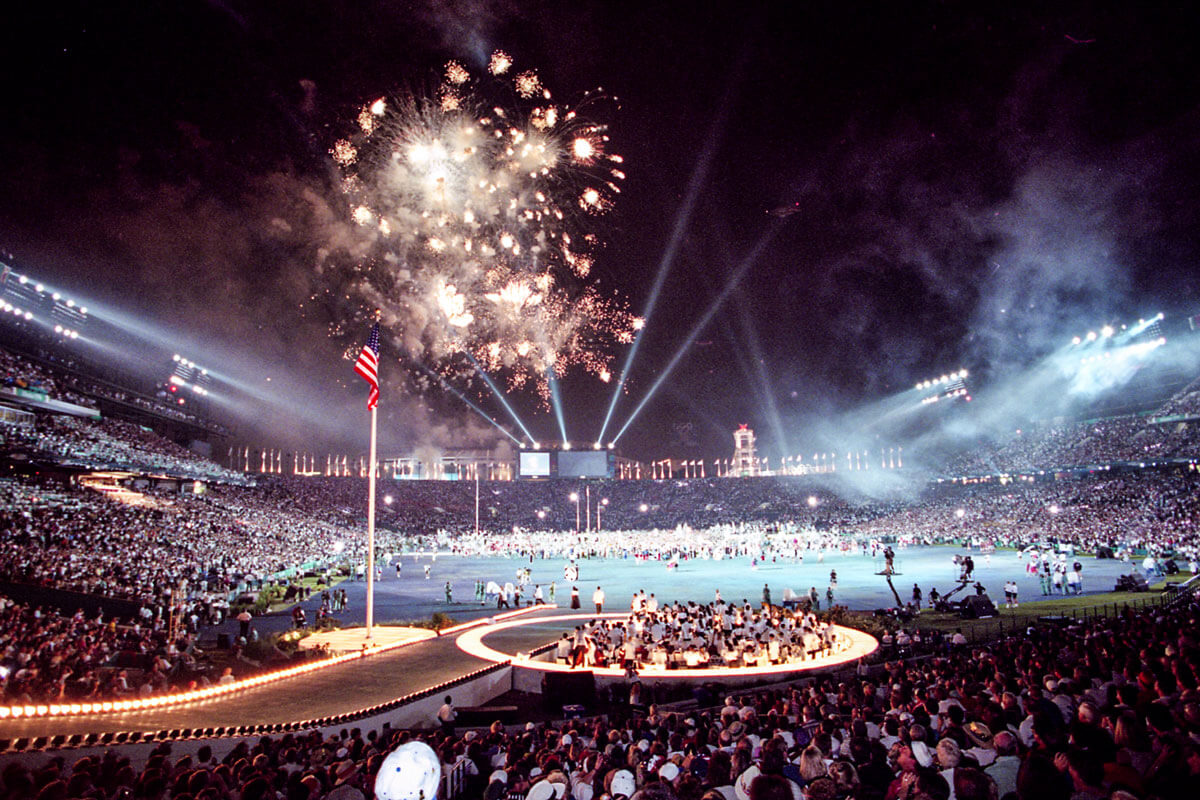
On Sept. 18, 1990, in the vast ballroom of Tokyo’s New Takanawa Prince Hotel, International Olympic Committee (IOC) President Juan Antonio Samaranch opened an envelope to name the city chosen to host the 1996 Centennial Olympic Games.
Samaranch paused. Was he surprised? Was there a mistake?
Tension high, he spoke.
“The International Olympic Committee has awarded the 1996 Olympic Games to the city of … Atlanta!”
“There was a volcano of joy and disbelief and surprise,” recalls Ed Hula, a radio production company owner and early Olympic torch bearer. Hula, who loaned pieces of his Olympic collection to the GSU Library for an exhibit that commemorates the 30th anniversary of the Games, and a delegation of some 400 Atlantans had flown to Tokyo hoping to hear their city’s name called at the 96th IOC meeting.
“Everybody was shouting!” Hula says. “There was Mayor Maynard Jackson hugging Billy Payne. People jumped up and down. I was literally crawling through the crowd with my equipment getting the sounds.”
Halfway around the world — a world that suddenly seemed much smaller — people in Atlanta jumped for joy too. They jumped in Columbus and Savannah, Macon, Plains, Blue Ridge, Ludowici. All over Georgia.
Upstart Atlanta, long-shot Atlanta, had beaten out some of the most famous cities in the world to host the 100th anniversary of the Olympic Games in 1996.
Atlanta had somehow bested even the sentimental, odds-on favorite, Athens, Greece, site of the first modern Olympic Games in 1896 — the capital of the nation where supreme athletic competition was first documented 2,766 years earlier, in 776 B.C.
Atlanta had just pulled off the greatest upset in sports history.
Check out The Phoenix Rises: Atlanta’s Olympic Journey, an exhibit at the Georgia State Library showcasing imagery, artifacts, programs, buttons and keepsakes from the 1996 Olympic Games.
UP FROM THE ASHES
Six generations or so before Samaranch opened his envelope, Atlanta smoldered. It was November 1864, six months before the end of the Civil War.
For the next century, the wider world mostly knew Atlanta only from Margaret Mitchell’s “Gone With the Wind.” The best-selling book and iconic movie that followed romanticized the slave-holding culture of the old South and fostered the notion that Atlanta and Scarlett O’Hara had been victimized by cruel fate and an invading Northern army.
Atlanta rose from the ashes, like the mythical phoenix that became its symbol.
The city prospered, but as a paradox — a rigid, often-violent system of Jim Crow segregation created wealth for whites, but somehow a Black mecca of education and commerce thrived too. As a business capital, Atlanta epitomized the progressive New South. But white supremacy remained deeply entrenched, glaringly evident in a 1906 race massacre that killed dozens of Black residents.
Not until the Civil Rights Movement of the 1960s would global perceptions of Atlanta change.
As the Rev. Martin Luther King Jr., a native son of the city, led a national equality struggle for Black people, Atlanta won a new reputation — now of tolerance and justice. Police in Birmingham, Ala., set attack dogs on Black residents. Mounted officers in Selma, Ala., clubbed marchers. But Atlanta, in full public view, emerged as “the city too busy to hate,” in the famous words of former Mayor William B. Hartsfield.
The world now beheld a prosperous Southern city that believed in a more expansive view of human rights.
A LONG MARCH OF BOOSTERISM
“Since the Civil War,” says Atlanta journalist and GSU alum Jim Auchmutey (B.A. ’77), “Atlanta had been obsessed with rising from the ashes and proving itself a great city. Even from the time of journalist Henry Grady in the 1800s, Atlantans were exquisitely concerned about what other people thought of them.”
Auchmutey points to the 1895 Cotton States and International Exposition, an event that symbolized a resurgent Atlanta on its feet again after Reconstruction.
“We always tried to emulate New York and Chicago to prove ourselves important,” Auchmutey says. “We beat our chest. We showed boosterism and a certain ambition, and when you care what others think of you, you behave a different way.
“Winning the Centennial Olympic Games was really the culmination of that long march of boosterism.”
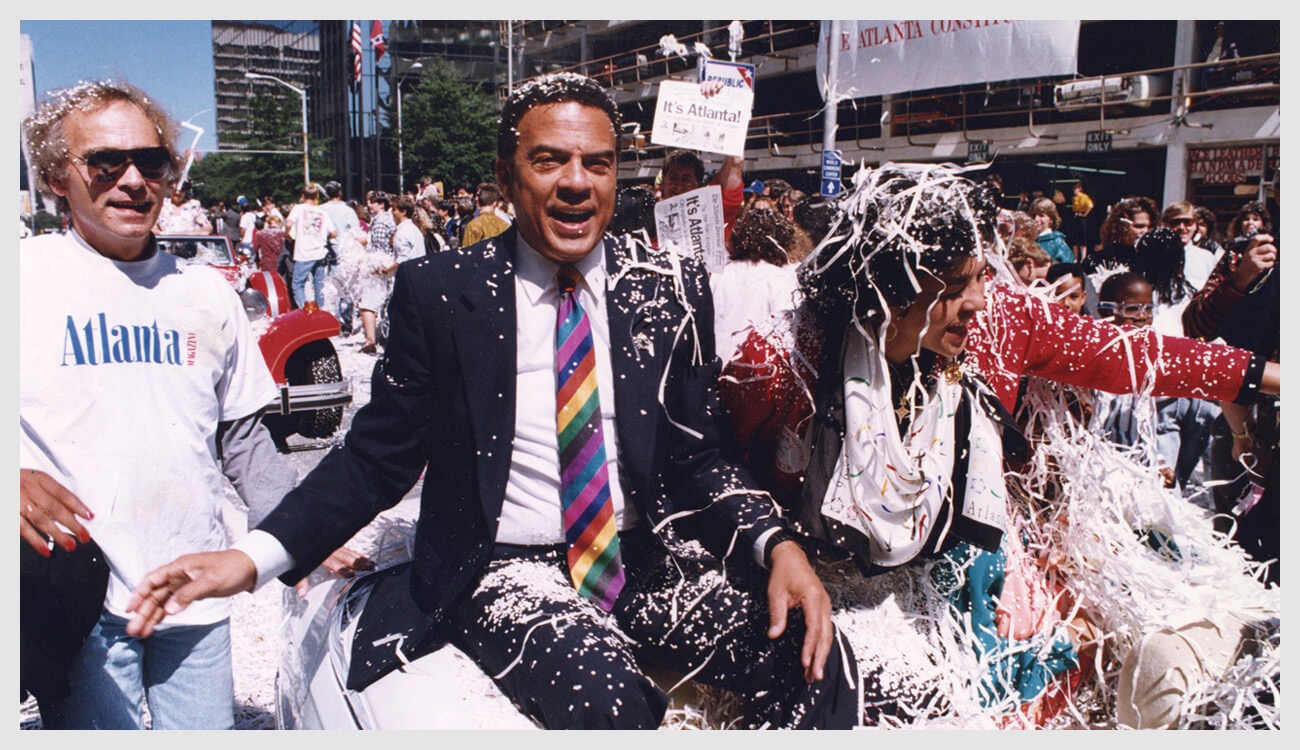
Without question, the key figure in bringing the Olympics to Atlanta was the civil rights icon and Atlanta mayor during the Olympics bidding competition, Andrew Young.
Mayor Young, whose name later became part of GSU’s own Andrew Young School of Policy Studies, had international credibility. He’d been a trusted lieutenant of MLK. He was the first Black U.S. congressman from Georgia since Reconstruction and the first Black U.S. ambassador to the United Nations. He helped pass the 1964 Civil Rights Act and 1965 Voting Rights Act. As Atlanta mayor since 1982, he’d been working relentlessly to transform the city into an international business hub.
In truth, the outside world knew more about Andrew Young than it did Atlanta.
“Andy embodied civil rights,” Auchmutey says. “And he also embodied Atlanta boosterism. Those two currents came together in him.”
For wooing the Centennial Olympic Games to Atlanta, Young proved to be exactly the right man — in the right place — at the right time.
GSU AWAITED ITS MOMENT
Once upon a time, Georgia State University was two buildings in downtown Atlanta. Most students carried briefcases to night classes. They were business professionals chasing degrees after working their day jobs, commuting home late.
The university had begun in 1913 as the Georgia Institute of Technology's "Evening School of Commerce." Twenty years later, it split from Georgia Tech to become the Atlanta Division of the University of Georgia.
Then, just after World War II, in 1947, the institution evolved into Georgia State College of Business Administration, still catering to downtown working professionals in night classes. In 1969, the school achieved full university status as Georgia State University.
In all those decades, and in its first 25 years officially as GSU, not one student lived in an on-campus residence. Scholars still commuted in and commuted out. After hours, the campus around Hurt Plaza was a lonely place.
But a singular event was coming that would vault the university from a commuter college to the status of a major urban university.
The springboard?
The 1996 Centennial Olympic Games.
OLYMPIC DREAMS
Michael L. Sanseviro (Ph.D. ’06), now GSU’s vice president for Student Engagement, came south from Long Island to attend Emory University as an undergraduate in 1986. He fell in love with Atlanta.
Even so, his career path eventually took him back north, working with an engineering school in New York City.
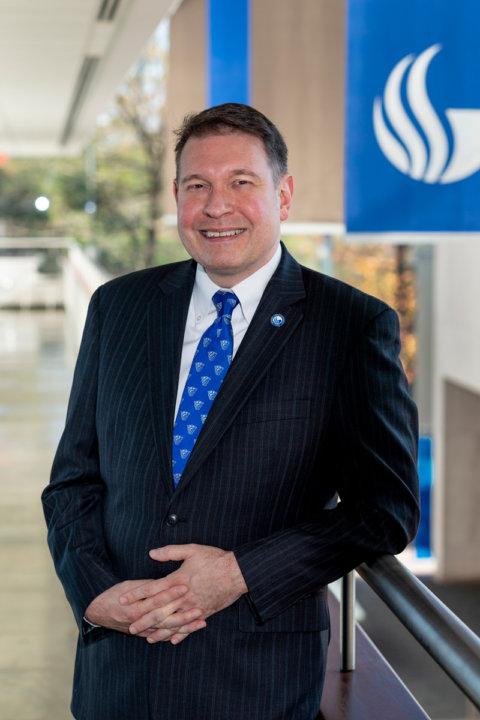
Michael L. Sanseviro, now Georgia State's vice president for Student Engagement, was the complex director for University Housing during the 1996 Olympics. He lived at the Olympic Village and helped support services for the athletes.
“Those polytechnic administrators wanted someone with a liberal arts background to teach engineers how to be human,” Sanseviro says. “I created an orientation program that took them out into the countryside, taught them camping and taught them life skills.”
Importantly, Sanseviro also developed new university housing.
He’d been in NYC a couple of years when a recruiting call came from Atlanta.
“The pitch got my attention,” Sanseviro admits. “‘The Olympics are coming. We need people with expertise. We want to develop residences for students for the first time. It’s an amazing time to be here. Oh, and you’ll be working directly with the Games.’”
Sanseviro threw his hat into the Olympic ring.
The decision left his family dumbstruck. How could he give up the sophistication of New York for the backwards South?
“I remember in 1986 one of my relatives asking me,” Sanseviro says, “if there was indoor plumbing in Georgia.”
Sanseviro moved to the Olympic Village in May 1996. He was subcontracted to the IOC and officially started work June 1, 1996 – 49 days before the July 19 opening ceremonies of the Centennial Games.
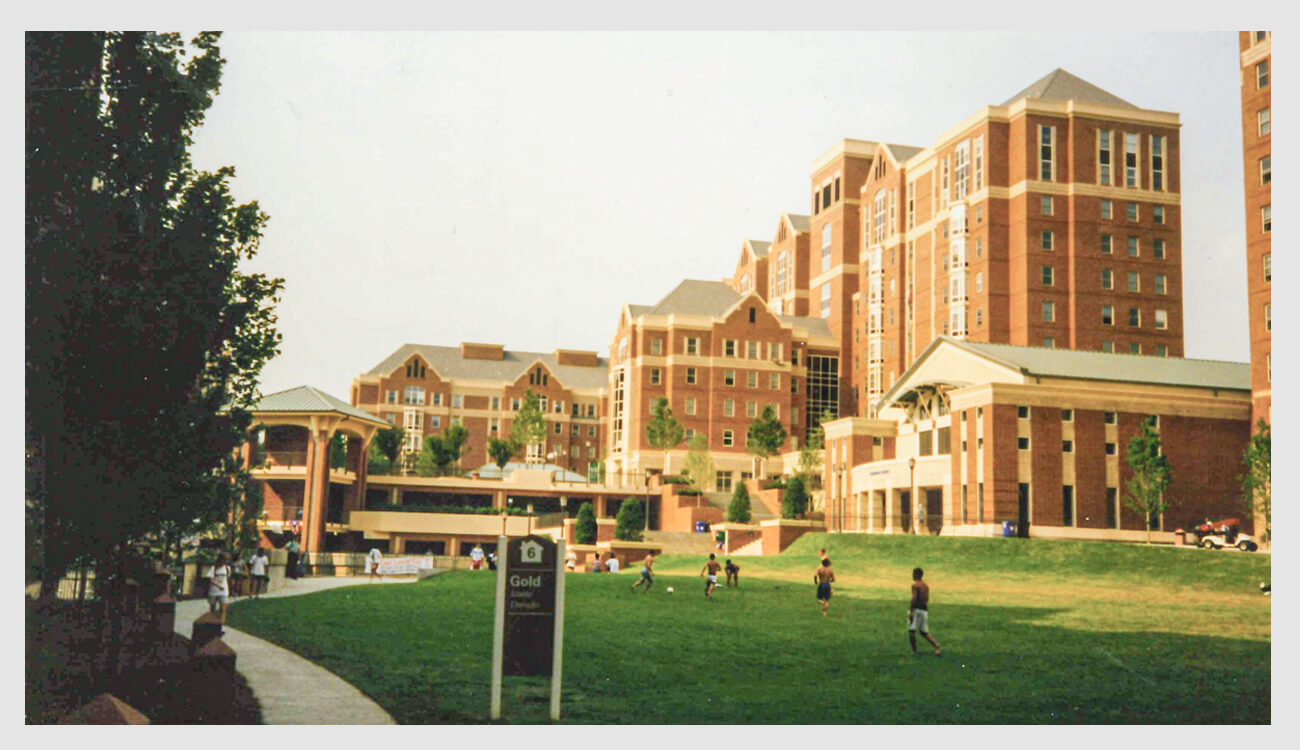
He lived and worked out of the first facility completed for the Village, one of a four-building multistory complex, each with a Greek name – Sparta, Ithaca, Athena and Olympia. The complex at the corner of North Avenue and Techwood Drive, today called North Avenue Village, ranged from five to 13 stories.
A capstone feature of the Atlanta plan was the Olympic Village – and, by design, when athletes departed, GSU would convert a share of Village living spaces to residence halls for college students.
For the first time, GSU students could live on campus the way students did at UGA, Emory, Georgia Tech and other classic universities.
“The Olympic Games were absolutely transformational for GSU,” said Sanseviro. “I’m not sure we would have become a residential university without the housing built for the games.”
BILLY PAYNE SEES THE LIGHT
A creative writer in advertising, George Hirthler, wrote Atlanta’s pitch for the 1996 Games at the commission of Billy Payne, a middle-aged Atlanta real estate attorney who had dreamed up the far-fetched notion of bringing the Olympics to Atlanta.
Hirthler’s immersion in Olympic history and lore later led to an award-winning historical novel, “The Idealist” (Ringworks Press, 2016), based on the life of Pierre de Coubertin, father of the modern Olympic Games. In 2024, after years of work, Hirthler and co-director Bob Judson, a former Georgia State professor and GSUTV managing director, released the documentary “The Games in Black and White,” detailing how Atlanta won the Centennial Games. (Several details in this article are sourced from the film.)
Six candidates made the Centennial Games short list: Athens, Belgrade, Manchester, Melbourne, Toronto and Atlanta. At that time, any one of the other five finalists likely had greater international luster than Atlanta.
But Atlanta had two resources no other city would be able to match: Payne and Young.
Payne had been a jock, an offensive and defensive end on Vince Dooley’s 1966 Southeastern Conference championship Georgia Bulldogs football team. He held folk hero status among Dawg fans for catching a game-clenching touchdown pass in the 1966 Sugar Bowl. Then, after working quietly in law for decades and dealing with significant heart health issues, Payne found a spark of civic calling when he led efforts to raise $2.2 million for the new sanctuary of St. Luke’s Presbyterian Church.
“It was the first thing I’d ever done where there was nothing in it for me,” Payne confesses in the documentary.
Now, Payne felt an even bigger calling.
He convinced some friends and colleagues to become The Atlanta Nine, a bid committee for winning the Olympic Games. And they went to see Mayor Andrew Young.
IT WILL BRING PEOPLE TOGETHER
It turned out to be a meeting of kindred spirits.
Payne had been an athlete. And Young had once harbored Olympic dreams.
At 15, Young left his native New Orleans and enrolled at Howard University, competing in swimming and track. His private goal? The 1952 Helsinki Olympic Games.
He had been inspired as a child by Jesse Owens, the Black sprinter from Alabama who won two gold medals in the 1936 Berlin Olympics. In those games, Adolph Hitler infamously looked on in person, confident that runners of the German race would dominate their competition.
Young eventually found the ministry a higher calling than the Olympics and set a new course that would eventually lead to Atlanta.
He agreed to meet with Payne in early 1987 to discuss bidding Atlanta for the Centennial Games.
Skepticism surrounded them.
Shirley Franklin, then Atlanta’s city manager and a future mayor, had strong feelings.
“I thought it was folly,” Franklin says. “I told Andy it was a waste of time.”
But the lawyer with his crazy Olympics dream and the Olympics junkie since age 4 hit it off. Payne made a persuasive case, speaking for the first 20 minutes. Then Young started talking.
When he finished, there were no skeptics.
Young stated the facts. Atlanta represented to the world a city where Blacks and whites lived and worked in harmony. He and Payne in the same room talking about the Games symbolized what made Atlanta special. Moreover, the city had been the cradle of the Civil Rights Movement, admired worldwide. Atlanta was the future. Athens was the past.
The timing was right. Jimmy Carter, from Georgia, had been elected a U.S. president, and Young as his U.N. ambassador had traveled to scores of nations, spreading goodwill and building a positive image of Atlanta. Young could pick up the phone and talk to leaders all over the world. He could persuade, too. In Young’s 1982-90 mayoralty, $70 billion of international business would come to Atlanta.
Young’s closing argument went like this …
Even if we don’t win, it will be good for the city. It will bring people together.
A CAMPAIGN FOR THE AGES
With the alchemy of Payne’s vision and Young’s pragmatism and connections, Atlanta launched one of the greatest charm offensives in U.S. history.
The pitch to the IOC emphasized Southern hospitality, Atlanta as a “city in a forest,” the centennial of the modern Games, and the unique partnership between Black and white leaders in MLK’s birthplace — “the world capital of human rights.” Young tapped his extensive international connections, especially with nations in Asia and Africa, where there were crucial IOC votes.
Atlanta technology wowed the IOC. The city gave members a “fly-through” of future venues using a groundbreaking computer animation developed by Georgia Tech and Pixar. Atlanta also pitched an Olympic Ring concept that concentrated most events within a two-mile radius of downtown — music to the ears of IOC members who had been exhausted by efforts to reach the dispersed venues at the 1984 Los Angeles Games.
Atlanta’s private funding model appealed to the IOC. The city assured the committee that the Games would be primarily financed through private investment and ticket sales. This alleviated fears of government debt that shadowed the Los Angeles Games — never mind the massive, long-term debt (about $1.5 billion U.S.) incurred by the 1976 Montreal Olympics. Corporations in Atlanta, most notably The Coca-Cola Company and NationsBank, promised significant financial and promotional backing.
Finally, Southern hospitality turned out to be an irresistible force.
Atlantans found ways to woo International Olympic Committee members at every turn — at meetings in their home countries, on site visits to Atlanta and seemingly everywhere else. The Atlanta Nine, led by Payne, hosted 78 of the 88 IOC voting members in Atlanta on personalized tours and events. Atlanta even reportedly tracked the personal preferences of IOC members to tailor its hospitality — including gifts like a pet bulldog, the University of Georgia mascot, for a Cuban delegate who loved UGA.
Such an approach to persuasion came naturally to Young. In his time at the U.N., Young found he could win trust, friends and votes by hosting diplomats in his own home. Often, he and Jean, his wife, served dignitaries home-cooked meals with ingredients brought up from Jean’s hometown of Marion, Ala.
That same human touch now won over IOC members. They found themselves simply “niced” by Atlantans into believing the city would be the best on Earth for the Centennial Games.
The city put backbone into its Games proposal, too.
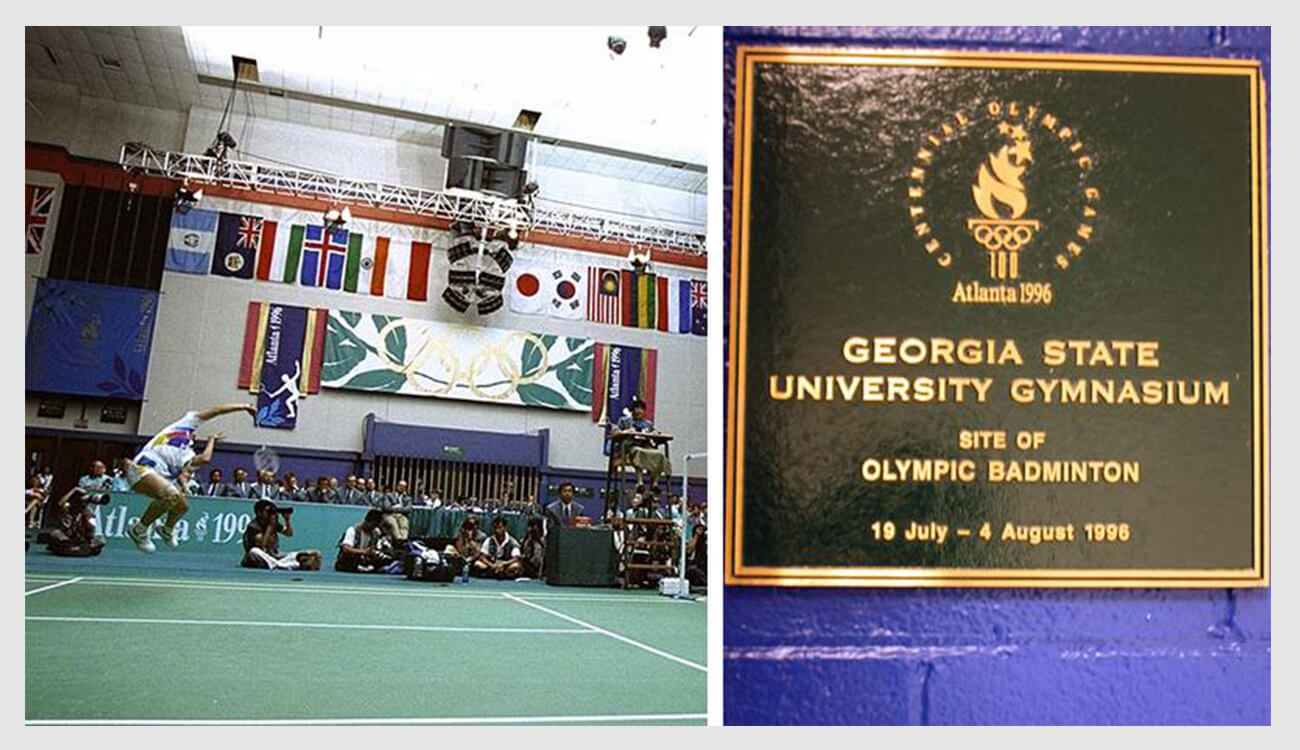
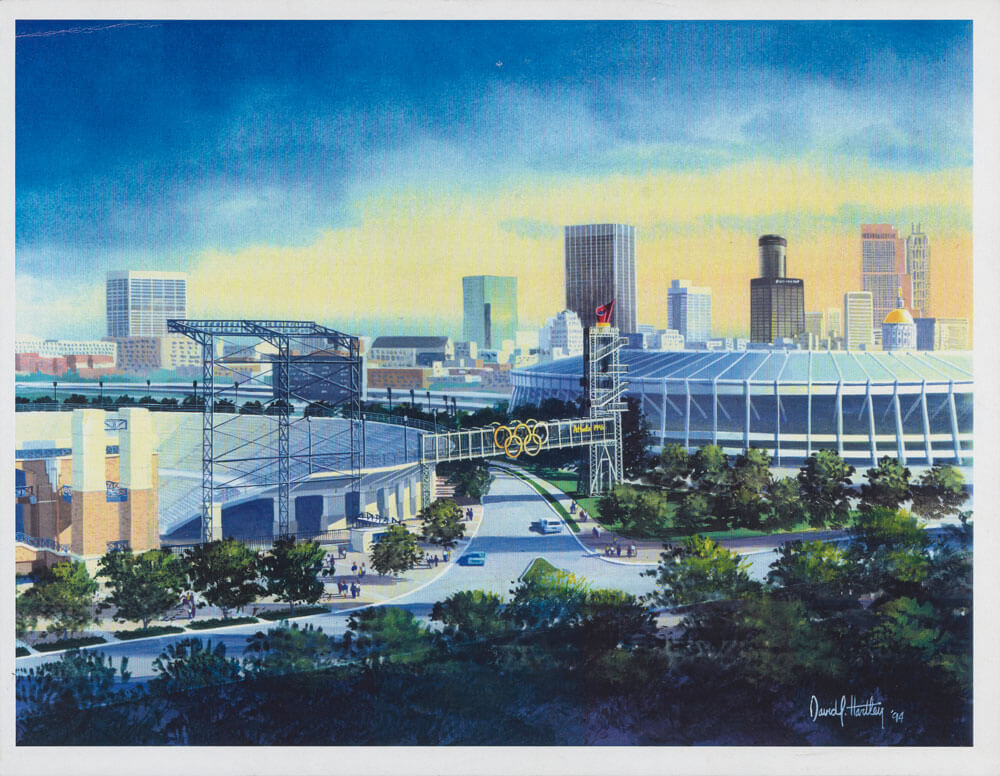
The IOC liked the vision of a new stadium to showcase the Games (a stadium that would one day belong to GSU). Payne, staring out his office window, dreamed up Centennial Olympic Park to replace a blighted downtown industrial zone. A Games transportation plan — moving athletes around using small electric trains and buses — met with approval, and so did proposals to use the Georgia Dome and other existing facilities to house events. (The GSU Sports Arena would be the venue for Olympic badminton.)
The IOC liked the attention Atlanta paid to dozens of other creative details that would ensure a successful event witnessed by billions of people around the globe.
Photos courtesy of the Georgia State Library's Digital Collections.