
Media Contact
Maisha Era
Public Relations Coordinator
School of Film, Media & Theatre
[email protected]
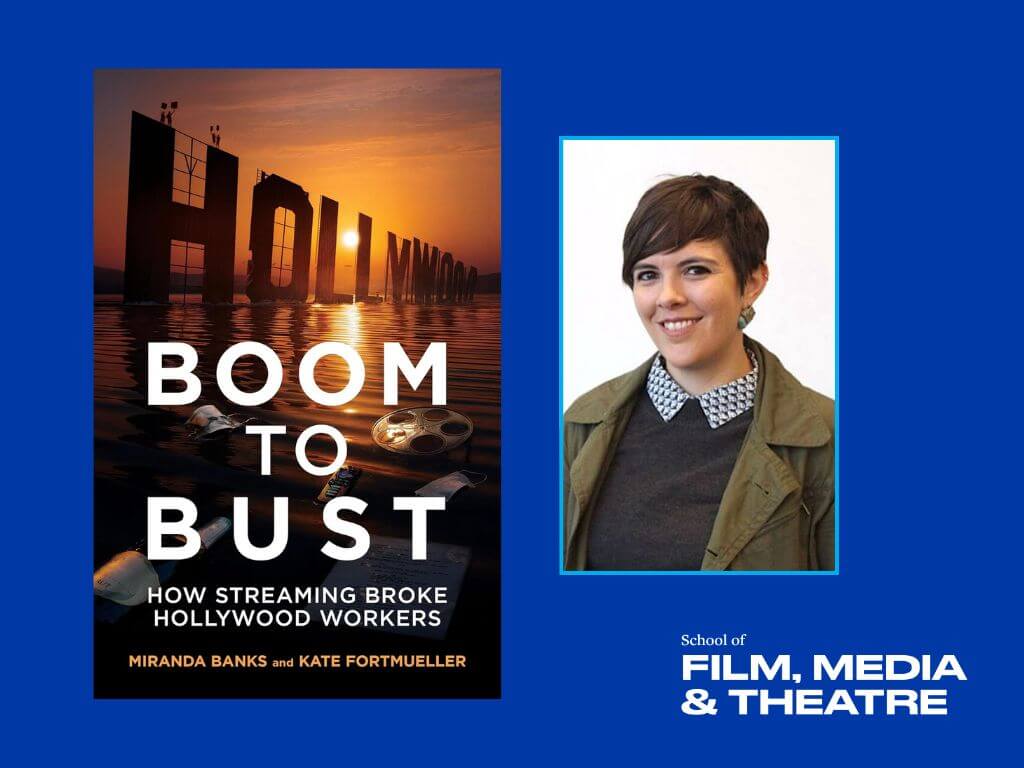
In the landscape of modern television, few periods have been as transformative or as turbulent as the era of Peak TV. For Dr. Kate Fortmueller, co-author of “Boom to Bust: The Rise and Fall of Peak TV,” the explosion of content production over the past decade has not only reshaped the industry but also redefined what it means to teach, research and participate in media culture. In this article, Dr. Fortmueller offers a candid look at the challenges, revelations and collaborative spirit that shaped this latest book and discusses the origins of the project, the shifting dynamics of Hollywood and what lies ahead in the ever-evolving world of media.
When did you first realize that Peak TV was becoming a crisis?
We discuss this in the book, but many people realized a decade ago that the current level of production was unsustainable. FX Chief John Landgraf coined the term Peak TV in 2015 and recognized it as a crisis at that moment. As a consumer, media scholar, and instructor, the lack of a mass culture has made teaching more challenging, especially when trying to find common reference points. It has been a long time since I have been able to find films or TV series that my students and I have in common, other than those assigned in class.
What signs did we overlook that indicated an overproduction of content?
Studios, networks, streamers, executives, critics and industry professionals were all aware of an excess of TV and straight-to-streaming films. Even though most recognized that there was too much television, some profited and many worked extensively until the strikes in 2023. The main issue was that this overproduction was framed as an abundance of consumer choice and worker opportunity. In reality, there was simply too much for audiences to sift through, and the quality of work, training, and compensation had declined compared to previous generations.
You include interviews with industry workers. Can you share a story that resonated with you the most?
Netflix has insisted that they don’t have a particular style because its goal is to appeal to everyone. This narrative is central to their brand identity and shapes how scholars discuss Netflix. However, in our conversations with workers, we discovered that this was not entirely true. We spoke with both writers and directors who described key differences in narrative structure and storytelling when creating serial stories such as limited series for streaming services. For instance, writer Doug Miro told us that, as a film writer, he was never able to sell a series until he sold Narcos. There has been substantial criticism about the so-called “Netflix look,” but this particular interview stood out to me. What I learned from these interviews, combined with thoughtful popular criticism, inspired the graduate-level course I taught about Netflix last spring. In this class, I asked students to revisit the concept of studio and network style and consider whether Netflix has a distinct “house style.”
If you could return to the beginning of this process, what advice would you give yourself?
This is my third book, but my first co-authored project. The book emerged organically as we reflected on the 2023 dual WGA and SAG-AFTRA strikes, and it was a joy to spend three years co-writing, editing, and proofreading. Co-authoring is uncommon in the humanities, where most people divide sections and write separately. As a graduate student and early-career researcher, I would have dismissed the idea of co-authoring. Dr. Miranda Banks and I wrote every word of this book together in a Google doc on Zoom, quickly finding our rhythm. Co-writing, which differs from co-authoring, requires balancing your own ego and developing a clear sense of self as a writer. I would tell my younger self that collaboration is one of the best ways to grow as a scholar and writer. I learn something new about the process each time, but I believe the most important lesson for any writer is to write daily. The amount doesn’t matter and what’s important is to engage with your writing projects every single day.
What are your next steps?
Dr. Miranda Banks and I have book talks scheduled throughout the year, so I will continue discussing the state of Hollywood work and the book. Academic researchers are a bit like producers—we always juggle a few projects at once. At the moment, three main projects are receiving most of my attention, but eventually, one will end up dominating my research and writing time:
- I am working with WGSS Associate Professor Dr. Rosita Scerbo on a project connected to the UCSB Carsey-Wolf Center Media Industries and AI initiative.
- I am contributing policy-related research documents and resources to support lawyers contesting the Paramount acquisition of Warner Bros. These efforts are organized by political economists Dr. Andrew deWaard and Dr. Shawna Kidman, who leads the UCSD MACRO Lab.
- I received an internal grant from Georgia State University to work on my next book, which explores how Hollywood has historically managed risk. Most of my research has focused on workers. While I am always most interested in the people who make our media, this project examines how workers fare amid Hollywood’s often curious business practices and dynamics.
I like to be busy, so I have a few other projects that I am working on, but I am not quite ready to talk about just yet!
"Boom to Bust: How Streaming Broke Hollywood Workers" is available for purchase HERE.