
Media Contact
Maisha Era
Public Relations Coordinator
School of Film, Media & Theatre
[email protected]
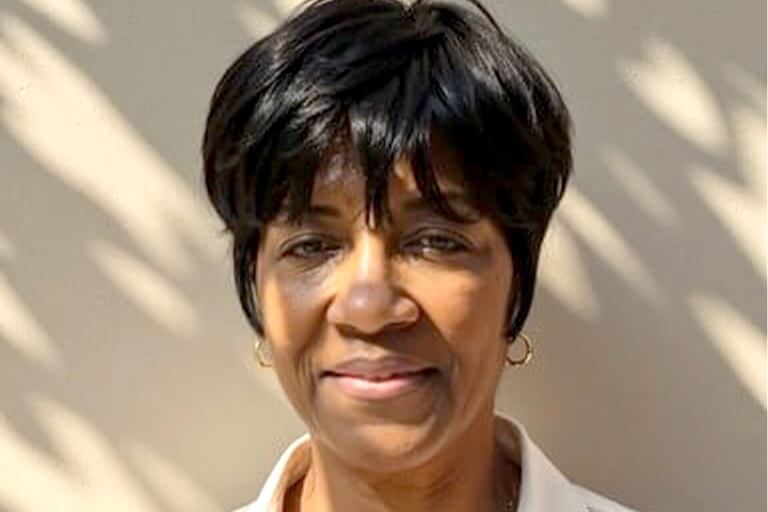
ATLANTA — Nearly 40 years after completing her first bachelor's degree, Gail McFarland (B.A. '17, M.A. '19, Ph.D. '25) returned to school through the GSU-62 program. Before pursuing her doctorate, she was a published author of contemporary African American romantic fiction and worked for over 20 years for the federal government as a fitness specialist, educator and program developer.
Her dissertation, "Location, Breaking Form: Black Standup and the Cinematic Black Social Cut," theorizes a distinct aesthetic tradition in Black film comedy, tracing how performers like Richard Pryor, Eddie Murphy and Tiffany Haddish actively cut into cinematic form through rupture, improvisation, call-and-response, signifyin(g), deadpan expression and what she terms ratchetness. Read more about her below.
What inspired you to pursue a Ph.D.?
I returned to school at Georgia State University as an older student through the GSU-62 program, nearly 40 years after completing my first bachelor’s degree, and I was genuinely surprised by how much I loved it. In the years before returning, I was writing contemporary African American romantic fiction, publishing short stories and novels that centered Black women’s interior lives, intimacy, humor and desire. As I wrote, I found myself thinking cinematically, imagining what these characters would look like onscreen, how they would move through space, how their voices, silences and relationships might register visually and affectively. Those questions, about translation, representation and form, are what first led me to think seriously about film studies and ultimately about Georgia State.
Once I arrived, I discovered that “school” itself had changed in ways that felt expansive rather than restrictive. Classrooms were more dialogic, theory felt alive and contested, and film and cultural studies were finally engaging questions of race, power, performance and spectatorship in ways that were not available when I finished the first time. What began as curiosity quickly deepened into intellectual commitment.
After completing my B.A. in Film and Media, I went on to earn an M.A. in Africana Studies with a focus on culture and aesthetics. That program sharpened my attention to Black expressive traditions and encouraged me to think seriously about how performance, sound, humor and visual form operate as sites of knowledge. Faculty mentors urged me to continue writing and reading across film and cultural theory, and I realized that the questions I was asking, first through fiction and later through scholarship, required the sustained time, rigor and depth that only doctoral study could provide.
How has this program shaped you as a researcher and thinker?
The Ph.D. program at GSU trained me to slow down, look closely and trust my analytical instincts while also re-forming language and demanding theoretical precision. I have learned how to build an argument across disciplines, how to move between close textual analysis and broader cultural critique, and how to situate my work within existing scholarly conversations without losing my own voice.
Equally important, the program encouraged methodological experimentation. My work draws from film studies, Black studies, performance theory and sound studies, and I was supported in developing an original framework rather than forcing my research into an inherited model. That freedom has allowed me to think expansively about cinema not just as a medium, but as a cultural practice shaped by performance, spectatorship and social rhythm. I emerged from the program not only as a stronger scholar but as a more confident and self-directed thinker.
How has your professional or personal history influenced the scholar you’ve become?
I came to academia after a long professional life outside academia, including more than 20 years working for the federal government as a fitness specialist, educator and program developer. That experience shaped how I think about learning, access and institutional structures. I do not take classrooms, students or the intellectual community for granted.
Coming back to school later in life also meant I arrived with cultural memory. I lived through the eras I now study. I remember when Richard Pryor, Eddie Murphy and later Tiffany Haddish were seen as disruptive, dangerous or unsanctioned. That lived experience informs my scholarship, but it also disciplines it. I am attentive to historical context, reception and affect, not just textual meaning. As a result, my work consistently asks how Black performance feels, circulates and lands, not simply what it represents.
What is your dissertation about, and why does it matter to you personally?
My dissertation, "Location, Breaking Form: Black Standup and the Cinematic Black Social Cut," theorizes a distinct aesthetic and formal tradition in Black film comedy that emerges through rupture, improvisation, call-and-response, signifyin(g), deadpan expression and what I term ratchetness. I trace this tradition from Richard Pryor’s late-1960s stand-up and cinematic work through Eddie Murphy and Tiffany Haddish, arguing that these performers do not simply appear in films but actively cut into cinematic form itself.
The Cinematic Black Social Cut (CBSC) names how Black comedians fracture narrative continuity, disrupt visual and sonic norms, and reorient spectatorship toward Black social rhythms. This work matters to me personally because it takes Black comedy seriously as theory rather than just entertainment. It insists that humor, excess and improvisation are intellectual practices that carry historical knowledge, cultural critique and aesthetic innovation. The project is also an act of recovery, giving language to forms of brilliance that have long been visible but under-theorized.
What’s next for you academically and professionally?
Academically, I plan to continue studying and expanding the CBSC across examinations of film, television and digital performance, particularly in relation to contemporary Black comedians and evolving modes of spectatorship. I am committed to publishing this work and contributing to ongoing conversations in film studies, comedy studies and Black cultural theory.
Professionally, I am deeply invested in teaching and mentorship, especially for first-generation, nontraditional and production-oriented students. I am also the founder of The Film & Media Theory Navigator, a digital platform designed to make film and media theory more accessible, usable and culturally responsive. The navigator will translate complex theory into practical tools without flattening its rigor, reflecting my belief that scholarship should circulate beyond the page. I have also taught as a part-time instructor this fall in the School of Film, Media & Theatre.
Ultimately, my work is part of a more extended conversation about race, representation and cinematic possibility. I am excited to keep writing, teaching and building spaces where theory feels alive, generous and necessary.
— Interested in learning more about our Ph.D. in Communication Studies with a concentration in Moving Image Studies program? Click here.