

Media Contact
Sam Fahmy
Director of Communications
School of Public Health
[email protected]
Ph.D. student Kaleb Whitfield is dedicated to advancing research that supports children, adolescents and families. His work explores how positive father involvement can help prevent childhood violence and trauma while improving long-term health outcomes.
Name: Kaleb Whitfield
Hometown: Valdosta, Georgia
Undergraduate and master’s degrees and institutions:
I received my B.S. in Biological Sciences from Georgia State University and my MPH from Morehouse School of Medicine.
Expected date of graduation: Spring 2028
Ph.D. concentration: Health Promotion and Behavior
Dissertation advisor: Shannon Self-Brown
Why did you choose the Georgia State School of Public Health?
I chose the Georgia State University School of Public Health because of its uniqueness of combining academic excellence with real-world experience. Located in the heart of Atlanta, GSU provides the opportunity to see and engage with people from all walks of life while witnessing firsthand the public health challenges and social determinants that shape our communities. That experience has been both humbling and motivating, strengthening my passion to become a change agent. I was also drawn to the opportunity to learn and work under Dr. Shannon Self-Brown, whose work in preventing child maltreatment, abuse and neglect closely aligns with my own research interests and career goals of improving outcomes for children and families.
Tell us about your research:
My research examines the role of father involvement in preventing childhood violence and trauma and improving long-term health outcomes for children and adolescents. I'm specifically interested in understanding how positive father involvement may reduce children's exposure to abuse and neglect and how those early experiences influence later outcomes, including youth incarceration. Ultimately, my goal is to generate evidence that informs family-centered interventions and policies that strengthen families, prevent violence, reduce juvenile justice involvement and improve the health and lives of children, adolescents and families.
What’s been your most memorable experience so far in the Ph.D. program?
One of the most memorable experiences was taking “Public Health Ethics” with Professor Jalayne Arias. The course challenged me to think critically about my own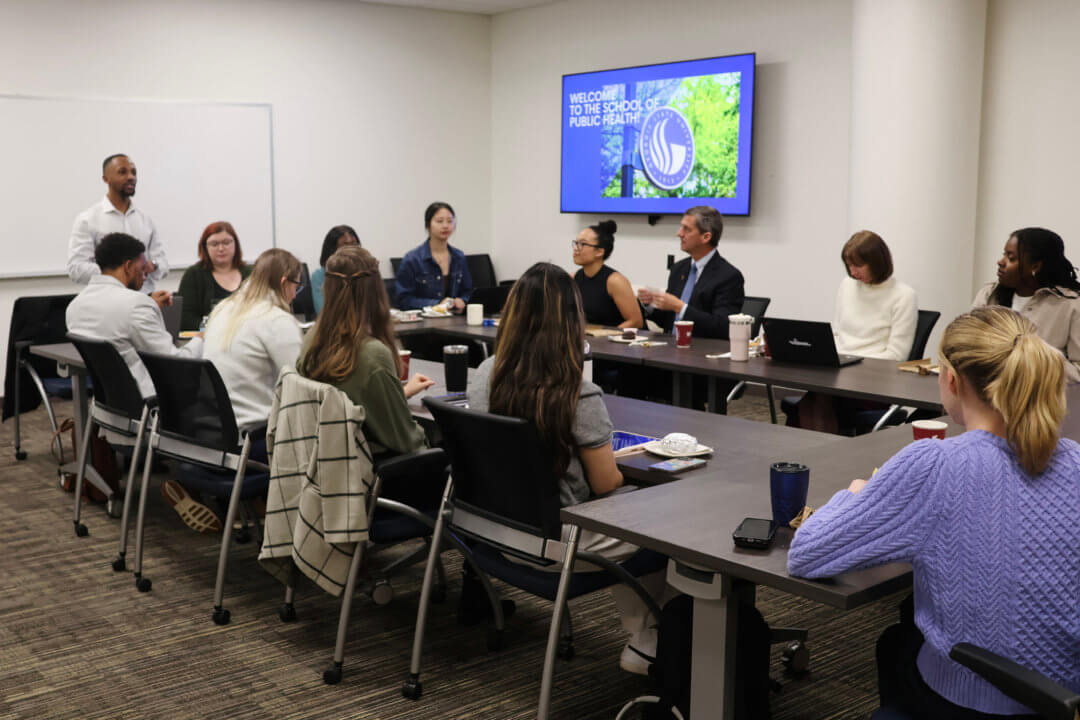 assumptions and biases and how they can influence the way we conduct and interpret research, especially when working with vulnerable populations where ethical and legal considerations are especially important. Another memorable experience was attending James Hodge's Grand Rounds Lecture and the student breakfast before. One of my biggest takeaways from the conversation at the student breakfast was that, although the early years of our careers in public health may be challenging, it's our generation's responsibility to carry the field forward.
What’s your career aspiration?
My career aspiration is to remain in academia at a research institution, where I can study the predictors of youth incarceration and the impact of childhood violence and trauma on justice-involved adolescents. My goal is to generate research that informs policies and interventions that improve outcomes for children, adolescents and families. I've also contemplated pursuing juvenile law down the road, allowing me to translate research into action by advocating directly for youth involved in or at risk of entering the juvenile justice system.