
Media Contact
Sam Fahmy
Director of Communications
School of Public Health
[email protected]
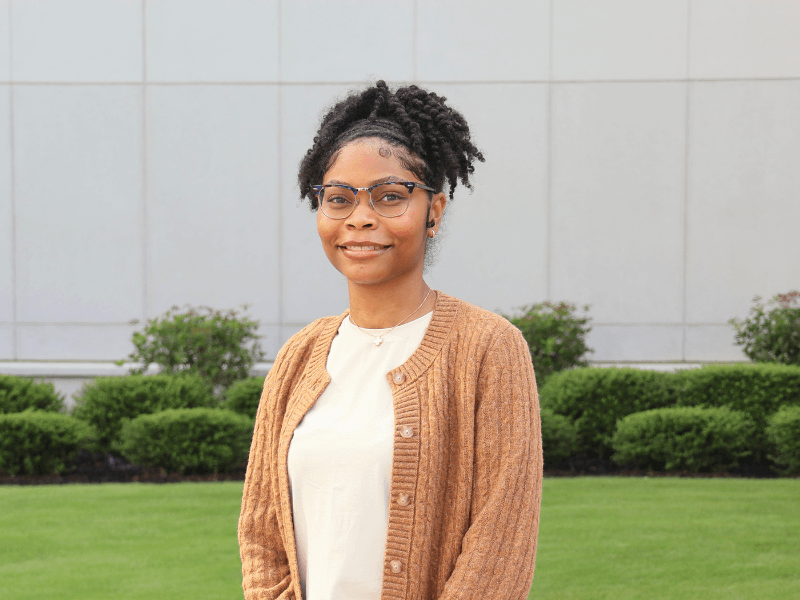
Ph.D. student Danielle Rivers was drawn to the School of Public Health by its research opportunities, its active role in contributing to community health, and the opportunity to collaborate with several cross-disciplinary centers and initiatives through the A-PREVENT T32 Fellowship.
Hometown: Atlanta, Georgia
Undergraduate and master’s degrees and institutions:
I have a Bachelor of Science in Genetics and a Bachelor of Science in Cell, Molecular and Developmental Biology from Purdue University. I received my Master of Public Health from Georgia State University.
Expected date of graduation: Spring 2029
Ph.D. concentration: Health Promotion and Behavior
Dissertation advisor: Daniel Whitaker
Why did you choose the Georgia State School of Public Health?
I chose the Georgia State School of Public Health due to the school’s overriding research theme of health equity. SPH offers diverse opportunities for both research and active contribution to communities; moreover, the school provides ample opportunity for cross collaboration and partnership, prioritizing genuine collaboration with several cross-disciplinary centers and initiatives. Additionally, the A-PREVENT T32 Fellowship is a great opportunity to strengthen skills in multi-layered program and study design.
Tell us about your research:
My research focuses on reproductive justice in Black maternal populations. I am particularly interested in the interplay of psychosocial factors (e.g. weathering, marginalization, stress, racism and social structures) on health outcomes in Black maternal populations at the intersections of disability and violence.
What’s been your most memorable experience so far in the Ph.D. program?
I really enjoyed taking “Alcohol, Substance Use, and Violence Prevention,” which is taught by Dr. Dominic Parrott on the intersecting fields of alcohol and violence. Although I had prior experience in the fields of substance use and intimate partner violence separately, I was less familiar with the epidemiology, study designs and theories unique to the role alcohol plays in different types of violence. I am incredibly grateful for the A-RPEVENT T32 Fellowship, which served as the catalyst for creation of the course.
What’s your career aspiration?
My ultimate career goal is to improve health outcomes and quality of life for minoritized communities via intentional, multi-layered program and study design that addresses these disparities. I have not yet decided the setting in which I wish to work, but I will be happy as long as I can address health inequities for racialized women and birthing people.