
Media Contact
Amanda Head
Manager, Marketing and Public Relations
College of Arts & Sciences
[email protected]
ATLANTA — Raymond Ejikemeuwa, a Ph.D. candidate in world history in the College of Arts & Sciences, has been named Georgia State University’s International Graduate Student of the Year. He will be honored during International Education Week in November.
His research at Georgia State University examines how post-Biafran Igbo migrants in the United States preserved cultural memory, built community networks and sustained a shared identity after the trauma of the Nigeria-Biafra War. For Ejikemeuwa, those questions extend beyond scholarship, shaping his approach to leadership and service.
“My scholarship, campus leadership and civic advocacy are deeply interconnected expressions of a single mission: using history and community engagement to drive tangible social impact,” Ejikemeuwa said.
Ejikemeuwa received two university-wide honors in April. He was awarded the Royal Flame Leadership Award April 13, followed by the George M. Sparks Award April 21.
He was the only student selected for the 2026 George M. Sparks Award, receiving the honor alongside two faculty members and two staff members.
“At Georgia State University, my goal has always been to build bridges between the classroom, the student body and the broader global community.”
As president of the Association of Historians at Georgia State University, Ejikemeuwa has worked to expand professional development and create new opportunities for students in the department. He has engaged faculty and staff to lead workshops on grant and conference proposals and organized a campus pop-up book sale to raise funds for student programming.
He has also served in the King Ambassador program. Ejikemeuwa said it was an experience that allowed him to combine peer mentorship, cultural literacy and civic engagement.
Ejikemeuwa’s dissertation examines how Igbo migrants rebuilt community after the Nigeria-Biafra War through material culture, oral histories and institutional archives.
At the center of the project is a broader question: How do postcolonial ethnic communities build and sustain enduring identities after severe collective trauma?
That research took Ejikemeuwa to The Ohio State University in July for a Mellon-supported Doctoral Summer Residency.
During the residency, he presented and refined a core portion of his dissertation on post-Biafran Igbo diasporic identities, focusing on intergenerational memory, archival silences and transnational identity formation.
He also participated in intensive workshops on oral history methods and archival research strategies and received feedback from scholars in the field.
“The Ohio State residency significantly advanced my doctoral work by refining my oral history methodology, addressing archival silences and sharpening my theoretical framework,” Ejikemeuwa said.
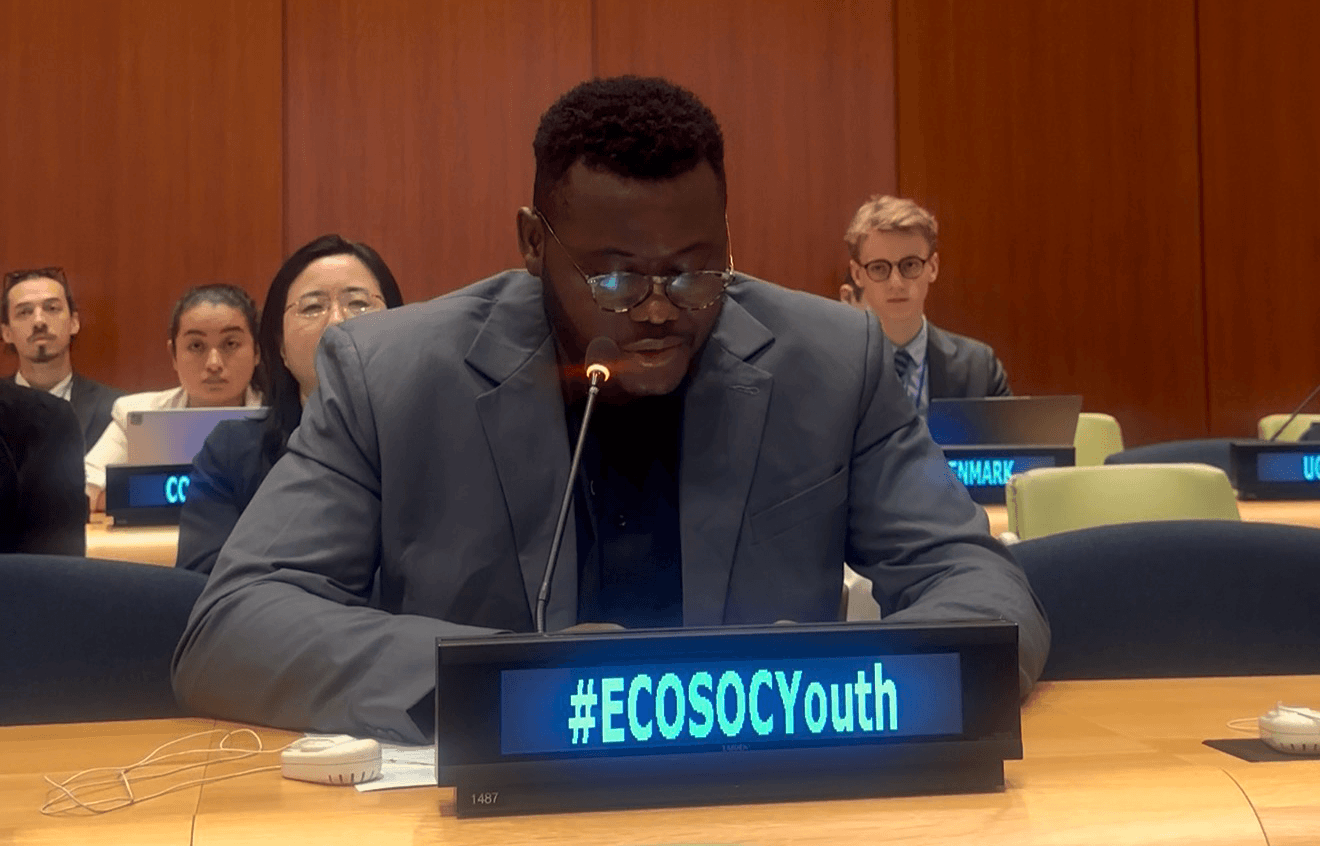
In April, Ejikemeuwa was invited by the president of the United Nations Economic and Social Council to participate in the ECOSOC Youth Forum as a youth delegate. During the forum, he became a speaker for the session “Youth Mental Health and Well-Being as a Foundation for Sustainable Development” in the Trusteeship Council Chamber.
In June, he participated as a delegate at the World Bank Group Youth Summit in Washington, D.C.
The two events gave Ejikemeuwa a closer look at how international organizations approach migration, inequality and youth empowerment, subjects that intersect with his interests as both a historian and community advocate.
“Engaging with the United Nations and the World Bank Group Youth Summit reinforced that sustainable global progress relies on bridging macro-level policy with grassroots community action,” he said.
Closer to home, DeKalb County CEO Lorraine Cochran-Johnson issued a proclamation June 30 recognizing Ejikemeuwa for his contributions and service to the community.
The proclamation honored his “extraordinary contributions and unwavering dedication to the betterment of our community.”
As he moves into the next stage of his doctoral work, Ejikemeuwa is also completing a graduate certificate in geographic information systems through the Department of Geosciences.
He hopes to incorporate that training into his research at the intersection of spatial humanities and digital history, using spatial analysis alongside archival methods to study migration and diaspora.
His immediate goal is to complete and defend his dissertation. Longer term, he hopes to pursue academic and research roles that use digital tools to make historical scholarship more analytical, engaging and accessible to broader audiences.
— Story by Tiffany (Orr) Harte, Communications Manager, The Graduate School