
Media Contact
Holly Frew
Office of Communications & Marketing
Robinson College of Business
[email protected]
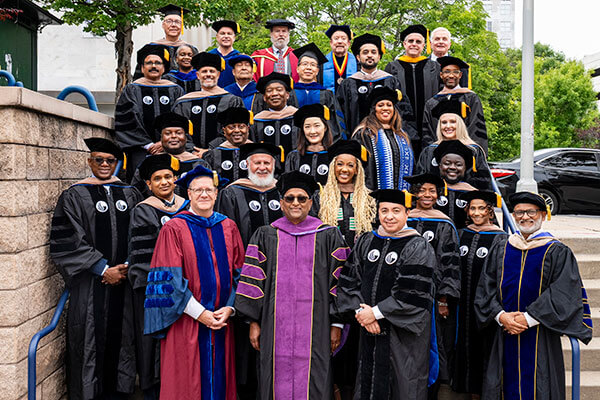
ATLANTA — Sixteen practitioner scholars comprising the Class of 2026 of the Doctor of Business Administration (DBA) program at Georgia State University’s J. Mack Robinson College of Business were celebrated at commencement exercises marking completion of the rigorous three-year part-time program. The event culminated in the hooding ceremony, during which the graduates’ advisors draped their newly acquired academic regalia over their shoulders, symbolizing the transition from student to scholar.
Robinson’s DBA program is designed for seasoned senior executives, with the 2026 cohort comprising experienced leaders from industries and backgrounds including chemicals, consulting, consumer goods, financial services, government, healthcare, logistics and real estate. DBA students enter the program looking to evolve business practices, develop new perspectives through applied research, and create flexibility for future career change, including academia. The demanding curriculum requires participants to balance high-level careers with intensive academic work and collaboration with faculty and peers.
A centerpiece in their academic journey is the dissertation process, which requires DBA students to identify meaningful business challenges, conduct original research, and successfully defend their findings before faculty committees. Their completed dissertations reflect the depth of their expertise, persistence, and commitment to advancing research-driven business practice by using evidence-based insights to address complex organizational challenges. (A table of the graduates and their dissertation topics follows this story.)
Keynote speaker Sergio Quiñonez (DBA ’16), chair and COO of the Mexican agricultural technology and crop protection company, ANSA, delivered the keynote. "Remember always, you were and are the nail that sticks out. From the moment you took this big step and enrolled in the program, you stood out. And most of the time, your context—your environment, your social circle—became the hammer.”
“Earning my doctorate remains one of the most meaningful achievements of my career. What a profound sense of accomplishment it was for me then, and I know it is for you today,” Robinson College Dean Richard Phillips told the graduates.
“It’s hard to believe that it has been 17 years since we started the program and recruited our first class,” said DBA Program Director Charles Dhanaraj. “Curiosity is what brought you here. Discipline is what got you through these three years of rigorous work.”
DBA 2026 graduates reflected on the personal and professional growth they experienced during the program.
“Earning my DBA has been a transformative milestone in my journey as a leader. It has not only strengthened my executive business acumen but also deepened my confidence in my voice. When I sit at the table with other executives, I no longer second-guess my contributions—I trust them.” Susan Haynes
“My Doctor of Business Administration is more than an academic milestone. It represents years of balancing entrepreneurship, research, family, and perseverance. As a business owner, I wanted my research to address real challenges faced by micro and small businesses, and I hope it contributes to helping entrepreneurs build more resilient and sustainable organizations.” Bertrand Abo
“This three‑year journey changed me in ways I didn’t expect. It taught me to trust my curiosity, lean into real‑world challenges, and turn rigorous inquiry into meaningful impact. It wasn’t just a degree—it was a personal transformation that prepared me to shape what comes next.” Sarita Watts
Doctor of Business Administration Class of 2026 |
|
|---|---|
| Graduate | Dissertation |
| Bertrand Abo | Dynamic Capabilities and Business Performance in Micro and Small Businesses (MSBs) |
| Ahmed Alkers | The Use of Behavioral Economics For Strategy Execution |
| Deborah Bloom | Where We Work and How We Cope: Mapping the Relationships Between Workplace Setting, Coping, Work Stress and Mental Health |
| Shyam Dasari | Understanding the Systemic Influences of Hallucination Drift Using the Lens of Minsky’s Society of Mind: An Experimental Study of Content Type, Input Length, Temporal Factors, and LLMs Variations |
| Carson D. Funderburk | Manufacturing as an Innovation Engine: Capability Systems That Accelerate Product Commercialization |
| Susan Marie Haynes | The Impact of Changing Organizational Support for DEI on Black Women Executives Leadership Strategies |
| Muhammed Humayon | Effectiveness of Ring Roads in Reducing Traffic Congestion in Cities: A Case Study of Atlanta |
| Tumara Jackson | Financial Capability and Digital Credit: Understanding Buy Now, Pay Later In the Lives of Financially Constrained Adults |
| Dwayne Roache | How Multinational Corporations Can Leverage Social Responsibility Programs to Relieve Poverty in Jamaica |
| Josey Sebastian | How Leaders Use Power to Drive Generative AI Adoption: A Study of Identity Threat and Organizational Power Dynamics |
| Mario Gonzalez Segura | The Impact of Export Promotion Programs on Export Performance for Small-Medium Size Enterprises |
| Padagnassou Simda | Regulation and Fintech Coopetition |
| Jessel K. Subero | Financial Innovation and Bank Performance: The Moderating Role of Risk Management, Management Efficiency, and Market Power in the U.S. Banking Sector |
| Seth Spurlock | Navigating Multiplex Pressures in Family Firms: Dynamic Salience and Tri-Concern Conflict Resolution |
| Sarita Wheeler Watts | Arrested Transitions: Institutional Uncertainty, Farmer Responses, and Organizational Resilience in Agricultural Systems |
| Brittny Wells | Beyond Teaching Quality: A Multilevel Analysis of Bias, Context, and Measurement in Student Evaluations of Teaching |