
Media Contact
Sam Fahmy
Director of Communications
School of Public Health
[email protected]
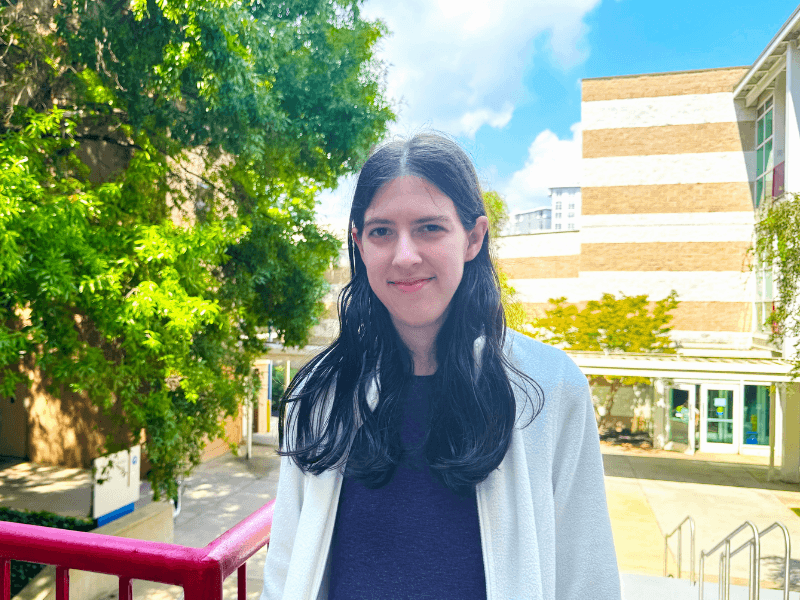
Ph.D. student Katherine Reuben chose the School of Public Health to advance her research on autism and child maltreatment through the A-PREVENT T-32 Fellowship Program. She’s currently developing a screening tool aimed at enhancing diagnostic accuracy for autism and co-occurring PTSD in mental health settings.
Name: Katherine Reuben
Hometown: Marietta, Georgia
Undergraduate and master’s degrees and institutions: I have a Bachelor of Science in Psychology from the Georgia Institute of Technology and a Master of Public Health, with a concentration in Epidemiology, from Georgia State University.
Expected date of graduation: Spring 2028
Ph.D. concentration: Health Promotion and Behavior
Dissertation advisor: Dr. Shannon Self-Brown
Why did you choose the Georgia State School of Public Health?
I volunteered to help with program evaluation for Project Intersect, a program for commercially sexually exploited youth, under Dr. Self-Brown. I really enjoyed working with Dr. Self-Brown and her students, and, when I was looking at master’s programs, GSU was at the top of my list. Dr. Self-Brown also told me that the GSU Center for Leadership in Disability had been discussing the need for more overlap with trauma research, which is exactly what I was hoping to study.
Tell us about your research:
My main research focuses are autism and child maltreatment. I’m very interested in the overlap between these constructs, specifically, the unique victimization risks and outcomes for autistic individuals. I’m particularly interested in commercial sexual exploitation/trafficking and posttraumatic dissociation, two topics which are very under-studied and which have almost no existing literature for autistic individuals. I’ve also recently become more interested in autism identification. I’m currently working on a novel adult autism screening tool, the Reuben-Ackland Autism Inventory, which I hope will help to better identify differential and co-occurring diagnoses of autism and post-traumatic stress disorder in mental health settings. Finally, the A-PREVENT training program has exposed me to research related to alcohol and violence, which is important for understanding at-risk family systems and post-traumatic reactions.
What’s been your most memorable experience so far in the Ph.D. program?
I participated in the Georgia LEND program through the Center for Leadership in Disability, and I returned the next year as a teaching assistant. These were great personal and professional experiences. LEND also has given me many opportunities to connect with other autistic adults and autism researchers. For example, one of the individuals working with me on the screening tool, Dr. Diana Robins, is at the A.J. Drexel Autism Institute, but we were able to connect because of her history with Georgia LEND.
What’s your career aspiration?
My goal is to remain in academia and become a principal investigator. I want to have the autonomy to set my research direction (as funding permits!). I also hope to continue to be a part of LEND. Research highlights problems and suggests solutions; training emerging professionals in the field is how we start making lasting changes.