
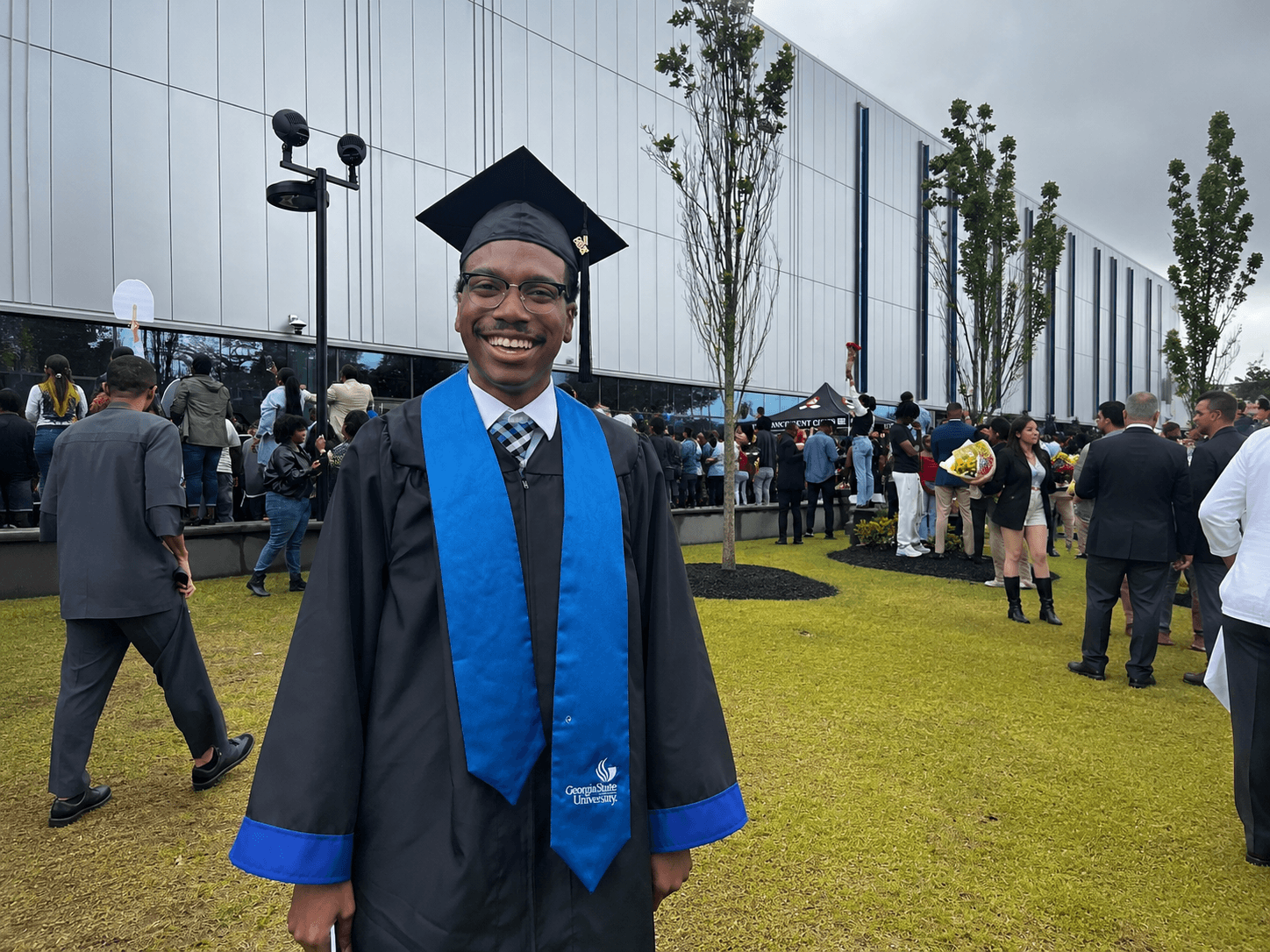
ATLANTA- When Georgia State graduate Cornell Stokes (BM '26) crossed the commencement stage last week, the moment represented far more than earning a degree in music education. It marked the culmination of nearly two years of auditions, setbacks and persistence before ever officially becoming a School of Music student.
“I could have easily walked away after the first rejection,” Stokes said. “But I knew deep down I wanted to become a music educator.”
Music had always been central to Stokes’ life. Growing up in church, he became fascinated with the music long before he understood the sermons themselves. By age five, he had started piano lessons with his church organist. In elementary school, he joined choir and frequently stayed after school for rehearsals before eventually committing to saxophone in sixth grade.
That experience helped shape his understanding of what music education could provide for students beyond performance alone.
“Band class felt like a safe space,” Stokes said. “I could come in and look up to my director personally and professionally.”
When he arrived at Georgia State in 2020, Stokes already knew he wanted to become a band director. But with less than a week to prepare for School of Music auditions, he was rejected from the program during his first attempt. A second audition the following semester led to another rejection.
During that time, he declared political science as his major while continuing to pursue music independently. On a third audition attempt, he was informed there was no room available in the saxophone studio due to current and graduate students already filling the available spots.
Still, he kept working.
Between auditions, Stokes began taking lessons with saxophonist Brandon Taylor, focusing on improving both his musicianship and practice habits. After nearly two years of preparation and persistence, he auditioned for a fourth time and was finally accepted into the School of Music in fall 2022.
“No one is going to listen to your excuses,” Stokes said. “You just have to show up every day and do the best you can.”
Once admitted, Stokes quickly immersed himself in campus life. Alongside his Bachelor of Music in Music Education, he also completed minors in journalism and economics, combining his interest in storytelling with his passion for education and music.
Through journalism coursework, he conducted interviews and wrote narrative profiles centered on people’s experiences and perspectives.
“I think that’s what I’m really into,” he said. “Making sure that someone’s story is heard.”
At Georgia State, Stokes became heavily involved with the Panther Band, the School of Music Student Advisory Board and the School of Music Ambassador program. He also worked in the School of Music admissions office, helping support auditions, recruitment events and communication with prospective students and families.
Stokes credits Dr. Charles Jackson and Prof. Devin Reid as two of the faculty members who most influenced his growth as both a student and future educator.
“Professor Devin Reid was especially important early on when I kept getting rejected,” Stokes said. “He was there both as a professor and as a mentor, helping me stay focused and committed.”
One of the defining moments of Stokes’ time at Georgia State came last December during a recital performance alongside fellow student Nic Thomas. For him, the performance symbolized far more than a degree requirement.
“That recital is a staple of the fight I had to endure to get here,” he said. “It was very emotional for me that night — being able to sit there and perform after years of thinking I would never get to that stage.”
As he begins the next chapter of his career, Stokes has already reached the goal that kept him motivated through years of auditions and setbacks. This fall, he will begin teaching as the band director at General Ray Davis Middle School in Rockdale County, where he hopes to create the same sense of encouragement and belonging that shaped his own experience growing up.
“I want to create that safe space for my students,” Stokes said. “Where they feel okay to make mistakes on their instrument, and where they can also come to me if something is going on in their personal life.”
For Stokes, the position is more than a first job—it is the opportunity to become the kind of educator who inspired him as a young musician and to encourage students who may one day face challenges of their own.
His advice remains as straightforward as the path that brought him here:
“Don’t give up,” he said. “Your dreams are worth the work.”