
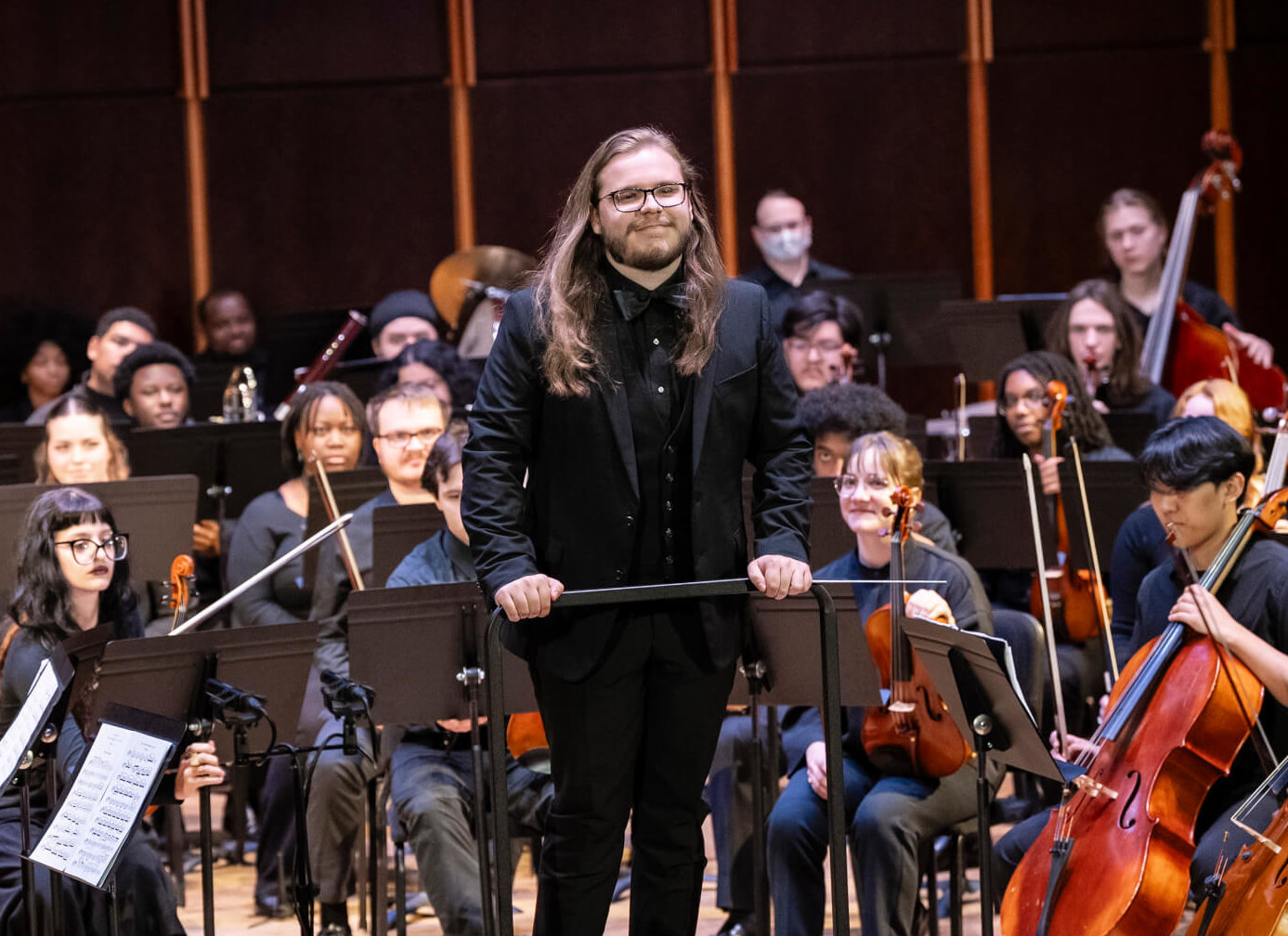
As he graduates from the School of Music, Garrett Clay (MM Orchestral Conducting '26) reflects on how his time in the Georgia State conducting program shaped his growth as both a musician and educator. From leading ensembles on the podium to working with young musicians across Atlanta, Clay says his experience at Georgia State helped him become a more confident conductor, teacher and collaborator.
Can you tell us a little about yourself and what brought you to Georgia State?
I did my undergraduate degree in music education at Kennesaw State University, and after graduating I taught orchestra and chorus at Peachtree Middle School in Dunwoody. I remember seeing that Dr. Tamara Dworetz posted about an opening in her graduate conducting studio, so I decided to apply.
I had a lot of support from friends and family throughout the process and one of my orchestra classes even helped me record footage for my application. I was really happy everything worked out the way it did.
What first sparked your interest in music?
I think I was around eight or nine when I started picking out tunes by ear on the piano at home. My parents signed me up for lessons pretty quickly after that. Then when I got to middle school, I heard the cello for the first time and immediately joined orchestra. In high school, I started helping coach younger orchestra students and realized how much I enjoyed teaching. That eventually led me into music education.
What has made the biggest impact on your development at Georgia State?
Working with the Campus Orchestra was a huge part of my experience. I love the Symphony Orchestra too, but Campus Orchestra was always sort of my stress relief. It’s a really special environment because so many of the students are there simply because they love making music and want to continue playing.
Another major experience for me was preparing and performing Shostakovich’s Second Piano Concerto with Miya Suen. It was my first time working with a soloist and I felt like I grew tremendously as a conductor during that process. The orchestra was incredibly invested and that performance is still one of the moments I’m most proud of from my time here.
Clay says the collaborative nature of the Georgia State conducting program helped him grow more confident both artistically and personally.
How has your time at Georgia State shaped you as a musician and educator?
I’ve changed a lot since coming here. I’m definitely not the same musician I was when I started the program. Beyond learning conducting skills, my mindset about interpretation, vulnerability and communication completely shifted. I’ve become much more open on the podium and I think that openness has really changed the way I approach music and rehearsals. That’s probably the thing I’m most proud of.
How have you connected with the musical community outside the classroom?
I’ve had opportunities to work with organizations like the Atlanta Music Project and the Metropolitan Youth Symphony Orchestra, and I also got to guest conduct the District 14 Honor Orchestra. Working with student musicians has always been really fulfilling for me, so those opportunities meant a lot.
What’s next for you after graduation?
Right now, I’m applying for teaching positions and looking forward to getting back into the education field. I’ve really loved my time working at the collegiate level these past two years, but I’m excited to bring everything I’ve learned here into future classrooms and ensembles.
What kind of impact do you hope to make through your work?
I think one of the reasons I wanted to study conducting at the graduate level was because I wanted to become the best possible director for whatever ensemble I end up leading. A good teacher can help a student discover a passion they didn’t realize they had and that’s something I really hope to do for future students.
Do you have a favorite memory from your time at Georgia State?
I’ll never forget my first performance conducting at Georgia State. I had been dealing with a lot of self-doubt and wondering if I made the right decision leaving my teaching job to come back to school. But a few minutes into that performance, all of that doubt disappeared. I was finally able to get out of my own head and just enjoy conducting. Then afterward, going backstage and feeling all the support from my classmates really confirmed that I was exactly where I needed to be.
What advice would you give to incoming music students?
Use your resources. There are so many faculty members here with valuable insight and experience who genuinely want to help students succeed. Take advantage of that while you can.