
Media Contact
Sam Fahmy
Director of Communications
School of Public Health
[email protected]
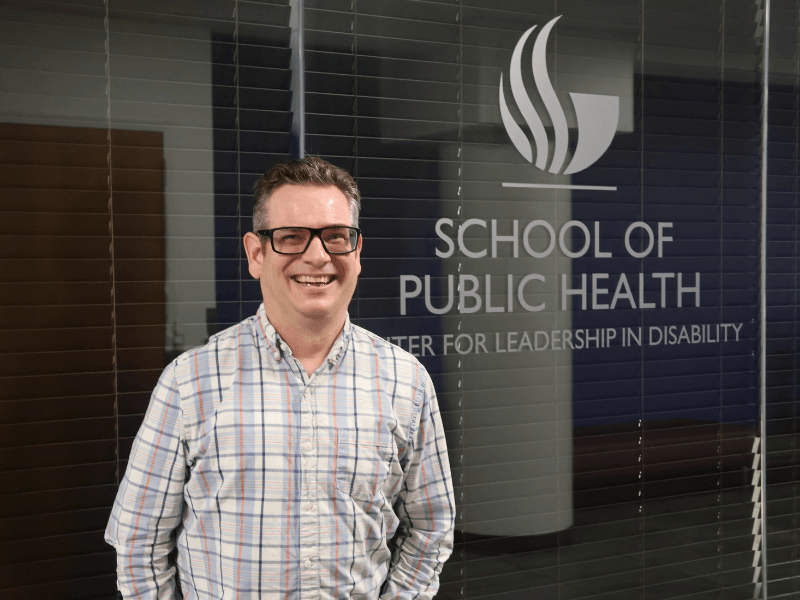
Mark Crenshaw has never had to look far to understand why his work matters. “I was born with cerebral palsy,” he said, “so I think that has really shaped career choices for me. I've always wanted to be involved in advocacy and in supporting other folks to use their voices.”
Those choices have earned him one of the disability community’s most significant local honors. Crenshaw, Assistant Director of Georgia State University’s Center for Leadership in Disability and its Director of Interdisciplinary Training, is a 2026 recipient of the Luminary Award from the Bobby Dodd Institute. The award recognizes Atlanta-area organizations that partner with BDI to hire people with disabilities, the contributions of people with disabilities in the workplace and the individuals who create opportunities for people with disabilities to achieve independence and success.
For those who work with Crenshaw and know him well, the recognition is long overdue.
“Mark’s leadership is distinguished by his ability to bridge experiential academic instruction with authentic community engagement, amplifying the voices of people with disabilities and improving lives locally and nationally,” said Kathleen Baggett, Associate Professor in the School of Public Health and Director of GSU’s Mark Chaffin Centers for Healthy Development.
CLD Director Erin Vinoski-Thomas, Research Associate Professor in the School of Public Health, said Crenshaw uplifts and centers the perspectives of Georgians with disabilities and teaches many others to do the same. “Mark’s work goes far beyond getting the curriculum right,” Vinoski Thomas said. “He is deeply intentional about who is at the front of the room delivering it, whose voices are elevated and whose lived experiences shape the learning. The effects of this approach to leadership education have shaped programming at the national level. I am so proud to see Mark's contributions recognized with this award.”
Crenshaw oversees training for the Georgia Leadership Education in Neurodevelopmental Disabilities (GaLEND) program, a one-year training experience for future disability leaders in maternal and child health that combines graduate-level courses, clinical experiences, community based activities and research projects.
“What LEND allows us to do uniquely is bring together lots of folks from across academic spaces and disciplines — future doctors and nurses and social workers and speech language pathologists and psychologists — to learn to work together with people with disabilities and their families to get to good outcomes,” Crenshaw explained.
Crenshaw also oversees a weeklong academy funded by the Association of University Centers on Disability that helps early career disability leaders strengthen their leadership abilities and build partnerships to achieve collective impact. Since 2015, more than 200 disability leaders across 51 states and territories have completed the AUCD Leadership Academy.
Dom Kelly, CEO and co-founder of New Disabled South, described Crenshaw as “one of the kindest, most caring, most genuine people I have ever known.”
Andrew Roach, Professor in the Department of Counseling and Psychological Services and a GaLEND faculty member, added that “Mark is someone who really clearly has a core value of love that is enacted in his leadership.”
Daniel Crimmins, Clinical Professor Emeritus and Founding Director of the Center for Leadership in Disability, hired Crenshaw at the inception of the LEND program 15 years ago. To date, GaLEND has trained more than 300 maternal and child health professionals to provide coordinated, culturally competent and family-centered care for people with disabilities.
“Mark, this is well deserved,” Crimmins said. “You have a huge following, and I hope this brings you joy and a sense of completeness for this much of your life — with more to do.”
Crenshaw said that when he learned he had been nominated for the award, his thoughts turned not to himself, but to those who came before him. “My mind went back to my mentors who created space for me in this work originally,” he said. “I see myself as an inheritor of their work. This award, for me, is just sort of an opportunity to celebrate, because we don't get to do that enough in the context of the work. It is difficult work — but it is really, really vital work.”