
Media Contact
Sam Fahmy
Director of Communications
School of Public Health
[email protected]
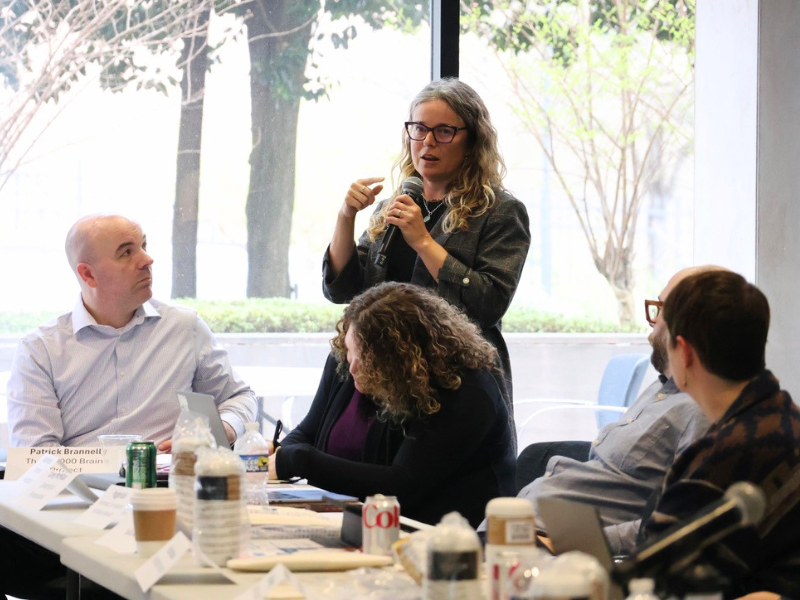
ATLANTA—Researchers from academia, federal agencies and national organizations, and participants enrolled in research studies focused on neurodegenerative diseases such as Alzheimer’s disease gathered at Georgia State University for a scientific retreat to advance ethical data and sample sharing practices and accelerate scientific advancements.
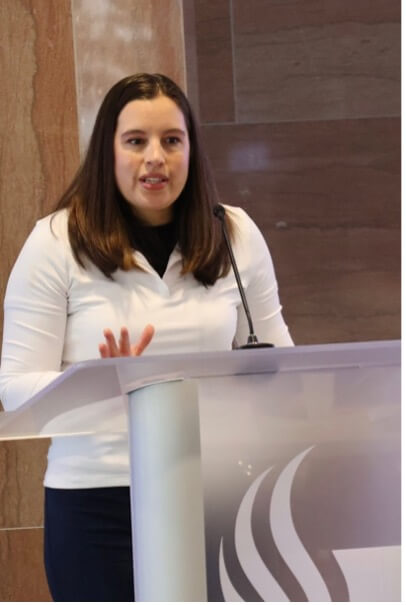
The retreat was hosted by Associate Professor Jalayne Arias in the School of Public Health.
Hosted by Associate Professor Jalayne Arias in the School of Public Health, the March 26 and 27 workshop explored challenges that have the potential to impede the sharing of critical research data. This year’s retreat was the first in a series of similar events at GSU funded by the National Institutes of Health. This year, attendees explored issues of informed consent for data and sample sharing and of aligning participants’ values and expectations with data and sample sharing practices.
“Data and sample sharing are central to advancing detection, diagnosis and treatment of neurodegenerative diseases,” Arias said. “It is important that we align consenting practices with participants’ expectations regarding the use of their data and samples. This series of retreats aims to generate new solutions toward best practices in neurodegenerative research and that facilitate data and sample sharing.”
Arias is leading two studies that include multi-institutional and interdisciplinary teams of researchers who are working to identify and evaluate barriers and facilitators to sharing research data in Alzheimer’s disease and related dementias. These projects aim to develop recommendations and guidelines that support collaboration and accelerate the discovery of new treatments. This work has described data sharing practices in ADRD research, including drivers of data sharing behaviors and outcomes from data sharing requests.
Her preliminary research has identified several challenges, including the time required to prepare data for sharing—such as redacting personally identifiable information—and concerns that sharing data might hinder a researcher’s career by making it more difficult to publish findings in a peer-reviewed journal or by giving other researchers a competitive advantage. The retreat laid the foundation for future collaborations that support data and sample sharing efforts.
Provost and Executive Vice President Nicolle Parsons-Pollard delivered welcoming remarks at the retreat and highlighted its alignment with Georgia State’s role as one of America’s fastest-growing research institutions.
“Our institution is deeply committed to interdisciplinary collaboration, to advancing public health and to addressing complex societal challenges with rigor and innovation,” Parsons-Pollard said. “The conversations that begin here reflect the very best of that mission.”
The workshop was funded by the National Institutes of Health under award number R13AG092165, the Alzheimer’s Disease Data Initiative, the Alzheimer's Association, and the Association for Frontotemporal Degeneration.