
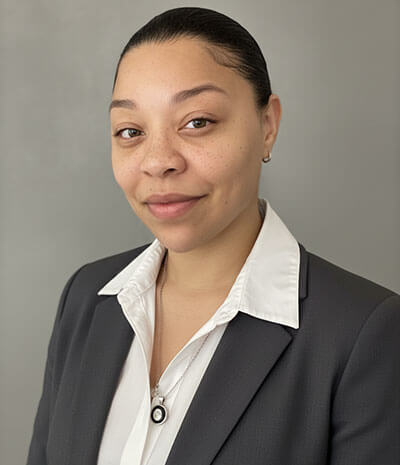
 Switching careers after almost 10 years as an insurance claims adjustor was daunting, but Janna Pankey is thankful she took that leap. Six years into her stint at State Farm, she felt like she’d advanced as far as she could. But then she was invited to join a "continuous improvement team” to identify bottlenecks and pain points. Pankey collaborated closely with a group of data analysts whose work piqued her curiosity. Making processes better and more efficient—to get more juice with less squeeze—came naturally to her.
“Being able to analyze vast amounts of data and recommend next steps for x outcome? I just thought that was interesting,” she said.
The State Farm assignment sparked Pankey’s desire to become a data analyst, but her transition to that space happened later. While at State Farm, she studied English language and literature at the University of Maryland, graduating with a B.A. in 2012. She relocated to Atlanta in 2015 and held positions at various insurance firms over the years before revisiting her urge to explore another path.
Pankey didn’t know any programming languages, and analytics was unfamiliar territory; she couldn’t make a major career pivot without acquiring some skills. Her brother had a positive experience earning his MBA at Georgia State’s Robinson College of Business, so she looked into getting her master’s there as well. She enrolled in Robinson’s M.S.A. in Data Science & Analytics program in September 2024.
Since she had no STEM background, Pankey added a Graduate Certificate in Generative AI and Machine Learning for Business* to her plate. The courses overlap, and she wanted the certificate for credibility with potential employers.
Through the Deep Learning and Generative AI class, Pankey developed foundational knowledge of large language models, so as novel technologies emerge, she can understand how AI has evolved. The Building Generative AI Business Solutions course equipped her with an essential skill: prompting a large language model. Though Pankey could do it herself from the ground up, she uses AI for code generation.
“That course taught me various techniques on prompt engineering, which is such a time saver,” she said.
For a final project, Pankey built a tool that analyzes job descriptions, scans applicants’ work experience, and generates resumes tailored to those specs. She used it to land interviews and showcase how she could practically apply the concepts she had learned at Robinson.
Pankey credits the certificate with not only exposing her to a field that is “going to fundamentally change how we work and live” but also allowing her to pivot to a totally new career in the same industry with significantly higher income and opportunity for growth.
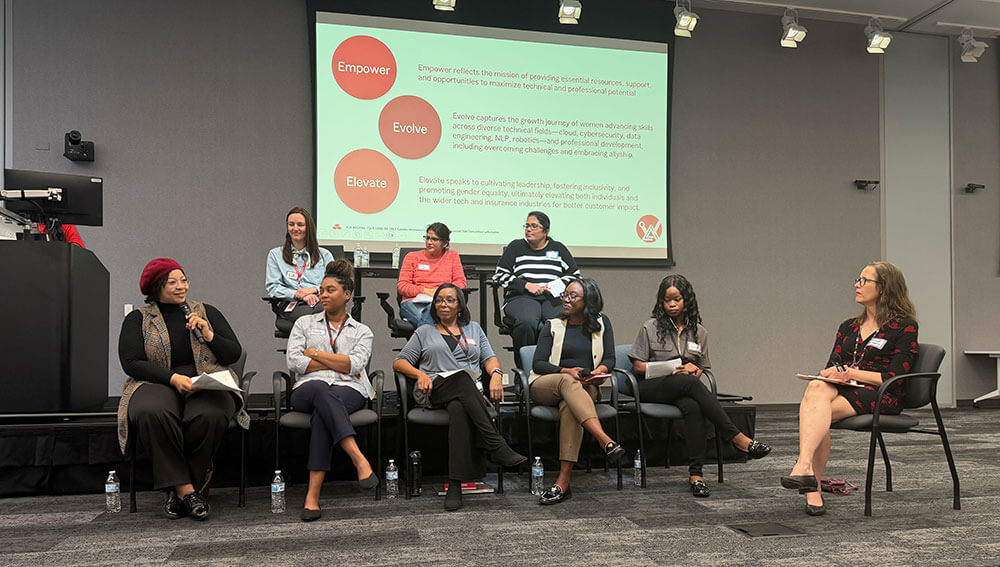
Pankey participates in a “Day in the Life” discussion panel at the 2026 Women in Technology Summit, hosted by State Farm.
Soon after Pankey graduated in December 2025, a classmate referred her for a data analyst opening at State Farm, where she was hired back nearly a decade later in a different department. She’s grateful to be in a role that enables her to make the world a better place with the help of AI. When a customer calls, something horrible has usually happened, like a car accident or house fire. Pankey wants customers’ experience to be as smooth as possible. Using AI to complete small, administrative tasks like code generation and emails leaves mental space for her to be more creative in her decision making.
“AI is a great partner,” Pankey said. “Because I'm not spending time generating a query or writing Python code from scratch, I have more time to experiment and add value.”
*During Pankey’s enrollment, the program was called the Graduate Certificate in Artificial Intelligence Business Innovation.