

ATLANTA — Applying for scholarships is all about understanding yourself, your goals and how you want to contribute to your field or community. The process encourages students to reflect on their achievements, clarify their ambitions and think critically about the impact they hope to make.
There are a wide variety of scholarship opportunities available in the Honors College and beyond, but the application process can be daunting. To help students demystify the process, we spoke with Marc Reyes, associate director of the Office of National Scholarships and Fellowships. He guides students through the application process to the finish line, all while searching for more opportunities that can benefit students at GSU. Although Reyes’s office is located within the Honors College, he offers guidance to all GSU students.
Reyes brings a unique perspective as both a former Fulbright Scholar and a longtime adviser to students pursuing national and international awards. In this interview, Reyes shared practical strategies for crafting strong applications, approaching essays and recommendations with confidence and turning perceived gaps or weaknesses into strengths.
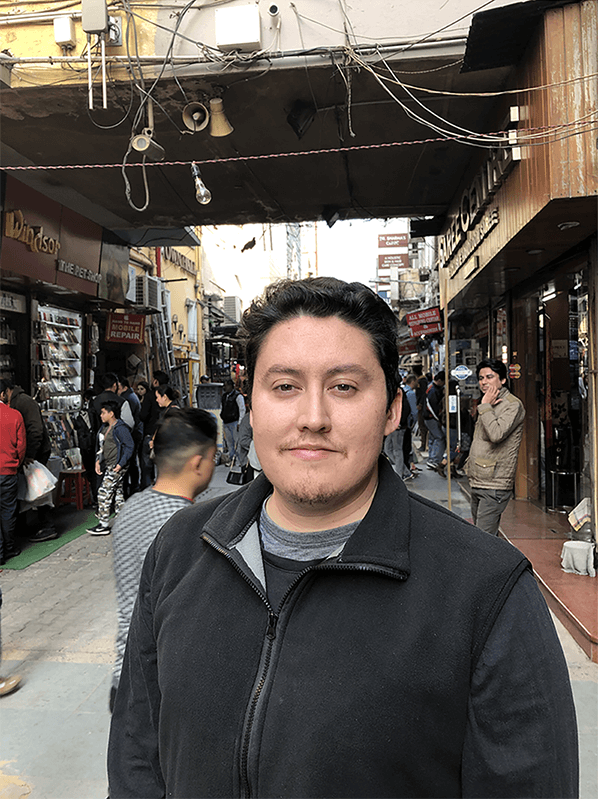
Marc Reyes in India as a Fulbright Scholar, browsing through New Delhi’s Khan Market shopping district (photo from 2018).
How can a student know if they are a fit for a scholarship or fellowship?
Reyes said students should search for an opportunity that reflects what they want to do, whether it’s for studying abroad, leadership or research. Reyes recommends that students opt for opportunities that fit within their personal timelines, not the other way around. From there, he said, students should look for alignment; something that makes them say, “It sounds like they’re describing me.” Ultimately, he emphasized how necessary it is to really want the award. “There has to be some buy-in from you. I can want the award for you, but you also have to want it as well,” said Reyes.
If a student feels they don’t have enough “experience,” what should they do?
Reyes often sees students underestimate themselves. “I usually find that students have more than enough [experience]. To be honest, a lot of students are too modest,” said Reyes. When it comes to showing leadership, he said, “There are many ways to do it, but it should be genuine.” He noted that many applications don’t require groundbreaking accomplishments: Small clubs, part-time service jobs and volunteer experience can all count as leadership or relevant experience. “Sometimes leadership is... ‘we used to have this meeting and only five people showed up. Now because of me, 10 people show up,’” said Reyes.
Many students restrain themselves from applying for opportunities if they don’t believe they fit the requirements perfectly. Should students give it a try anyway?
Reyes advises students to “take a possible weakness and make it a strength or make it a story that ultimately has an arc that is a successful one.” For example, if a student’s grades dropped during a semester, they could frame it as something they overcame and grew from. He added that grade point average (GPA) is usually a bit lower on the priority list, as the essays and recommendations are often more important. Students can also frame a lack of experience in a certain area as a reason why they want to pursue the opportunity in question. For example, if they want to study a foreign language that their school doesn’t offer, a student can emphasize their passion for the language and explain how a foreign language scholarship would help them explore this passion.
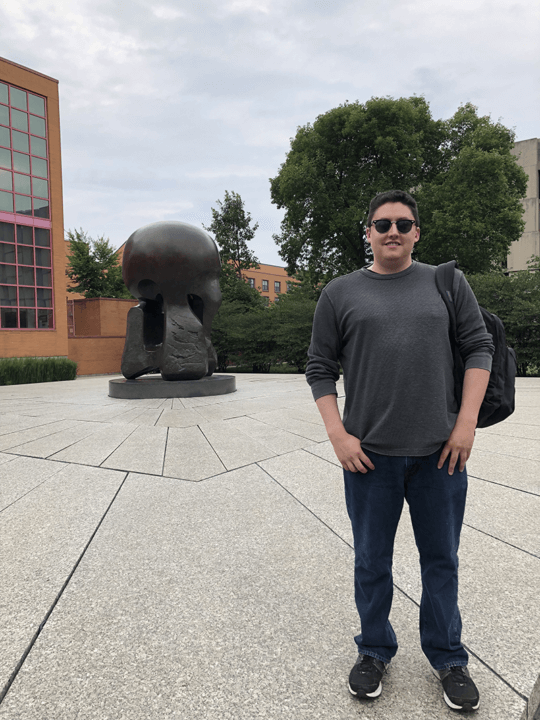
Marc Reyes conducting research at the University of Chicago. He is standing at the spot commemorating where, on Dec. 2, 1942, scientists achieved the first human-created sustained nuclear reaction (2018).
When it comes to personal essays, how can a student make their scholarship application stand out?
One of the most important things a student should not do: overthink the prompt. Reyes noted that reviewers may toss aside an essay if it’s not responding directly to a prompt. According to Reyes, clarity and specificity are key. He recommends approaching the essays as both narrative and plan: “Tell a story about who you are, what have you learned and where are you going.” Reyes said essays are a chance for applicants to show reviewers who the person is behind the application. He stressed the importance of including a vision of what the applicant will do as a member of the scholarship cohort. “You want to show funders that if they give you this opportunity, you are going to make the most of it,” he said.
How can a prestigious scholarship change a student’s life?
Reyes notes that the immediate impact is often financial. He’s heard students say they can quit their jobs, graduate from college debt free or go into a public service career and not worry about income. The emotional and personal impact can be just as important. “The less tangible thing is just that confidence,” said Reyes. “It’s just that feeling of, ‘I was picked.’” Joining a scholarship or fellowship cohort can also shift a student’s visibility and allow even more opportunities to surface. “Winning those types of awards does really open a door,” said Reyes. “That might be how people know you.”
When a student is working on an application and feels stuck or unsure, what should they do?
Reyes offered both practical and emotional guidance. “Maybe you might need to step away for a few days, maybe a week… just to get away from it and come back to it with fresh eyes.” He also suggests connecting with former winners. “I always think it goes a long way to talk to someone who was recently in your shoes.” He reassures students that the process is repetitive: “This process isn’t about perfection. It’s about revision.” His own feedback style reflects this. “I’ll tell you when something is good,” said Reyes. “I’ll also tell you if I don’t like something… but I will tell you how I think you can fix it.” He describes himself as a “competitive” person who wants the students he advises to win the awards they’re seeking. “We want to be able to feel that once you hit submit, that this was the strongest possible version,” said Reyes.
How can students work toward securing a great letter of recommendation?
Reyes emphasizes meaningful relationships over last-minute requests. “Did you like a certain professor or major? Take multiple courses with them, try to stand out, go to office hours,” said Reyes. By graduation, students should have multiple people they can ask for a recommendation. When an application allows multiple recommendations, he encourages students to use the full range. “If they give you up to five, have five,” said Reyes. To help professors write strong letters, students can share materials like their resumes and transcripts. He is firm about one point: “If you ask a professor to write you a letter, there really should only be two responses: yes or no.” He strongly warns students against drafting their own letters.
Is there any advice you wanted to hear about scholarship applications while you were a Fulbright Scholar?
Reyes explained that seeing an example of a Fulbright essay too early became a hindrance. “I think that was a bad idea because then it made me think it has to look like that,” he said. His advice now is: “Don’t get too boxed in by previous examples. Look at it in terms of what it’s saying, as opposed to trying to replicate it.” He also stressed the importance of writing for a broad audience. “You want to make it something that anybody could pick up and understand,” said Reyes. Scholarship review panels often include reviewers from a wide variety of fields. Scholarship reviewers may not be working in the respective field related to the opportunity. This, he says, makes clarity paramount.
Write, Submit, Grow
Reyes makes it clear that applying for scholarships is about taking stock of your experiences, thinking about where you want to go and figuring out how to tell your story in a way that feels authentic. The process can be messy, full of revisions and second guesses, but that’s also where the learning happens. Every essay you write, every conversation you have with a professor and every draft you revise is a step toward understanding yourself and what you want to achieve.
So go ahead – apply for that scholarship you have been bookmarking, finish that essay you have been putting off or ask for that recommendation letter. You don’t need to wait for the “perfect” moment or a flawless application. And even if you do not win every award, the effort itself is a step toward becoming the kind of GSU student — and person — you are striving to be.
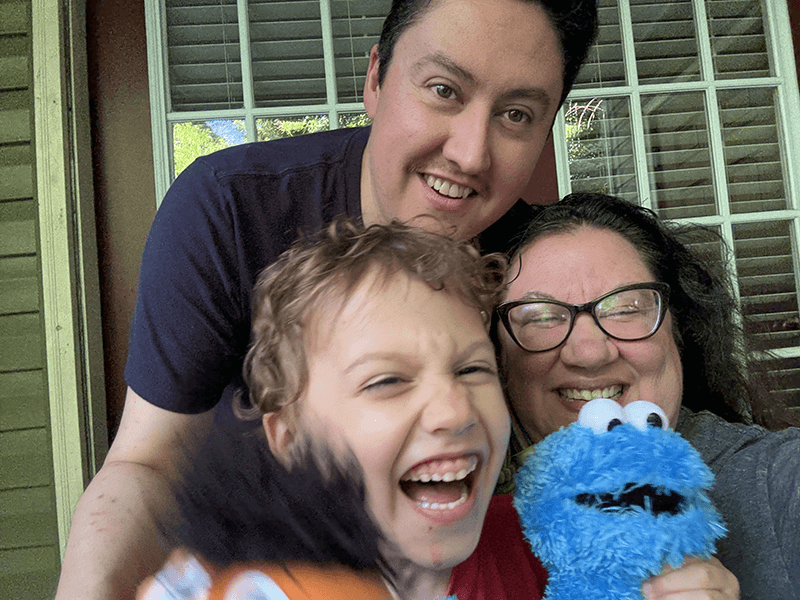
Marc Reyes with his wife Libby, and his son Henry as well as the Cookie Monster and the top of Ernie’s head.
The Office of National Scholarships and Fellowships (ONSF) advises students pursuing nationally competitive, external awards in research, leadership, graduate study and global experiences. Since joining GSU in 2022, Marc Reyes has supported successful applicants for the Gilman, Goldwater, and Luce Scholarships, as well as Fulbright U.S. Student Program awards.
All GSU students are welcome to work with ONSF, which is housed in the Honors College.
If you’re looking for the Scholarship Resource Center, you can visit it here. The Scholarship Resource Center supports internal GSU scholarships, while ONSF focuses on external, national opportunities.
Services in both offices are open to all GSU students!
Story By:

Heather Fields:
Heather Fields is a third-year journalism student in the Honors College who serves as a reporter for Honors College Communications. She loves philosophy, foreign language studies and cats.
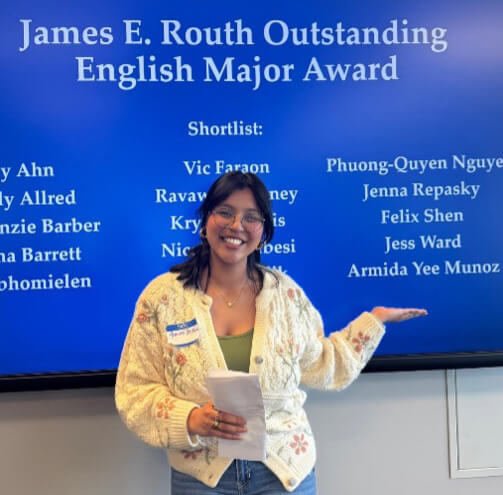
Armida Yee-Muñoz:
Armida is a senior in the GSU Honors College and a student reporter for Honors College Communications. She writes, edits and publishes news articles for the News Hub. She enjoys spotlighting student achievements, connecting with alumni and is always looking for her next book to read.