
ATLANTA — When Dulce Costilla Gonzalez arrived at Georgia State University in fall 2025, she assumed research opportunities would come later in her college career.
Instead, the chemistry major joined a research group during her first semester, studying how seawater chloride affects the phototoxicity of marine pollutants. By spring, she was presenting her findings at the Georgia State Undergraduate Research Conference, where her work earned a sustainability award.
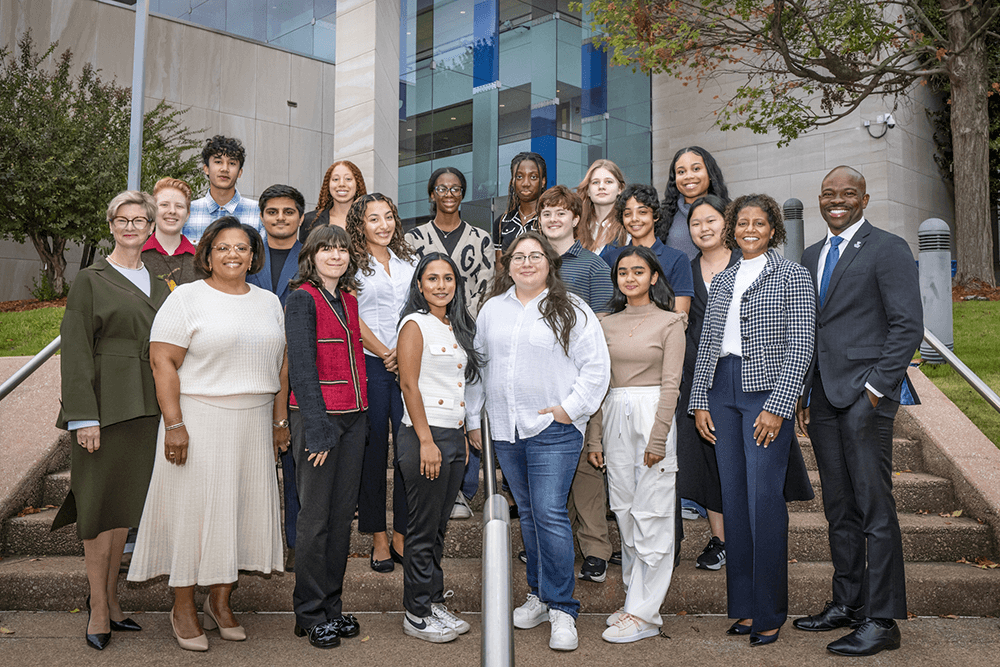
Costilla Gonzalez's experience reflects a broader trend among Georgia State's newest cohort of Stamps and Presidential scholars, who entered the university in fall 2025.
Within the Honors College, scholars encountered small, discussion-based courses, close interaction with faculty and experiences like the Honors 1000 seminar, which introduces interdisciplinary thinking and creates community among scholars during their first semester.
Stepping Into Work Early
While the Honors College's academic environment remains a defining part of the student experience, many scholars also find themselves pursuing research, internships, creative projects and other hands-on opportunities beyond the classroom from the start of their college careers.
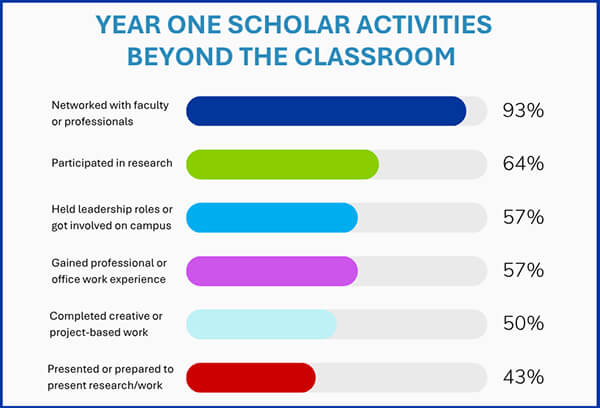 Programs such as the Undergraduate Assistantship Program (UAP) provide many students with an entry point into research, connecting them with faculty and projects early in their academic careers. Whether studying marine pollutants, observing non-human primate behavior or assisting with laboratory instruction, Honors scholars found themselves working in research environments much earlier than they expected.
In computer science, Karan Pratap Singh spent his first year competing in hackathons, earning top placements at HackGT, UGAHacks and HackPrinceton while collaborating with other students on technical and entrepreneurial projects.
Opportunities also emerged in community-based work. Mikayla Wilson, a public health major, was selected for a grant-funded internship with a nonprofit serving Atlanta's unhoused population.
“I didn’t expect to have an internship my freshman year at GSU,” she said. “It ended up shaping my future career plans and inspired me to continue serving and supporting our unhoused community.”
Creative work followed a similar pattern. Laura Hayes, a studio art major, worked with a small team of students to design a mural for the Honors College — an opportunity she said she did not expect to have so early in her college career because of the level of creative ownership involved.
Support, Access and Community
The opportunities students pursued during their first year were often supported by a combination of financial resources, faculty mentorship and community connections.
For some, financial support changed how they approached college from the beginning. Amy Lee, an exploratory nursing major, said receiving the Presidential Scholarship removed a significant financial barrier.
“Having free tuition really made it possible for me to pursue a higher education,” she said. “It got rid of the financial stress that usually comes with a privilege like this, allowing me to focus on my studies and building a community.”
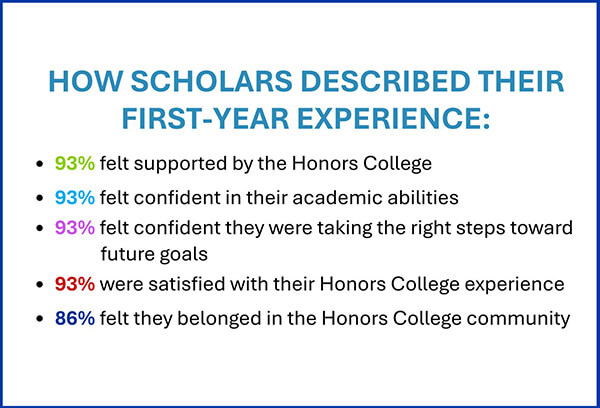 Financial support functioned as more than a scholarship benefit, making it easier for students to pursue research, internships, travel and other opportunities early in their college careers.
Close interaction with faculty and staff opened doors to additional opportunities. Through their UAP placements, students gained experience contributing to research projects while building relationships with faculty mentors that sometimes led to additional opportunities, including internships.
Community played a supportive role as well. For many scholars, college is shaped not only by opportunities but also by the people they encounter along the way.
“What surprised me most about my experience is the number of amazing relationships I was able to cultivate, ranging from academic to personal,” said Oyinkansola Adekonye, a neuroscience major. “I was not expecting to get as close as I did to my scholarship cohort, professors or even Dean Sarah Cook.”
That sense of connection took different forms for different students. For Lane Miller, a psychology major, it meant finding friends who helped him navigate the demands of his first year.
“These friends helped me find a happy medium between work and play and allowed me to find a much-needed break from my coursework,” he said.
Together, financial, academic and interpersonal support created opportunities for students to pursue experiences early and with confidence.
Carrying the Experience Forward
By the end of their first year, many students are already extending those experiences into the summer.
Some are studying abroad, others are continuing research or beginning internships and many are using the summer to build on skills and interests they identified during the academic year — whether through coursework, creative work or professional preparation.
Neuroscience major Kellan Howard, who is continuing research through a summer fellowship, summed up the experience this way: “[My Stamps Scholarship] opens so many doors that I didn’t even know existed.”
Reflecting on that first year, Karan Pratap Singh described the experience in simple terms: “The most valuable part of my first year wasn’t what I planned. It was everything I never expected to do.”
Click here to learn more about the Stamps and Presidential scholarships.
The Honors College at Georgia State University is a destination for high-achieving students who embody curiosity, take pride in their work and dream about how they can make an impact through their studies and careers. Its mission is to serve students in a welcoming space by engaging students’ curiosity, empowering them to achieve their highest potential and inspiring them to find their place in the world. Its students form life-long friendships, participate in community service, perform research, excel academically, explore their interests and chart their career paths.