

ATLANTA — When Nnaemeka (B.S. ’24) and Chinedu Odedo (B.S. ’24) left Nigeria for Georgia State University, they arrived not just as students but as dreamers chasing parallel destinies. Chinedu pursued medicine and Nnaemeka sought technology.
As fraternal twins with distinctly different callings, they spent their undergraduate years building a shared legacy rooted in faith, ambition and gratitude — a journey they say was strengthened by the supportive community they found within the Honors College at Georgia State.
“We were born and raised in Nigeria,” Nnaemeka Odedo said. “Growing up as twins, we did everything together. It helped us foster community and love.”
The two attended boarding school starting around age 9, a formative experience that, as Chinedu Odedo described, “taught us independence early.”
Though they were only 20 minutes from home, they lived apart. This decision was rooted in what Nnaemeka Odedo calls a “Nigerian ideology that twins shouldn’t depend on each other too much with the intention to foster independence and exposure to the real world. That independence would later define them both.
Coming to the United States was both a leap of faith and a family decision for the twins.
“One of the major deciding factors was family,” Nnaemeka Odedo said. “We had some relatives here in the States.”
So, when Chinedu received the 100% out-of-state tuition waiver from Georgia State, he immediately told his brother to apply.
“At first, they didn’t give him the scholarship,” Chinedu said. “Naturally, I reached out to the person who emailed me, Carlos Rivera, and asked if my brother could receive the same award.”
He smiled, remembering that Rivera later extended the offer. “It was significant. That’s what made it possible for both of us to come here.”
Chinedu Odedo added, “Our parents wanted us to be close, to have that support system. So, we both chose GSU.”
Adjusting in a Pandemic
Their first semester began under the shadow of the COVID-19 pandemic.
“It wasn’t what I expected,” Chinedu Odedo said. “I thought I’d go to class and see more people, but the campus was empty. It felt like a ghost town.”
“Learning online was tough,” Chinedu added. “In Nigeria, everything is taught face to face. Suddenly I was doing chemistry labs virtually and trying to understand our student digital hub for the first time.”
But their resilience carried them through.
“I got my first job in the business school because I was genuinely bored,” Chinedu said, laughing. “But it wasn’t really aligned with my career path.”
Thus, their search for community continued.
Despite the challenges of their search, they found community through the African Student Association and the basketball courts at the Student Recreation Center.
“People here are so welcoming,” Chinedu said. “Maybe it’s because I’ve been able to connect with people who are from diverse walks of life. Everyone learns and adapts differently, and that makes people more inclusive.”
Engineering at Amazon
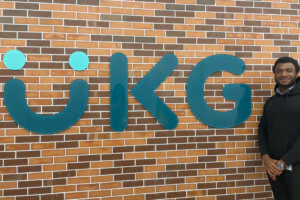
Nnaemeka Odedo interned at UKG, an American multinational technology company.
While both brothers pursued science, their passions diverged early.
“He’s always been the technical one,” Chinedu Odedo said about his brother. “He was the kid who fixed the TV remote, the computer, everything.”
“I’ve always been more interested in machines and the internet,” Nnaemeka Odedo said. “I like taking things apart just to see how they work.”
That curiosity led Nnaemeka to computer science and eventually to Amazon, where he currently works as a software engineer. Opportunities like these, he says, became more accessible thanks to the Honors College’s emphasis on exploration and career launch.
“Tech helps improve our daily lives,” he said. “I’m really interested in cybersecurity and quantum computing — fields that are going to revolutionize how computers work.”
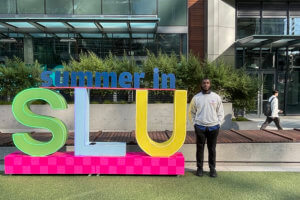
Nnaemeka Odedo at Amazon’s Seattle campus as a full-time employee.
His journey to Amazon began in 2022, when he stumbled upon an email from the Computer Science Department about CodePath, a nonprofit organization that provides courses and mentoring services to students in the technology sector.
“I didn’t have anything lined up that summer,” he said. “So, I applied. That one decision changed everything.”
After showcasing a web application he built through CodePath, Amazon hired him first as an intern and then offered him a full-time role. “People still tell me, ‘I saw your face on the CodePath website,’” he said, grinning.
Med School at Cornell
Chinedu’s calling has always been medicine. Born with a ventricular septal defect, he underwent life-saving surgery at just 2 years old.
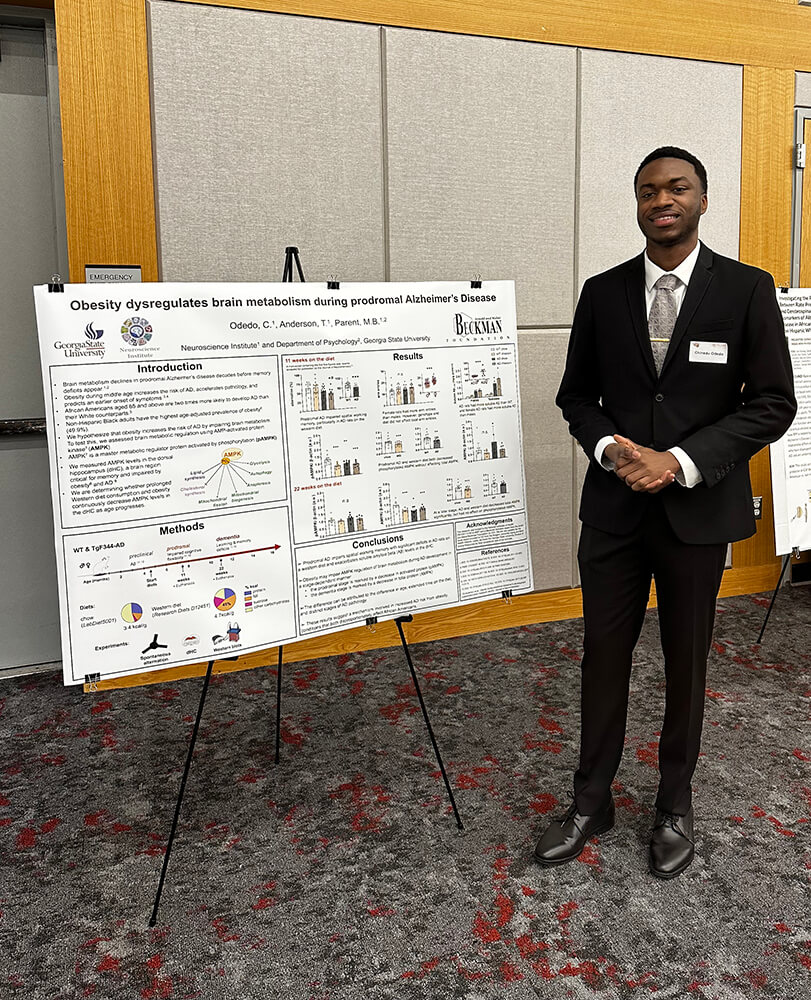
Chinedu Odedo presents his research at the annual Beckman Symposium in Irvine, California.
“Realizing that it was through surgeons and medicine that I’m ultimately alive gave me a moral responsibility to pursue that path,” he said.
As a Beckman Scholar, Chinedu spent years researching the risk factors behind Alzheimer’s disease, focusing on how menopause and the loss of ovarian hormones affect myelin integrity. His research earned recognition and medical school acceptances from Morehouse School of Medicine, the University of Virginia, Albany Medical College and Wayne State University. Chinedu ultimately chose to attend Weill Cornell Medicine.
He also cofounded the Pre-Medical Mentorship and Clinical Program (PMCP) at Georgia State.
“We created it to address the lack of clinical hours among pre-med students,” he explained. “Now, over 70 physicians are in our network, and at least 10 students shadow doctors each semester.”
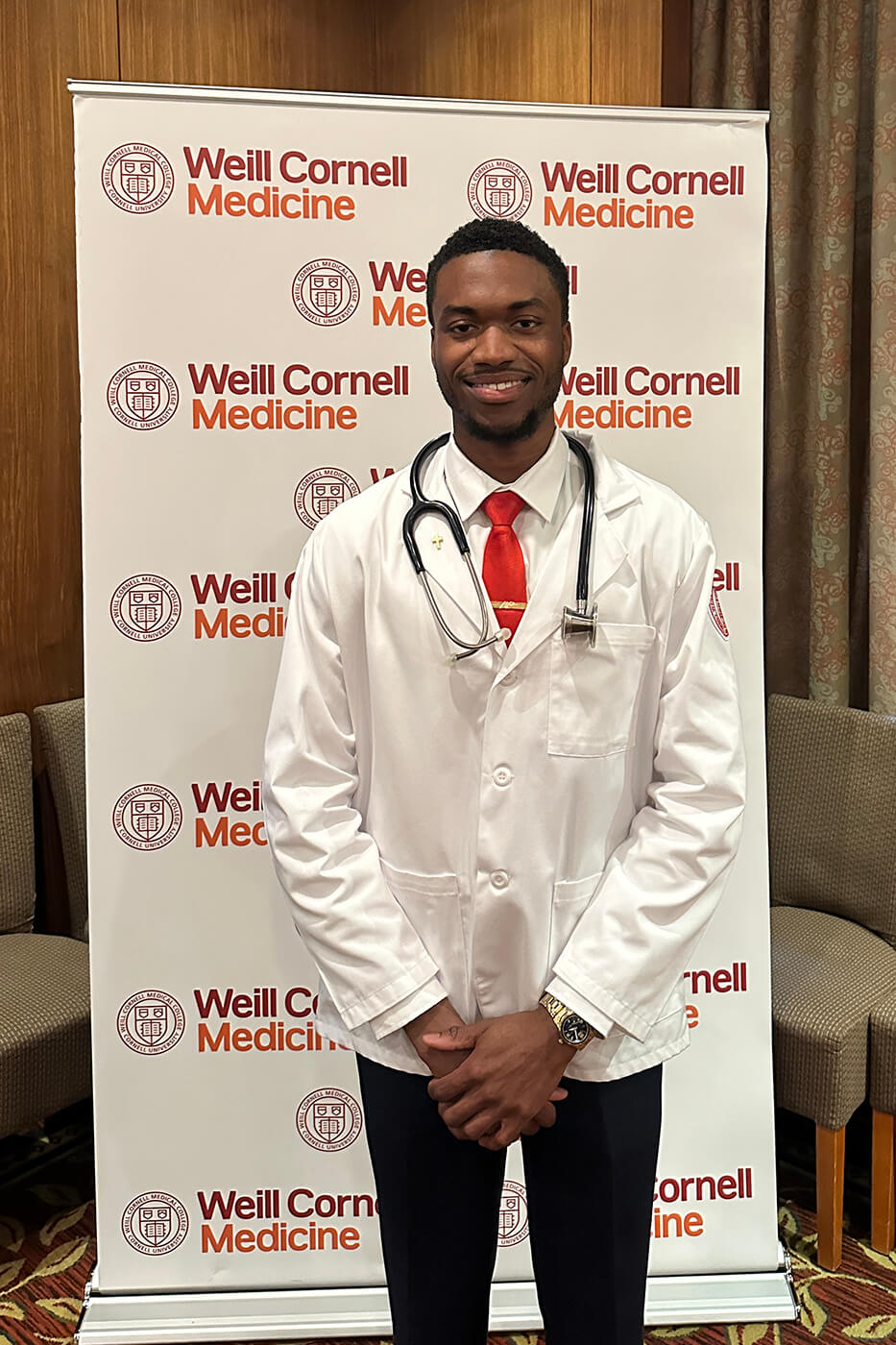
Chinedu Odedo at his white coat ceremony at Weill Cornell Medicine.
When asked about his motivation, he paused before saying, “I just tried to make an impact on the pre-medical experience at GSU. I knew clinical hours were lacking, so I wanted to leave behind a tangible program that could fill that gap. It is fulfilling to know I made such a considerable impact that is benefitting people’s careers.”
Last summer, he did exactly that. He returned to Nigeria with the VOOM Foundation to assist in pediatric heart surgeries.
“I saw a patient my age with the same defect I was born with,” he said. “It reminded me how lucky I am. That experience changed me.”
Looking Forward
For both brothers, Georgia State became a launching pad. Nnaemeka earned the Gilman Scholarship to study urban development in Berlin, while Chinedu leveraged his research and faith to be admitted into top medical schools.
“The Honors College elevated our network,” Chinedu said. “The advisers were exceptional. People like Emily Bius and Marc Reyes changed our lives.”
They describe the Honors College as a close-knit community where staff, faculty and peers are deeply invested in each student’s growth.
When asked what advice they’d give to a high school senior, Chinedu didn’t hesitate: “Put yourself out there, but take everything with a grain of salt. Don’t limit yourself, but don’t be naive either. Have faith.”
And perhaps the most powerful reflection comes from Nnaemeka: “You don’t have to succeed at the first try,” he said. “You could fail. All that matters is just keep trying.”
For the Odedo twins, each other’s success at GSU was a shared journey they navigated together.
Story By:
Armida Yee Muñoz
Armida recently graduated from GSU and the Honors College, where she was a student reporter for Honors College Communications.