

Media Contact
Kenya King
Director
Public Relations and Marketing Communications
Perimeter College
[email protected]
CLARKSTON, Ga. — An ongoing project on the Clarkston Campus of Georgia State University's Perimeter College is giving a little songbird a big chance at survival. The brown-headed nuthatch, a songbird that makes a high-pitched squeak sound, is native to the Southeast U.S. In fact, the Southeast is the only place the bird lives. Unfortunately, in recent years, the nuthatch’s habitat has been dwindling.
Mature pine trees, especially longleaf pines, provide the perfect habitat for nuthatches to nest as well as their primary source of food — pinecones and insects. While pine trees were once abundant in the region, clear cutting, a practice used for residential and commercial development, has wiped out most of the nuthatch’s habitat, leaving less than 5% remaining. The bird is not considered endangered, but the population is severely diminished. Noticing this diminished population, Associate Professor of Biology Diane Lahaise was determined to help the birds.
In 2015, Lahaise created some bird boxes to install on Perimeter’s Clarkston Campus. She saw the project as a way to encourage the nuthatch to nest and a way to get students involved in research. Originally funded by internal money from Perimeter, this past year Lahaise and Associate Professor of Biology Mark Graves were able to secure a grant from the National Wildlife Federation in conjunction with Mutual of Omaha’s Wild Kingdom Program. They used the grant money to buy a lot of materials for making more bird boxes and to hire six students. The students – Kai Watts, Chisvon Carter, Chino Chilaka, Amber Burns, Naomi Lopez and Sam Tsegay – receive a stipend and are gaining research experience.
“The idea for the project ultimately started because of my interest in songbird conservation,” said Lahaise. “But it really was created as a way to engage undergraduate college students in research-based science. Over the span of the project, we have had six or seven independent student research projects developed from the data we have collected. Some of these students have gone on to present their findings at local conferences. I have also used the data collected during the project in some of my lab classes to teach students how to work with real data sets and learn what can and cannot be concluded from data.”
The boxes have a numbering system, and each box has a unique number so that Lahaise, Graves and the student research team can track what goes on with each box. The bird boxes provide a place for nuthatches to nest and, since 2015, there have been 14 brown-headed nuthatch nests on Perimeter campuses. The nuthatch population is not all that has benefited from the boxes though. Since the project’s beginning, Perimeter’s bird boxes have fostered 19 house wren nests, 28 Carolina chickadee nests and 42 eastern bluebird nests. While the intended avian beneficiary of the bird boxes is taking a slow and steady approach, neighboring birds are taking full advantage of the cozy boxes.
As Lahaise explained, “brown-headed nuthatches are not prolific breeders. They are also small birds with large territories and really space themselves out. We are definitely benefiting bluebirds and chickadees and that’s also a good thing. Habitat loss affects all species of birds.”
Nuthatches and other birds are important to humans because they eat tons of insects in spring and summer. Just one pair of nuthatches eats thousands of insects every year. “If they weren’t doing that, we’d be overrun by bugs,” Lahaise said.
Over time, the bird box project has evolved into an outreach program. Funding from the National Wildlife Federation grant has allowed Lahaise, Graves and their team of students to build and distribute boxes at various locations around Atlanta. There are currently 12 boxes on the Clarkston Campus, 18 on Perimeter’s Newton Campus, 10 boxes at Stone Mountain Park, 12 at Blue Herron Nature Preserve and a site has been designated for boxes to be installed at Arabia Mountain. There are 50 newly constructed boxes that will be placed at sites soon.
There are also six boxes directly across the street from the Clarkston Campus at Indian Creek Elementary. In September 2025, the Perimeter team was able to teach students about the boxes and nuthatches. This spring, the elementary students will get involved by checking the boxes regularly and collecting data about bird usage of the boxes.
“I am proud of the fact that I’ve been able to maintain the project over the 10 years, even when it wasn’t funded and thanks to help from Mark Graves," Lahaise said. "The fact that this project is always ‘running’ allows us to bring in successive groups of students for individual research projects. Additionally, when it comes to conservation, having long-term data sets is critical for tracking overall trends.”
Lahaise, Graves and their student researchers are hopeful about the spring. There is opportunity and possibility for new nuthatch babies on Perimeter’s campuses as well as throughout the city.
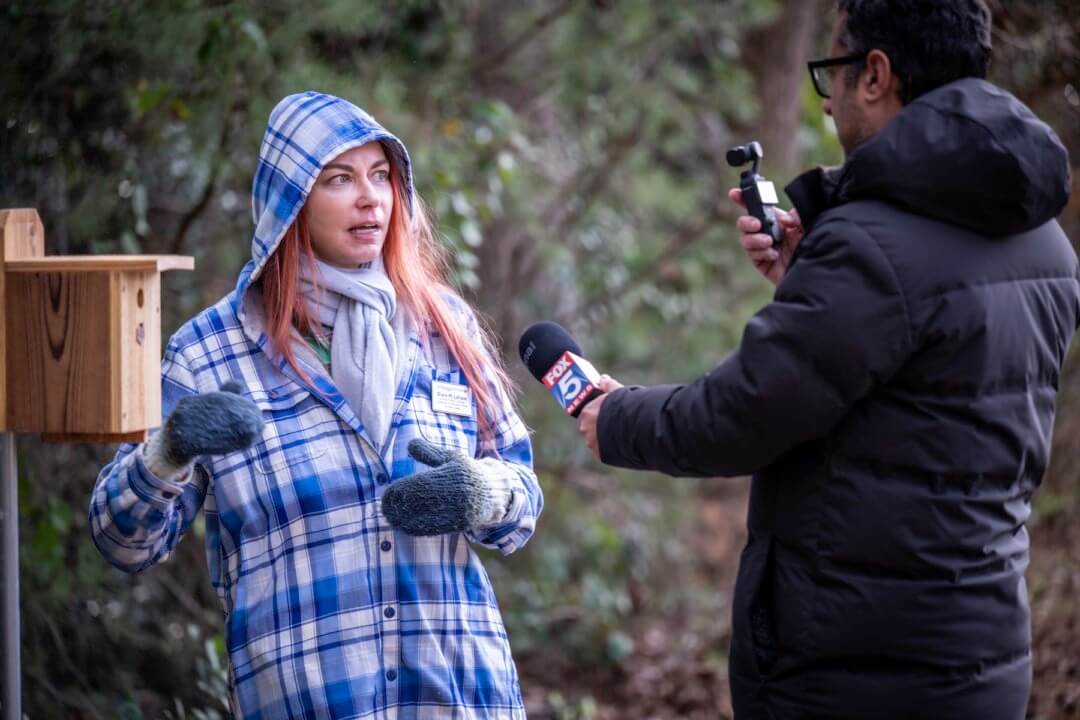
Chris Rosenthal of Fox 5 Atlanta interviewed Lahaise about the bird boxes in January.
— Story by Christy Petterson
— Photos by Bill Roa