
Media Contact
Kenya King
Director
Public Relations and Marketing Communications
Perimeter College
[email protected]
A team of four Georgia State University Perimeter College students earned national recognition this summer when they were selected as finalists in the Community College Innovation Challenge (CCIC). The competition, hosted by the American Association of Community Colleges (AACC) in partnership with the National Science Foundation (NSF), selected Perimeter’s team of engineering and computer science students as one of 12 finalist teams for their smart drain monitoring system project.
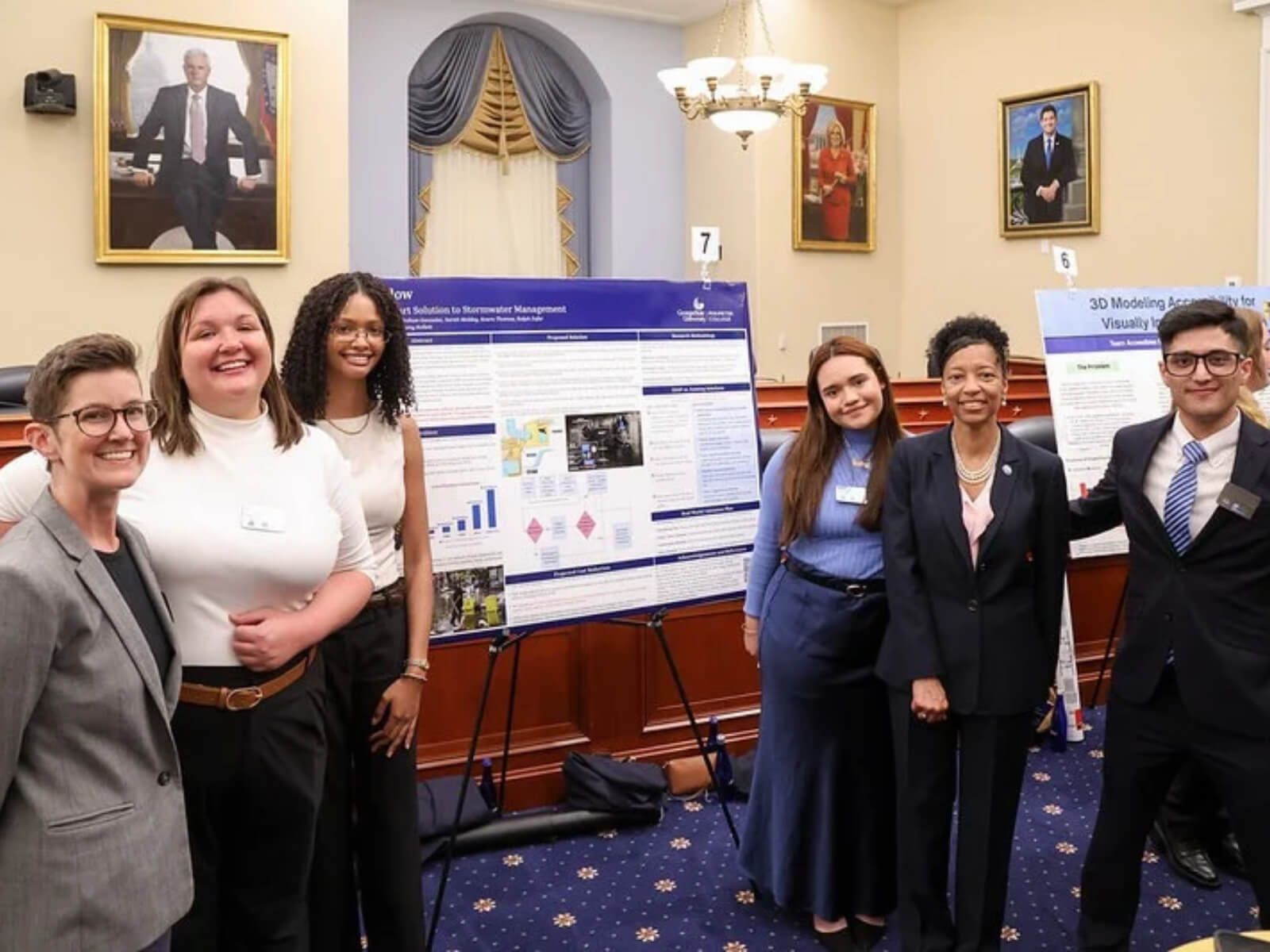
Finalists Ralph Zafar, Keara Thomas, Sarah Mobley and Saihan Gonzalez, along with faculty mentor Dr. Kimberly Kellett, attended the CCIC Innovation Boot Camp in Washington, D.C. The event that culminated in a Student Innovation Poster Session on Capitol Hill, where finalists presented their ideas to STEM leaders and congressional stakeholders. While there, the team connected with other CCIC finalists from across the country, as well as experts in business planning, communication and strategic problem-solving.
“Our students took advantage of many networking opportunities, meeting with innovators from other two-year institutions, professional communicators, representatives from NSF and members of the U.S. Congress,” said Kellett, associate professor of biology and faculty associate for Perimeter College’s Hub for Innovation and Entrepreneurship.
According to the AACC, the innovation presentations this year featured solutions for food insecurity, search and rescue, road safety, energy efficiency, safe drinking water and accessible learning for people with visual impairments, among other topics. Many submissions incorporated emerging technologies, including AI, machine learning and advanced manufacturing.
Perimeter College’s submission, titled Enhanced Drain Obstruction Prevention (EDOP), featured a smart drain monitoring system designed to track water levels and help prevent urban flooding before it starts. Describing how the system works, Thomas said EDOP uses sensors inside drains to detect debris buildup and monitor water flow. The system sends real-time alerts to maintenance crews. “The goal is to give public works departments early warnings so they can respond before flooding becomes dangerous or costly,” Zafar said.
The CCIC application process included a written essay and a video presentation. After advancing to the finals, the team conducted customer discovery interviews to gather feedback on their idea before attending the competition. They spent hours speaking with civil engineers, municipal water system employees and representatives from city design firms, using their insights to refine the concept and identify new opportunities for the product.
As the team worked together, members discovered they each brought unique skills and interests to the project. Zafar focused on the technical development of EDOP. As a computer science student, he integrated the electronics and designed the machine learning model. Mobley, who has experienced flooding firsthand, focused her research on the problem, solution, impacts and benefits of EDOP. Gonzalez, whose expertise is in civil engineering, recognized the project’s potential to improve municipal infrastructure. She contributed to the design and presentation materials. Thomas, who plans to pursue a degree in industrial engineering, helped bridge gaps across her teammates’ ideas and contributed her unique perspective to their problem-solving process.
The benefits of working as a team became evident, as members combined their interests, ideas and responsibilities. “Our different personalities made us stronger,” Gonzalez said. Thomas said she learned the importance of keeping a project running smoothly by giving every team member an opportunity to contribute in a new way. “I learned to stay actively curious and be open to new perspectives.” Mobley added that assigning roles based on individual interests allowed everyone to take ownership and make meaningful contributions to the project.
CCIC is open to students pursuing subjects other than engineering and STEM-based ideas. The competition emphasizes entrepreneurial thinking, innovation and communication skills. “As a mentor, I worked with the team on communication skills, creating a concise and descriptive application and developing a poster that effectively communicated the problem, solution and outcomes,” Kellett said. She also noted that her role with Perimeter College’s Hub for Innovation and Entrepreneurship includes mentoring student teams and leading CCIC workshops to help students understand the competition process.
Although this year’s team did not place among the top three, the students left the competition with stronger professional skills and a clear understanding of how to develop EDOP. “We know how competitive the market is for a product like ours, and we plan to pursue our options,” Gonzalez said.
“We strongly believe EDOP provides a viable monitoring system to help prevent urban flooding,” Mobley said. “I’m interested in pursuing a career in biomolecular engineering and public health, and the environmental aspects of preventing illness are high on my radar. Limiting infrastructure damage can be an important part of solving the problem.”
Kellett said being named CCIC finalists is a significant achievement for Perimeter College, whose teams have reached the finals for three consecutive years. This year’s team returned with valuable professional networks, stronger communication skills and a deeper understanding of how innovation can address environmental challenges.
-Story by Barbara Obrentz