
Media Contact
Sam Fahmy
Director of Communications
School of Public Health
[email protected]
More than 4,600 people living in high-cost, low-quality housing in DeKalb County
ATLANTA — A new report from the Georgia State University Center on Health and Homelessness finds that extended-stay hotels are serving as a shelter of last resort for more than 4,600 people in DeKalb County, including 2,004 households and 1,635 children.
The study found that families living in extended-stay hotels typically pay an amount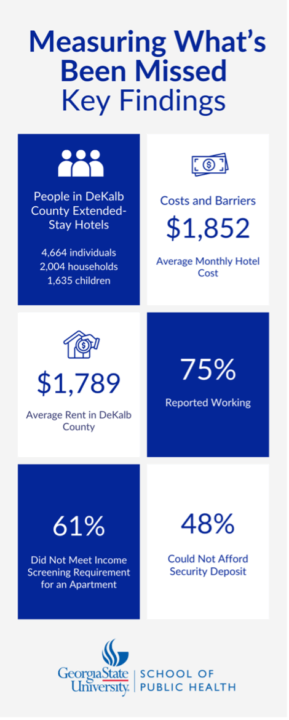 that exceeds the average monthly rent in the county but often remain in substandard housing due to factors such as not meeting income screening requirements for rentals and a lack of upfront costs for a security deposit.
Funded by DeKalb County and conducted in partnership with family advocate Sue Sullivan and the nonprofit Single Parents Alliance and Resource Center, the study provides the most comprehensive data on families living in extended-stay hotels in the county. It highlights the health and safety risks that residents face, educational disruptions and how targeted programs can help families obtain stable, long-term housing.
“Thousands of people in DeKalb County are living in extended-stay hotels but are not included in federal homelessness counts or local administrative systems,” said report co-author Shannon Self-Brown, a Distinguished University Professor in the School of Public Health and co-lead of the Center on Health and Homelessness. “These families are excluded when resources are allocated, yet they face the same instability, cost burdens, and risks to health and safety as other people who lack stable housing.”
Spending More for Less
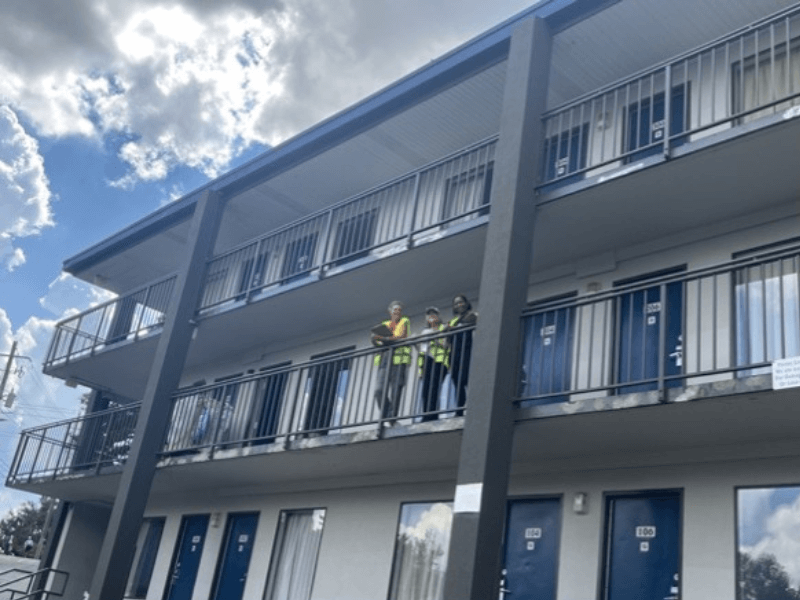
To conduct DeKalb County’s first large-scale assessment of people living in extended-stay hotels, a team of 50 GSU and community volunteers conducted door-to-door surveys at 42 hotels to gather data on household composition, income, hotel conditions, educational impacts and barriers to permanent housing.
They found that 78% of households surveyed had at least one person who was working and that 24% of households had at least one person who worked multiple jobs. The average monthly hotel cost was $1,852, a figure that exceeds the average rent of $1,789 in DeKalb County.
“Our data show that families are paying what it costs to rent an apartment but are locked out of the rental market, often because of screening barriers and high upfront costs,” said April Ballard, an assistant professor in the School of Public Health and co-lead of the Center on Health and Homelessness. “They’d overwhelmingly like to move into more stable housing but often are trapped because they don’t meet screening criteria for rentals or can’t save enough for a security deposit.”
When asked about barriers to securing permanent housing, 61% of respondents cited not meeting screening criteria for income, 48% said they couldn’t afford a deposit, 36% cited a low credit score and 33% cited previous evictions. (The total exceeds 100% because respondents could select more than one reason).
Health, Safety and Educational Impacts
The study also documented the health, safety and educational impacts many families face. Nearly 33% of residents reported mold and nearly half (49%) reported insects or rats. These environmental hazards are associated with increased risk for asthma, respiratory illness and skin irritation, as well as harmful levels of stress. Twenty-two percent of respondents reported crime, violence or unsafe conditions, while 25% reported excessive noise.
In addition to health and safety risks, living in extended-stay hotels creates significant barriers to school attendance and academic performance. Under the McKinney-Vento Homeless Assistance Act, children experiencing homelessness have the right to transportation assistance, immediate school enrollment and school stability supports. Only 25% of households researchers surveyed reported receiving McKinney-Vento services, however, suggesting that a large proportion of children living extended-stay hotels are at risk of poor attendance and lower academic achievement.
“Extended stay hotels are designed for short-term lodging, not long-term living,” Ballard said. “In addition to impacts on physical and mental health, the housing instability these families face makes it difficult for children to succeed academically and for adults to maintain stable employment.”
Seeking Solutions
The report found that rather than serving as a temporary living arrangement, extended-stay hotels often function as long-term housing. More than 16% of residents had lived in extended-stay hotels for more than five years, the study found, and an additional 45% had lived in hotels for one to five years.
The report notes that targeted, one-time assistance to help renters pay for upfront costs such as security deposits could immediately unlock permanent housing for hundreds of families. The creation of a program that provides rental assistance to ensure that families spend no more than 30% of their income on housing — the federal threshold at which households are defined as cost-burdened — would require approximately $1,100 per month per family, based on current average rental costs.
“The extended-stay hotel crisis will not resolve on its own and is likely to get worse without coordinated action,” Self-Brown said. “Our project findings highlight the urgency of the crisis but also emphasizes that meaningful solutions are possible.”
In addition to Ballard and Self-Brown, co-authors of the report include:
- Alicia Daubon, School of Public Health graduate (MPH ’25)
- Kylie DeBoer, Research Associate, Center on Health and Homelessness
- Joleesa Freeman, Single Parent Alliance and Resource Center and School of Public Health graduate (MPH ’25)
- Joy Monroe, Founder and CEO, Single Parent Alliance and Resource Center
- Sue Sullivan, Extended-Stay Hotel Family Advocate
— Story by Sam Fahmy