
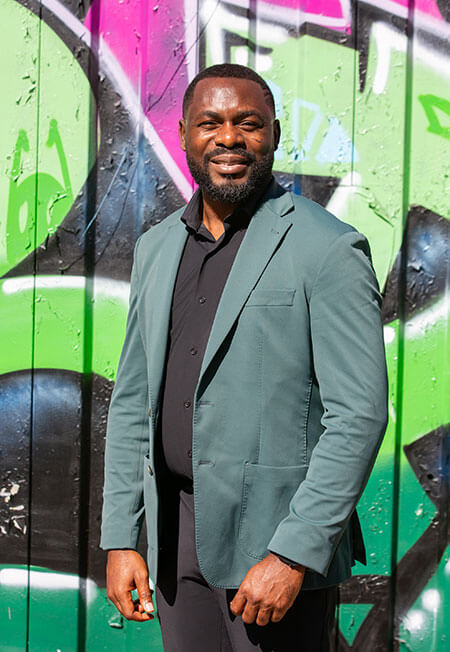
 For more than two decades, Etchu “EJ” Ebott II has solved practical problems across industries.
“I’ve never been drawn to academia for its own sake,” he said. “My entire career has been about application—taking ideas and turning them into solutions that work in the real world.”
That action-forward mindset eventually led him to Robinson’s Doctor of Business Administration (DBA), a three-year degree designed for senior professionals who want to apply academic research to complicated business issues. For Ebott, the program has bridged experience and evidence.
“I realized the biggest challenges in business and policy aren’t just technical,” he said. “They’re human and complex.”
His research focus—the survival of independent pharmacies in a shifting market—started close to home. About one in three pharmacies has shuttered since 2010, particularly in underserved communities like the ones Ebott seeks to support. He wants to know why.
“It’s not enough to have an opinion,” he said. “I want to develop evidence-based strategies that can help them thrive.”
Ebott is comfortable with reinvention. After earning a bachelor of engineering in France in 2002, he spent five years as a civil engineer before applying those skills to sectors including international oil and gas, healthcare, aerospace, and finance.
“They weren’t random jumps,” he said. “Each transition was about learning something new and building knowledge that would make me a stronger, more versatile leader.”
That path accelerated in 2019 when Ebott landed a consulting role with UN-Habitat, the United Nations agency focused on sustainable urban development. The following year, he earned an Executive MBA from the University of Oklahoma. His interest in convoluted systems had deepened, but his technical expertise alone wasn’t enough to spearhead change. His “final mile” is the DBA, which will equip him with a framework for rigorous, research-driven leadership.
Through the program, Ebott has developed what he calls “systematic problem diagnosis”: the ability to take a messy business issue and turn it into clear research questions. Through an especially memorable team project, he and a group of peers discovered what it means to become a “practitioner-researcher.” The students used dialectical theory—a structure for examining pressure between opposing forces—to explore how senior professionals balance academic research with demanding careers.
“It was a turning point,” he said. “That project helped me see my own struggles in a new light. The tension between being a father, executive, and student isn’t a failure of balance. It’s a natural part of living at the intersection of multiple roles.”
Outside the classroom, Ebott serves as chief of BIPOC arts nonprofit MECA Houston and vice president of SOBA Houston; the latter organization serves United States- and Canada-based alumni of St. Joseph College, located in his home country of Cameroon. Those leadership positions connect him to hundreds of Cameroonian community members across the U.S. and abroad. The roles also ground him with perspective and purpose.
“It’s not just about volunteering. It’s about preserving our heritage and supporting one another,” he said. “When I’m navigating the pressure of work and school, my community reminds me why I’m doing this: to create impact that lasts beyond my own career.”
Through the DBA, Ebott has honed the tools and confidence to lead. Now, as he acquires a decades-old pharmacy that will double as his research site, he sees the journey coming full circle.
“The shift in transforming from a practitioner to a practitioner-scholar is powerful,” he said. “I can now take what I know from experience, back it with research, and shape conversations that influence real change.”