

Launches Fundraising Effort for Scholarship in Honor of Michael P. Eriksen
ATLANTA — When Michael P. Eriksen joined the faculty of Georgia State University in 2002, he was charged with directing an Institute of Public Health that would leverage the research expertise of the university’s faculty and its connections with Atlanta’s thriving public health community.
He ended up doing so much more, eventually spearheading the creation of what is now the GSU School of Public Health, where he served as founding dean from 2013 to 2018. In honor of his retirement earlier this year — and in recognition of his impact on public health research, education and practice — the School of Public Health is raising funds to create an endowment for the Michael P. Eriksen Scholarship, which will support graduate students at the GSU SPH with an interest in tobacco control, health behavior and policy.
“Over the course of his distinguished career, Dr. Eriksen has led national and international efforts to reduce tobacco-related illness and death, educated and mentored scores of emerging leaders, and played an essential role in the creation of Georgia State’s nationally recognized School of Public Health,” said Dean Rodney Lyn. “The scholarship that will bear his name is a testament to his extraordinary vision and unwavering commitment to public health education, research and practice.”

Founding Dean and Regents' Professor Emeritus Michael P. Eriksen
Saving Lives Through Tobacco Prevention and Control
Eriksen’s career spanned public health practice as well as academia. He played a critical role in developing U.S. tobacco control policy and developed multiple Surgeon General’s Reports on the health consequences of smoking as director of the Office on Smoking and Health at the Centers for Disease Control and Prevention. He later served as a CDC Distinguished Consultant assigned to the World Health Organization (WHO) in Geneva, Switzerland, where he worked with leaders and policymakers from around the globe to implement tobacco control measures.
Eriksen has advanced the science of tobacco prevention and control as principal investigator for more than $38 million in grant funding, including a $19 million grant issued by the National Institutes of Health in 2013 to establish a Tobacco Center of Regulatory Science at GSU. The grant remains the largest single federal grant awarded to GSU in its more than 100-year history. Eriksen has authored more than 150 scholarly publications, has co-authored seven textbooks and chaired or served on more than 40 student culminating committees.
Building a Nationally Recognized School of Public Health
Under Eriksen’s leadership, Georgia State earned its initial accreditation from the Council on Education for Public Health and developed a full complement of undergraduate and graduate degree programs. It also established the university-level Mark Chaffin Centers for Healthy Development, which focuses on the real-world implementation of evidence-based public health programs.
The school now has nearly 900 students and more 2,000 alumni who are making a difference in the health and well-being of individuals and communities. Among public institutions, it is ranked a top-30 public health program by U.S. News & World Report and is the No. 1 public program in Georgia. The school’s reach extends globally, with projects and partnerships in more than 25 countries on six continents. Since 2006, it has educated more than 100 Fulbright students from around the world.
“My single, overriding goal was to secure the necessary resources, hire the right people and create a culture of pride and success that would establish a sustainable foundation for the School of Public Health for future decades,” Eriksen said. “Looking at the School of Public Health and all that its faculty, staff, students and alumni have accomplished, I believe we have achieved that goal.”
Leadership at Georgia State and Beyond
In addition to serving as founding dean of the School of Public Health, Eriksen served as GSU’s interim vice president for Research and Economic Development from 2019 to 2020. He was named a Regents’ Professor, the highest academic rank a faculty member can achieve within the University System of Georgia, in 2014. He was bestowed the title of founding dean and Regents’ Professor Emeritus upon his retirement.
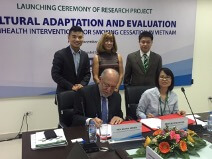
Eriksen has testified before Congress seven times on subjects such as preventing teen tobacco use and has led tobacco prevention and control projects in China and Vietnam.
“Michael was a key member of the 2011 – 2021 strategic planning committee that set the direction and foundation for the university’s strides in research accomplishment and student success,” said Risa Palm, who served as GSU’s senior vice president for academic affairs and provost from 2009 to 2019 and is a professor in the Urban Studies Institute. “He consistently asked key questions and exerted an important influence on the university’s quest for excellence. As both a Regents’ Professor and dean, he was an ideal model of the combination of leader and faculty member.”
Eriksen’s impact extends well beyond campus and includes leadership of GSU’s CDC-funded Prevention Research Center, which focuses on the health and well-being of the metro-Atlanta community of Clarkston. He has testified before Congress seven times on subjects such as preventing teen tobacco use and has led tobacco prevention and control projects in China and Vietnam.
He is the recipient of several awards and honors, including being named a Distinguished Cancer Scholar by the Georgia Cancer Coalition and receiving the CDC’s Charles C. Shepard Science Award for Outstanding Scientific Contribution to Public Health, a WHO Commemorative Medal on Tobacco or Health, and a Presidential Citation for Meritorious Service awarded by former President Bill Clinton.
“Michael has been an invaluable friend, colleague and collaborator during my public health career,” said Rosemarie Henson, chief of staff at the Child Health and Mortality Prevention Surveillance (CHAMPS) program at The Task Force for Global Health. “I have called upon Michael’s expertise time and time again to sort through difficult scientific and policy issues. He is candid and thoughtful, but above all else, he has always been passionate and highly committed to the work of public health.”
— Story by Sam Fahmy