
Growing up “ultra poor” in India, Hindupur “Rama” Ramakrishna shared a 500-square-foot rented house with his parents and eight siblings. His family viewed education as the way out of poverty.
Despite never having earned a bachelor’s degree themselves, Rama’s parents made sure all their children graduated from college and could pursue whatever path they wanted.
“I think that's why I’m interested in supporting education,” Rama said. “The fundamental idea is that people can get to a better position in life.”
To that end, he and his wife Nalini recently established the Ramakrishna Excellence in Teaching Award, a $25,000 gift designated for a Ph.D. student concentrating in management at Georgia State’s Robinson College of Business.

Hindupur "Rama" (right) and Nalini (left) Ramakrishna at a recent Georgia State University President's Society event that recognized their donation
Education as a path to upward mobility worked well for Rama. He earned a B.E. in mechanical engineering at Bangalore University in India in 1972. He relocated to the United States in 1976 to earn an MBA, but the university where he enrolled was not a good fit. So he skipped the MBA and headed straight for a Ph.D. in decision sciences, offered through what is now the Department of Management at Robinson; he completed the program in 1983.
As an engineer, Rama was attracted to business as an applied field.
“Decision sciences opened up broad possibilities,” he said. “It could be technical. It could be non-technical. It could be behavioral.”
Rama has spent his career at the intersection of decision sciences and information systems—teaching and researching at academic institutions such as the Pennsylvania State University and the University of Connecticut. Now in the twilight of his career, and currently a professor of analytics and information systems in the School of Business and Society at the University of Redlands in Redlands, California, he wants to give back and help the next generation in their journey.
Both of Rama’s children are well settled. “I don’t really need to leave any money to my children,” he said. “At some point in time, you need to make a decision. I need to give away the money I have.”
Initially, Rama planned to space out his contribution over the next five years. “[But] my belief is, when you want to do something good, you need to do it immediately,” he said. “So I changed my mind and gave the entire fund so it can be distributed to students right away.”
Since Rama studied management, the award is designated for students within the same academic space. More specifically, it will recognize excellence in teaching because “teaching is just as important as research,” the longtime educator said.
Rama named the endowment in honor of the person who taught him to teach—Harvey Brightman, Regents Professor Emeritus of Managerial Sciences at Robinson. When Rama became a Ph.D. student in the late ’70s, Brightman immediately took him under his wing. Like Rama, Brightman held an engineering degree that provided an unlikely springboard into academia as a business professor.
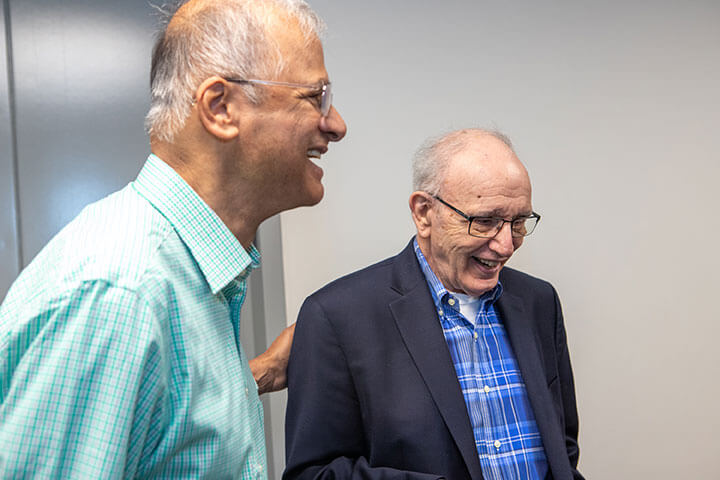
Brightman taught Rama how to adapt his writing; move away from the long, compound sentences typical of British English; and turn down job offers without burning bridges. Brightman even shared his office with Rama as his dissertation approached. Brightman carved out 15 or 20 minutes several times a day, taking his mentee to the cafeteria for coffee and helping him design his dissertation proposal by writing notes on napkins.
Perhaps most importantly, Brightman instilled in Rama a love of and respect for teaching. Brightman began teaching a doctoral seminar on university-level instruction in 1979 with Rama in the inaugural session. Brightman visited classes that his graduate students were teaching and gave them feedback. He became the director of the Master Teacher Program, a 3-day intensive workshop attended by approximately 1,300 faculty members from around the world, and has conducted more than 120 teaching and learning workshops at universities across the globe.
“People who earn a Ph.D. are trained to conduct research but often not to teach. Harvey wanted to address that issue,” Rama said. “I know of excellent researchers who publish in top journals but ignore their teaching responsibilities. Even though they're required to teach, they walk into class and do whatever they want because they don't care. It is unfortunate that more weight is placed on the research component of a professor’s job.”
Brightman’s influence made Rama lean towards teaching and become passionate about helping the next generation of professors. Teaching comes naturally to some people but is a challenge to others.
“For those,” Rama said, “there are resources available to make them be good teachers."