
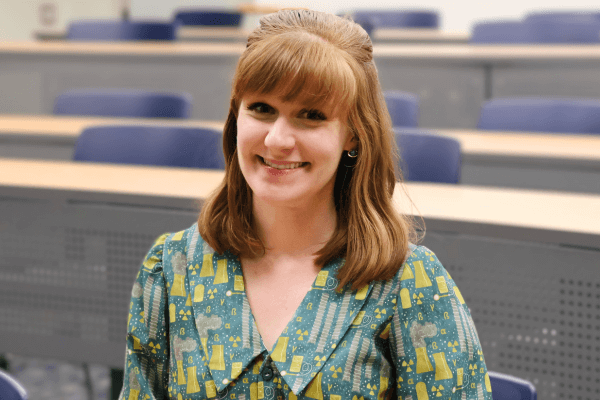
An innovative training board game for radiation safety that DrPH student Lauren Finklea designed as an in-class project has gone on to win an award, become a CDC product and inspire a training for congressional staff that she developed.
Name: Lauren Finklea
Hometown: Denver, N.C.
Undergraduate and master’s degrees and institutions:
I earned my Bachelor of Science in Nuclear and Radiological Engineering and a Master of Science in Mechanical Engineering with a concentration in radiation protection from the Georgia Institute of Technology.
Tell us about your current position and role in public health:
My position is a Physical Scientist in the Emergency Management, Radiation and Chemical Branch within the National Center for Environmental Health at the Centers for Disease Control and Prevention. I work with state and local health departments to develop and test their radiation and other hazard response plans. I also develop software for state and local health departments to use to estimate their response capacity and perform dose assessment to individuals after a radiation emergency.
What led you to choose the Georgia State School of Public Health’s DrPH program?
I knew that I wanted to pursue a doctorate in public health but wasn’t sure where I wanted to go. I had a few colleagues who had recently graduated from the Georgia State School of Public Health with their doctorates, so I talked to them about their experiences. I also met with Dr. Harry Heiman to get the overall vibe of the program to see if it would be a good fit for me. I applied and am so thankful I did. As I’m almost complete with my dissertation, I definitely see the end of this journey and am looking forward to the future.
Tell us about some of your most valuable experiences in the DrPH program.
I’ve had several experiences that I think have been very valuable, but one in particular has continued to move me forward in my career. During Dr. Sheryl Strasser’s “Workforce Development” class, I was able to design an innovative training board game for radiation. Coincidentally, there was an opportunity at work to further develop and refine that game and use it with state and local health departments in a big event with hundreds of federal, state and local partners. That game has since won awards, become a CDC product and has inspired several other innovative trainings, including a training game I was able to develop for educating congressional staff on the importance of public health emergency preparedness. Without the creative and encouraging space I had at Georgia State, I do not believe I would have been able to accomplish this. Lastly, I think my cohort and advisor are truly amazing people, and being surrounded by so many inspiring minds who are driven to help others like me has been the motivation to keep me going.
How is the DrPH program at Georgia State helping prepare you for leadership roles in public health?
As an engineer, I feel I had some soft skills needed for leadership but definitely had room to grow. I feel this program has let me develop my soft skills and find my leadership style while also reflecting on the styles of my fellow classmates. I see the strengths in each of them and learn how to build my best self so that I can be my best leader. While in the program, I was detailed to lead a team of 10 staff during a major reorganization. I kept reflecting back to my leadership class with Dr. Heiman and thinking of our lessons on change management and the different leadership styles. I feel that I was a better leader because of this program and received an award for my leadership during my six months helping the team transition.