
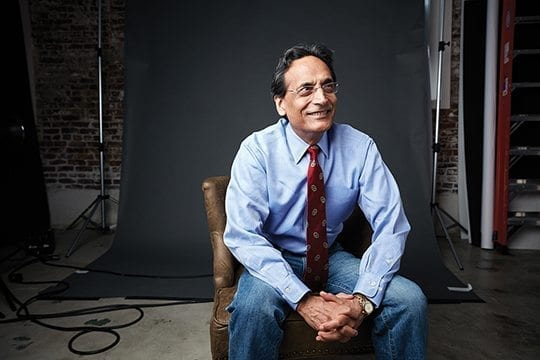
Story by Anna Varela
Satvinder “Pearly” Dhingra sees a world where everybody can be a “citizen scientist.”
Dhingra, a former health scientist at the Centers for Disease Control and Prevention turned entrepreneur, envisions a future where cellphones, smart watches, fitness trackers and other devices will connect with networks of scientists and lay people to allow researchers to make huge strides in improving health for everyone.
Today, many discussions about health start with data gathered the old fashioned way — through random phone calls. Of course, the number of people with landlines is shrinking rapidly. And many people simply won’t answer their cellphone if they don’t recognize the caller’s number.
Dhingra says it’s time to ditch such techniques, which can take more than two years for data to become available.
“You wouldn’t try to run a company on two-year-old data,” he said. “But that’s what we do in public health.” Taking inspiration from the growing number of Americans willing to participate in online market research, Dhingra has been working on an app called Quantextualize — or Q.
Dhingra sees Q as a platform to help re- searchers connect with study participants, and as a tool that empowers individuals who want to track their own health or monitor the condition of an elderly relative.
A social element will connect people with similar health challenges — such as diabetes — with peers who can offer moral support and practical tips. It can also be used to connect to a caregiver or coach. Some may choose to keep their encrypted health record in the system. Users will be able to share as much, or as little, as they want.
“It’s your data,” he said. “That’s your choice.”
Dhingra also envisions traveling nurses in rural areas using the app to be more effective in the field.
Researchers at Georgia State, Duke University and the University of Washington, as well as scientists in Brazil and the Middle East, have tested Q through the summer.
The free Quantextualize app is currently available on desktop platforms.