
CALLING THE SHOTS
If students could get behind those cameras, he figured, that’s where he wanted to be.
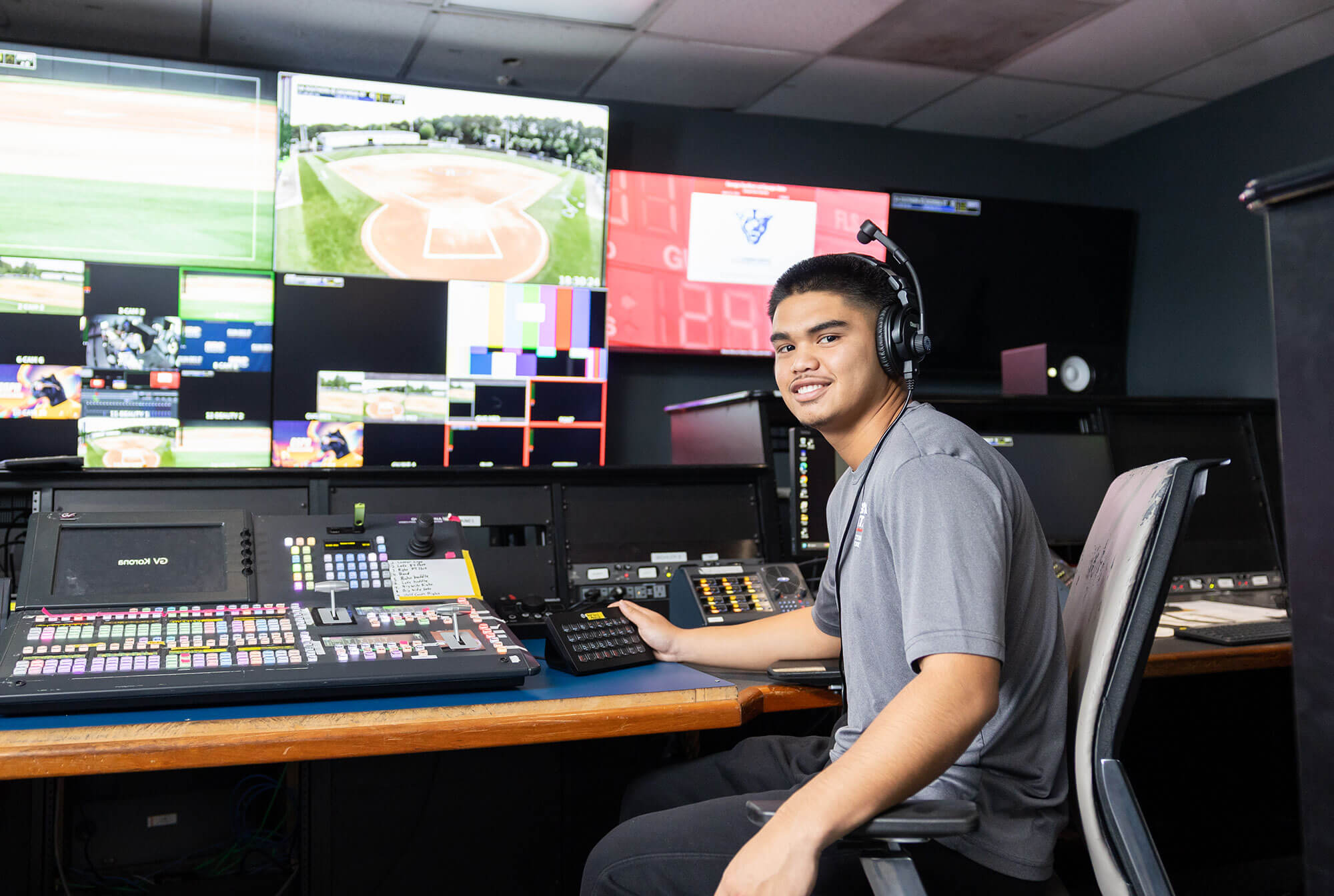
A native of Hawai’i and a rising junior at Georgia State, 20-year-old Ponteras now regularly finds himself behind the camera not only in the Convocation Center, but at the GSU Baseball Complex, at the Bob Heck Softball Complex and on the field at Center Parc Stadium. He’s also transitioned into the control room at Center Parc, the nerve center of every televised Georgia State sporting event that goes out over the ESPN family of networks.
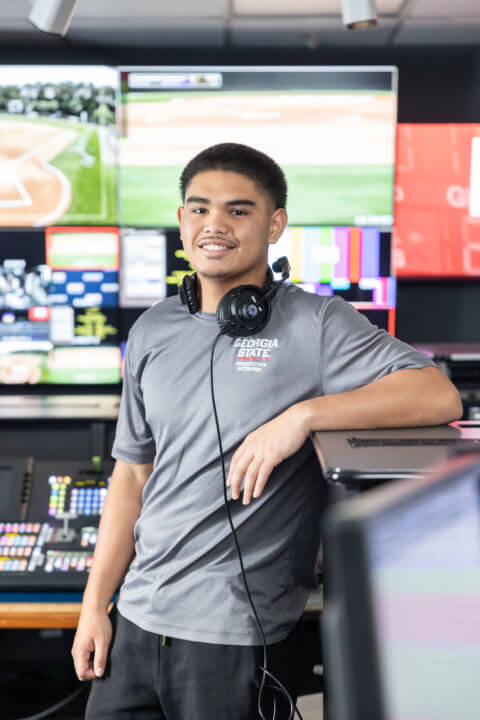
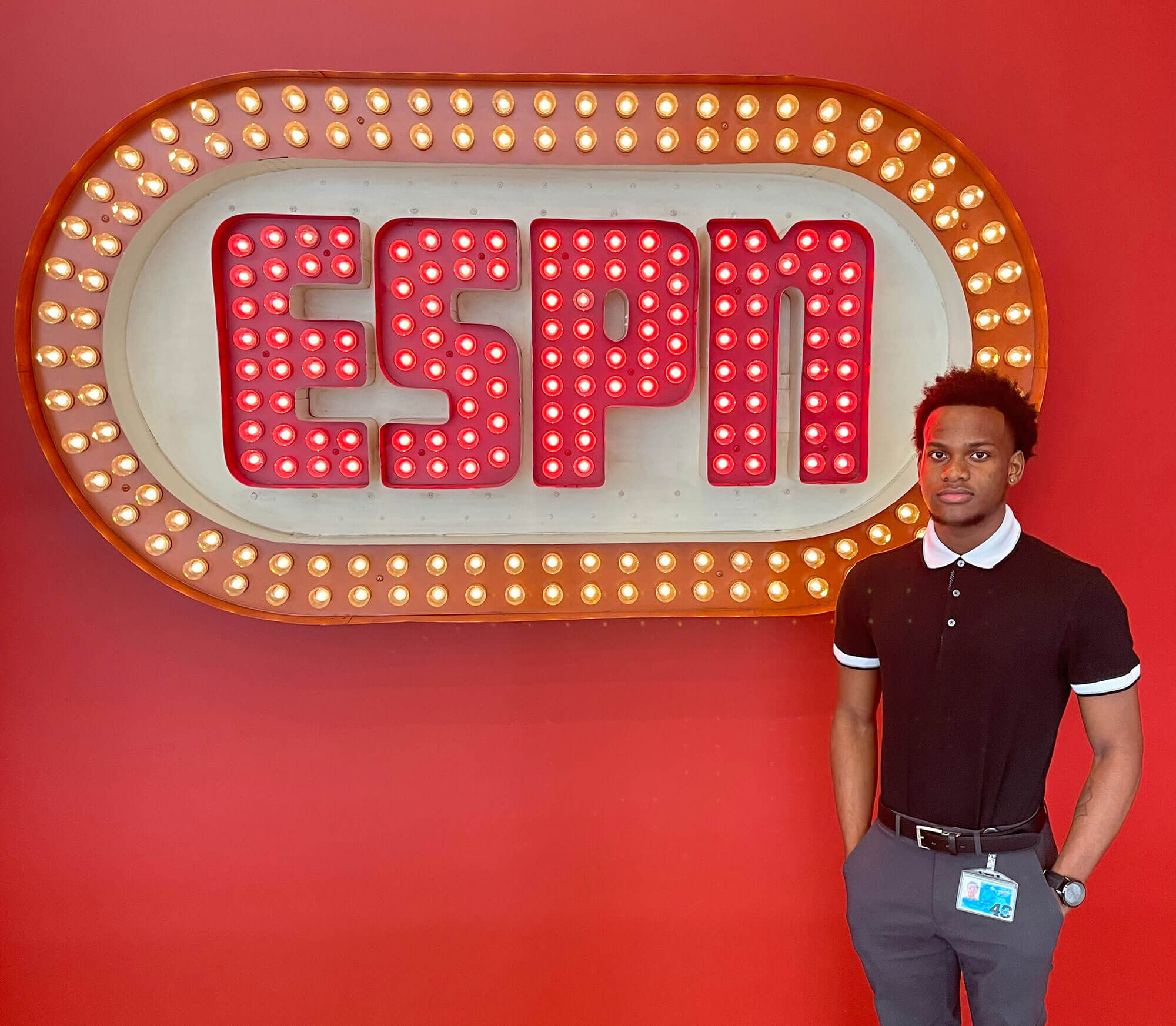
Rising junior Chaseton Ponteras, a film and media major, has had the opportunity to work several positions in production as part of the GSPN program, including camera operator and director.
“My goal initially was exploration,” Ponteras says of getting involved in the Georgia State Production Network (GSPN), the university unit responsible for producing broadcasts of live events and sports programming. “When I joined, I wanted to get some reps behind the camera, and they allowed me to do that. Eventually they allowed me to start directing shows.”
Having enjoyed dabbling in his high school’s on-campus television program, Ponteras came to Georgia State in part for access to the world-class media market Atlanta has become. Majoring in film and media in Georgia State’s College of the Arts, he’s still exploring possible career paths, but as part of GSPN and its feeder club, the Broadcast Experiential Learning Team (BELT), he’s getting access to and experience with all of the same equipment and job responsibilities that go into producing live events.
And he’s putting into practice many of the concepts he’s learning in class.
On-Campus Training
Before joining GSPN and setting apertures and pushing up faders, students at Georgia State join BELT, a student organization that offers training classes, shadowing opportunities and networking with pros in the Atlanta media landscape. There are training sessions on properly wrapping and storing audio and network cables. There are training sessions on how to operate DreamCatcher, the live production platform used at Center Parc Stadium and as many as 45 NFL and MLB stadiums.
When Ponteras asked around about how to get behind the cameras he saw at the Convocation Center, he was directed to BELT, where he met the club’s adviser, Chandler Apple, who’s also the assistant manager for GSPN and its lead engineer.
GSPN and BELT trace their roots back to the rise of streaming television and the creation of the family of ESPN brands that opened the door for fans of smaller schools to watch their favorite teams. Following the siren’s song of broadcast engineering he’d heard while studying at Mercer University, Apple, who has a bachelor’s degree in computer engineering and a master’s degree in software engineering, came to Georgia State in 2021 after a short stint working for a defense contractor.
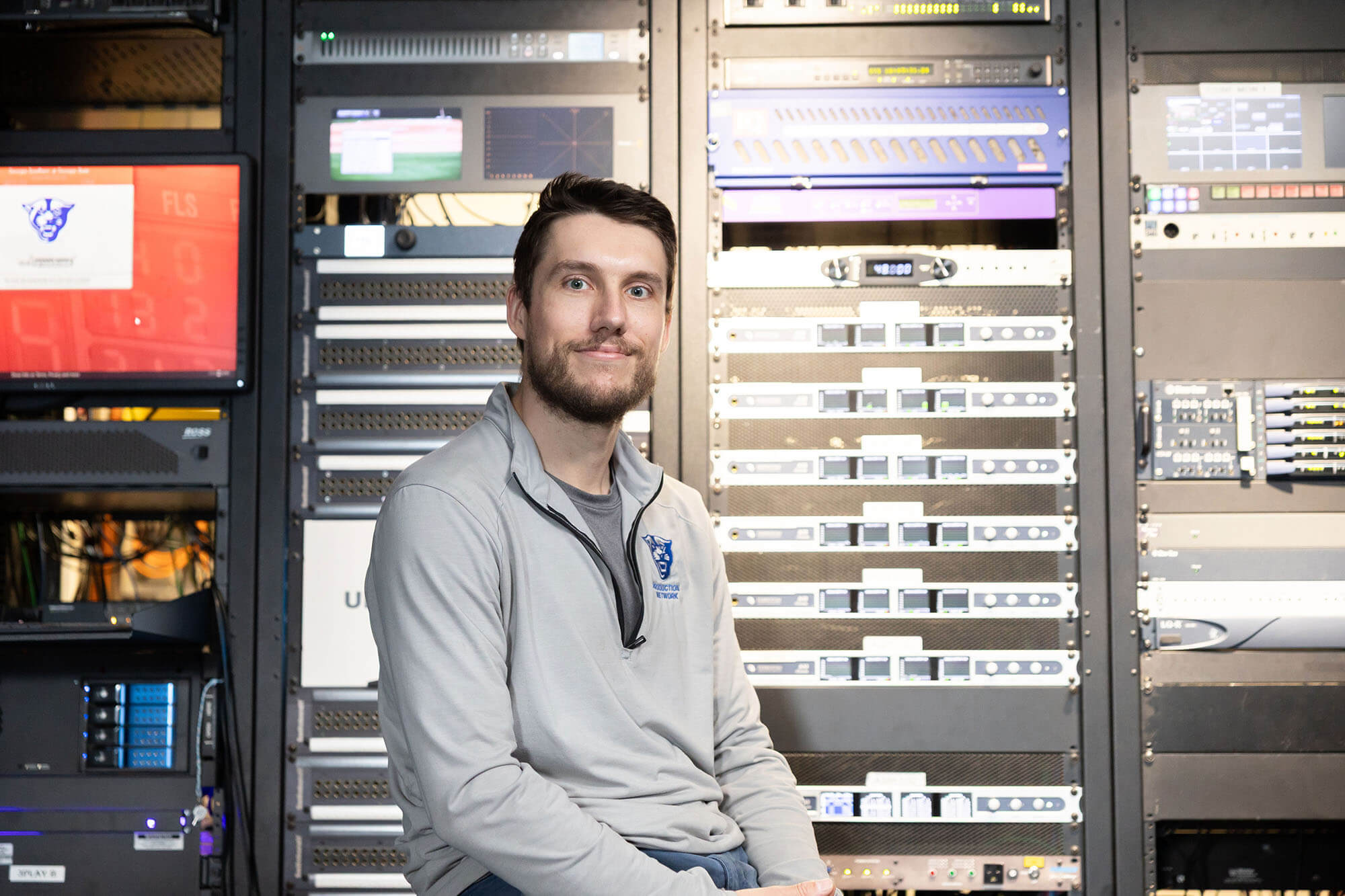
He recalls having some free time after moving to Macon in the week before his first classes started, when a friend convinced him to go to an audio-visual club meeting at the school, which was then beginning its relationship with ESPN.
He was immediately enamored with the technology.
“As soon as I got here to Georgia State, from day one, I was focused on bringing a student-focused program here,” Apple says. “Now, there are over 200 students in BELT, and we have more than 20 student workers working with GSPN.”
Interested BELT members have the opportunity to shadow production crew members on game days and at events like convocation and commencement, watching camera operators work the baselines during men’s and women’s basketball or the sidelines of Center Parc Stadium on fall football Saturdays. It’s a chance for the curious to get a true sense of what the jobs entail and ask questions to learn more.
That’s how Ponteras got started.
Game-Changing
It’s how Corey Alberty (B.A. ’08) got started, too.
With a degree in film and video under his belt, Alberty, a native of the Augusta, Ga., area headed into the Arena Football League as a wide receiver after his time with the Panthers. When it was time to make a career change, he came back to Georgia State and joined GSPN.
“I knew I wanted to do something with sports and television. I knew that,” Alberty says. “And someone asked me one day if I wanted to be a camera operator for a basketball game.”
That was 2017.
One day in early April 2026, Alberty woke up in Boston, traveled to New York City, settled into a hotel and waited for his call time at Madison Square Garden as part of the NBC Sports crew covering the next night’s Knicks-Celtics game.
In the five years since Alberty moved on from the GSPN program, he’s worked as a camera operator for some of the highest-profile events in pro and college sports across the country, including ACC championships, NBA playoffs and the Super Bowl.
He’s held positions with TNT, CBS Sports, the SEC Network and FOX Sports.
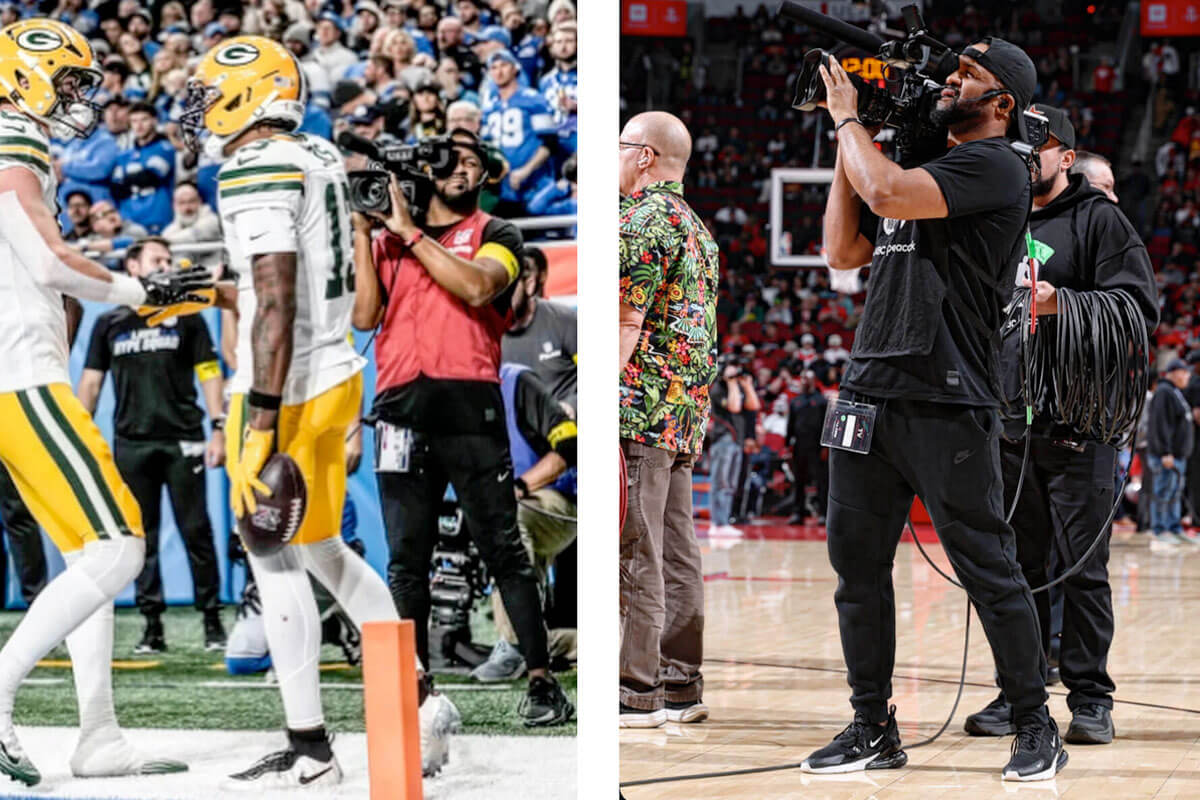
He vividly remembers his first ESPN gig at Mercedes-Benz Stadium.
“I’d never been in the stadium before,” Alberty says. “But it was a full-circle moment. Thanks to all of the things I learned at GSU, I was on the big stage. When athletes say, ‘the more you practice, the game slows down,’ it was like that. GSPN definitely had me mentally prepared for the opportunity when it came.”
GSPN prepared Roger Max (B.I.S. ’22), too. The year he graduated with a degree in media entrepreneurship from Georgia State, he attended a symposium hosted by ESPN in Atlanta. He had no idea it’d lead to the start of his career with the network.
After an on-the-spot interview, Max was called in for a second interview and offered a position as a production assistant at ESPN’s headquarters in Connecticut. He’s now an associate producer for the network’s morning shows, helping to package together stories and highlights from contests the night before and adding context to the shows’ reporting.
“I always had aspirations of working in the sports industry,” Max says. “But I never thought I’d go straight to ESPN from college. Working at ESPN has been nothing but a blessing. It doesn’t feel like a job because it’s something I love doing.”
As a student at GSPN, he worked numerous roles, from operating stationary and handheld cameras to working in the control room.
“All of the things I saw there, it’s the same stuff I’m seeing day to day here,” Max says. “That guidance and mentorship is everything.”
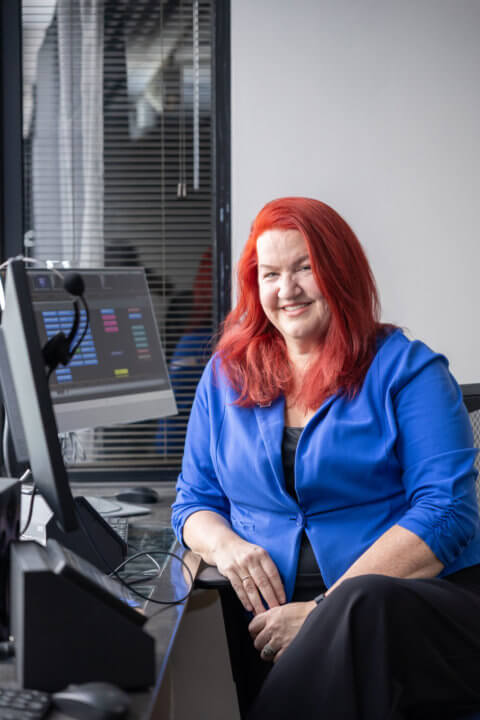
Amy Seals is manager of the Broadcast and Events Services Team, a unit of Georgia State's Instructional Innovation & Technology Division.
And that guidance and mentorship is intentionally designed, says Amy Seals, manager of Georgia State’s Broadcast and Events Services Team, which oversees GSPN.
“We’ve had people who don’t know anything about production come in and be successful,” Seals says.
From operating cameras to designing graphics to patching audio cables to technical directing and directing, she says there are more than 1,300 shifts to be filled across nearly 100 ESPN shows broadcast by GSU in a given year. That’s not including about 50 additional campus events that occur throughout the year, from Atlanta Vibe volleyball and eSports contests to GSU and other schools’ commencements and inauguration ceremonies for area political leaders. Center Parc Stadium will even be home to this year’s Cricket MEAC/SWAC Challenge Kick-Off, which opens the college football season with a contest between teams in the Mid-Eastern Athletic Conference and the Southwestern Athletic Conference. This year’s contest, Aug. 29, features Alabama A&M and Howard.
To augment GSPN’s student staff, some slots are filled by experienced professional Atlanta-area freelancers who not only mentor students but help them make industry connections.
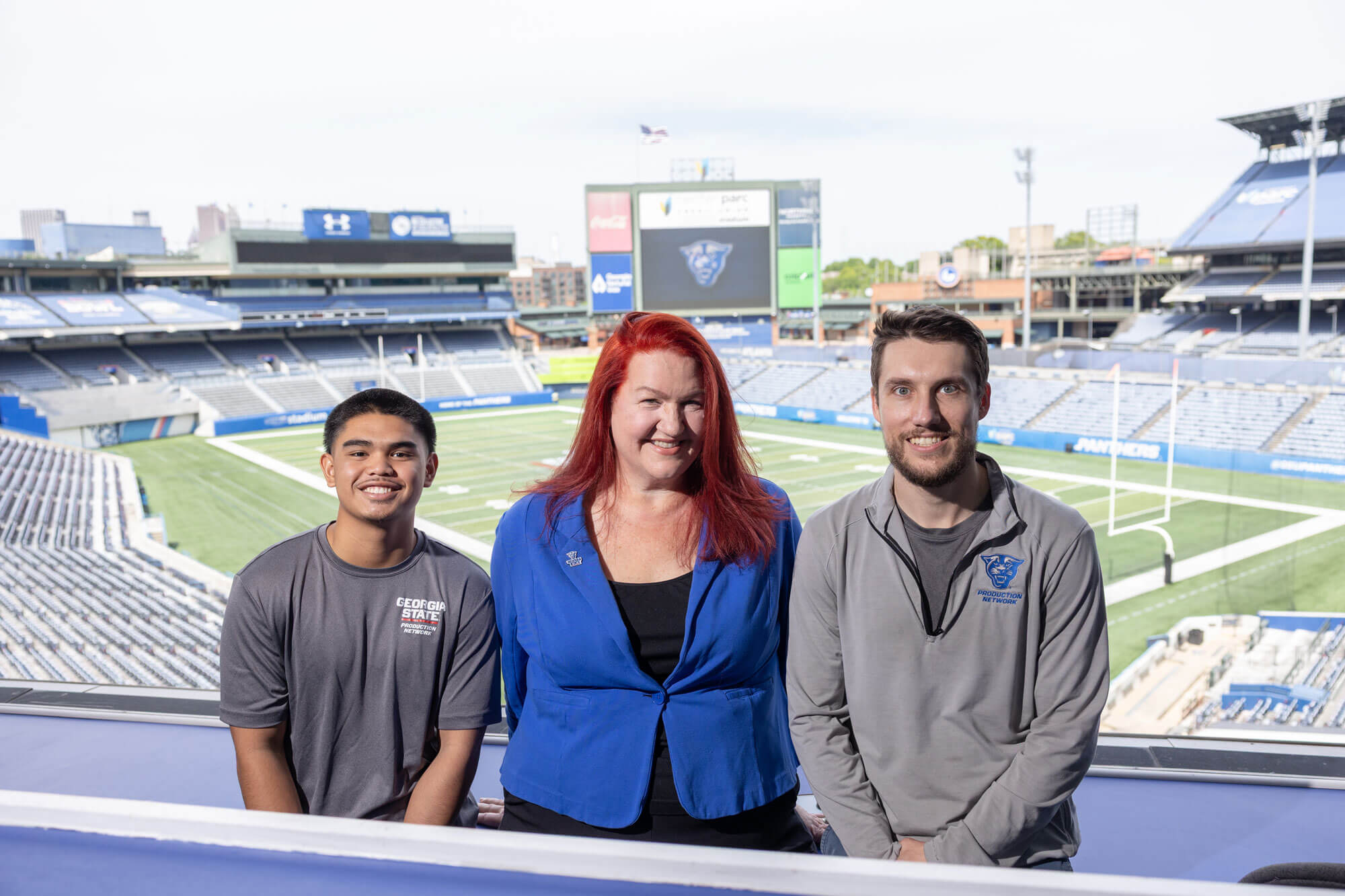
“The BELT club is a great entry into the field, because as students come through and they show they’re interested and they want to develop not only the technical skills but the soft skills — like keeping to a schedule, arriving on time, working with a team — we can train them the right way to do things,” Seals says. “Then they’re prepared for the industry.”
After cutting his teeth operating cameras for court volleyball last fall, Ponteras, the rising junior, has gone on to hold positions involved with the production of nearly every sport Georgia State competes in. This spring, he’s had the chance to direct Panthers baseball games, an exhilarating experience he likens to driving a car at break-neck speeds.
But first there’s preparation. And communication.
Two hours before game time, the crew meets with the producer. What’s the plan for the show? What should be highlighted?
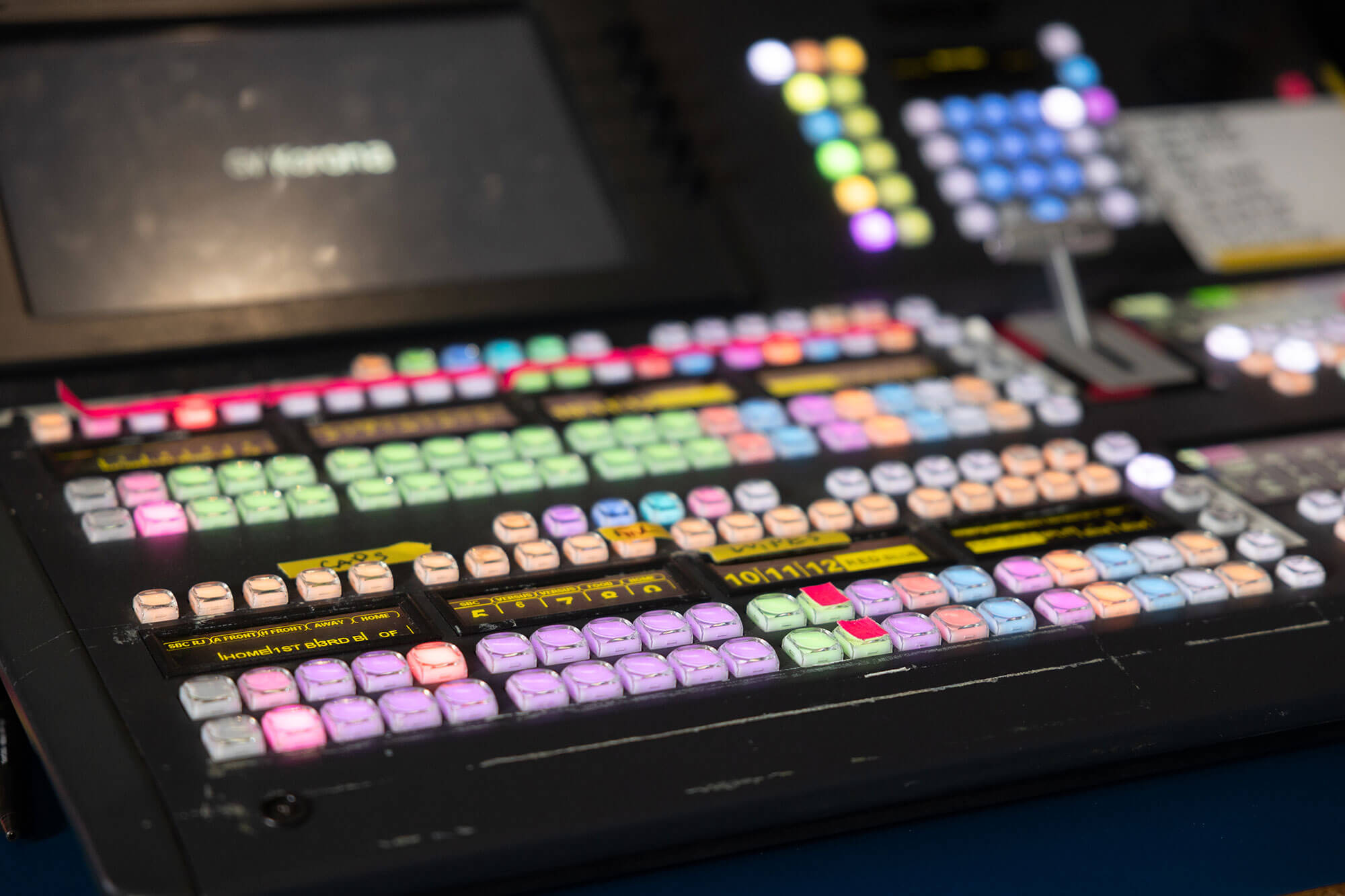
Then, checks of every audio and video feed into the switcher. Now’s the time to troubleshoot.
A short dinner break. The calm before the storm. Then, the countdown. And first pitch.
A flow of audio and visual information. Snap decisions. In control. But sometimes, just barely.
“You’re controlling how what others are doing impacts the show,” Ponteras says. “It’s a big rush.”
Photos by Addison Hill