Stargazing's New Age
Stargazing's New Age
How the big data revolution has changed the way Georgia State scientists make discoveries about weather, faraway planets and the history of the universe.
How the big data revolution has changed the way Georgia State scientists make discoveries about weather, faraway planets and the history of the universe.
At 23, Clovis Simons is a nationally ranked chess player studying engineering at Georgia State University’s Perimeter College.
Kevin Vettickatt (B.S. ’22), an Honors College student and Presidential Scholar, refuses to let setbacks keep him down and has his sights set on an emerging industry.
Transition metal dichalcogenides (TMDCs) possess optical properties that could be used to make computers run a million times faster and store information a million times more energy-efficiently, according to a study led by Georgia State University.
Georgia State University has signed a licensing agreement with DaZen Theranostics Inc., a Delaware-based start-up company, to develop a product that can target cancer cells, function as a contrast agent to improve the visibility of cancer cells during diagnostic imaging and deliver a therapeutic drug to destroy cancerous cells.
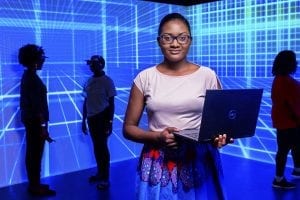
Natsai Nadia Ndebele has a mission. The computer science student wants to change the face of the science, technology, engineering and mathematics (STEM) fields by opening doors for other young women of color.
Commitment to democratic values is the strongest predictor of climate change concern globally, Georgia State University faculty have found in a new study comparing climate change attitudes across 36 countries, including the U.S.
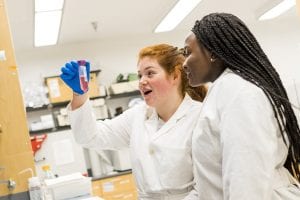
High school students from across the state — and occasionally beyond — can participate in programs that allow them to attend college-level lectures and gain experience in research labs focused on neuroscience, cancer and more.
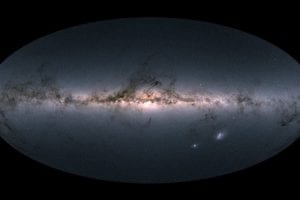
A thin gap has been discovered on the Hertzsprung-Russell Diagram (HRD), the most fundamental of all maps in stellar astronomy, a finding that provides new information about the interior structures of low mass stars in the Milky Way Galaxy, according to a study led by astronomers at Georgia State University.
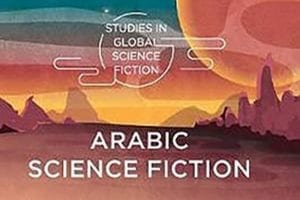
In contrast to America, where science fiction uses technology to examine society, science fiction in the Arabic-speaking world examines society and politics to promote technology, a Georgia State University associate professor of world languages and cultures says in a new book on the subject.