
Media Contact
Kenya King
Director
Public Relations and Marketing Communications
Perimeter College
[email protected]
Clarkston, Ga-When Najma Jama’s flight landed in the nation’s capital this summer, her stomach started churning from excitement and her heart thumped with intensity.
“I was a nervous wreck,” she said, smiling broadly.
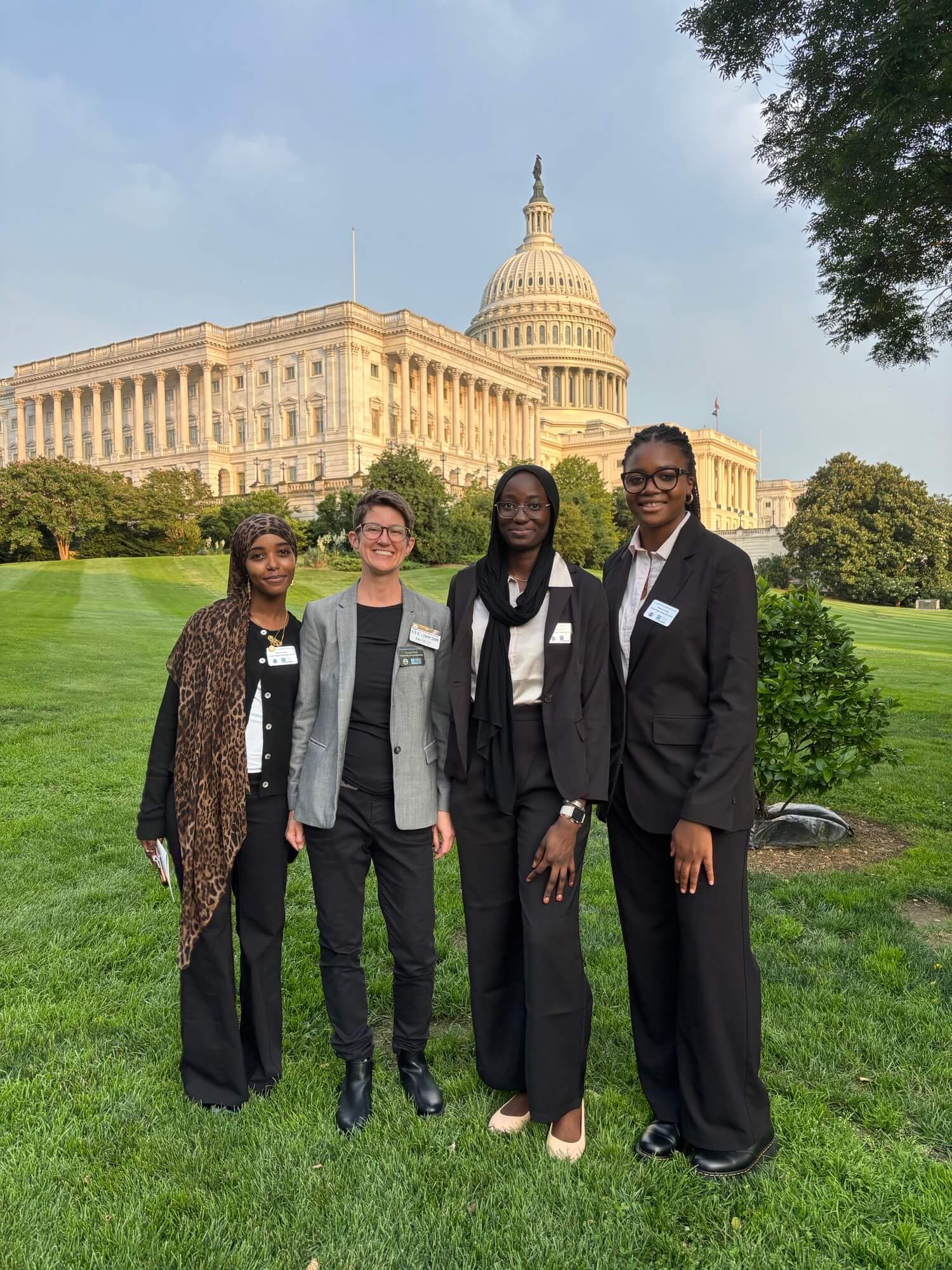
Jama, a sophomore studying engineering at Georgia State University’s Perimeter College, had traveled to Washington along with two other schoolmates, Paloma Hodje and Ndeye Sarr, who were just as nervous.
The trio had been selected as one of only 12 teams in the country invited to an Innovation Boot Camp sponsored by the Community College Innovation Challenge (CCIC) and hosted by the American Association of Community Colleges in partnership with the National Science Foundation.
Months before the competition, the three students had labored between classes, labs and other school activities, to design a low-cost, yet effective, medical device called RoyaNest, which uses passive cooling methods and temperature regulation materials to address the problem of birth asphyxia in babies in low-resource countries.
Nervousness struck again for Jama as she and her engineering pathway teammates, as part of the CCIC boot camp, prepared to pitch their innovative project to a panel of industry and entrepreneurial professionals. Judges selected only three winning inventions-with RoyaNest bringing home the 2nd place victory.
“After the competition, I was convinced that persistence and determination are one of the keys to success," Sarr said.
The Faculty Effect
It’s faculty mentors like Kimberly Kellet, Ph.D., who make opportunities like this possible for enterprising and motivated Perimeter students like Jama, Hodje and Sarr. Kellet, an associate professor of biology and Faculty Associate for Innovation in the Perimeter College Hub for Innovation & Entrepreneurship (PCHIE).
Kellet said that the "three students are all exceptionally bright and able to think in innovative ways, but they were also competing against other exceptionally bright students. I believe their success ultimately boiled down to how well they worked together as a team. They remained calm, and supportive of one another, in an extremely stressful environment.”
“As a mentor, I helped students with effective communication of their ideas-I gave feedback on their application, poster and pitch presentation; and also assisted in the "customer discovery" process - connecting them with professionals who could give them feedback about the potential need for and uses for their device.”
Kellet added that she especially enjoys mentoring two-year college students for experiences like these.
“It can be more difficult for students who attend non-residential college campuses to get involved, but it so important that we do our best to provide opportunities for them to engage in campus life and extracurriculars and support them in their decision to pursue these experiences.”
A year before the RoyaNest win, Janna Blum, Ph.D. mentored a team of Perimeter students who participated in the annual CCIC, bringing home the prestigious 1st place trophy for their design of a self-administered Pap test, called Gorginea Care. Blum is a professor of chemistry and program coordinator for MESA, the Mathematics, Engineering, Science, Achievement at Perimeter.
“I love helping students shine...and want the world to see them the way I do: creative, talented, and full of unique perspectives that deserve recognition," Blum said.
“I believe our students succeed on national stages because they bring passion, authenticity, and technical skill to their projects.”
And, as Blum shared, sometimes winning comes with sacrifice-for both the students and faculty mentors like herself.
“My son has severe special needs and medical complications that make travel especially difficult,” Blum said. “Last year, my entire family came together so I could go, my mom and daughter traveled with me to D.C., while my husband cared for my son back in Atlanta. Even with those challenges, the reward of working with these students makes the effort more than worthwhile.”
Students like Jama, Hodje and Sarr recognize the commitment.
“We cannot stress enough how grateful we are for Dr. Blum and Dr. Kellett’s commitment, support and assistance throughout this process,” Sarr said. “They have guided us all the way through and most definitely made this easier for us.”
What’s Next for RoyaNest?
Now, with the CCIC experience behind them, the Perimeter RoyaNest team is focused on developing their medical device even further. Plans are to do more research, seek a patent and get a prototype.
“We are aware of how much this device is needed in low-resource countries around the world, therefore, we will do our best to work on these things as soon as possible,” Sarr said.
She added that the entire experience of competing and winning has been a big boost to her belief in doing big things.
“It’s so fun and rewarding to see students grow during these experiences, especially when you see the self-confidence they gain,” Kellett said.
“You can really imagine them going on to accomplish so much and become world-changers.”
Story by Kysa Anderson Daniels