
Media Contact
Amanda Dobbs
Associate Director, Public Relations and Communications
Office of the Vice President for Research and Economic Development
[email protected]
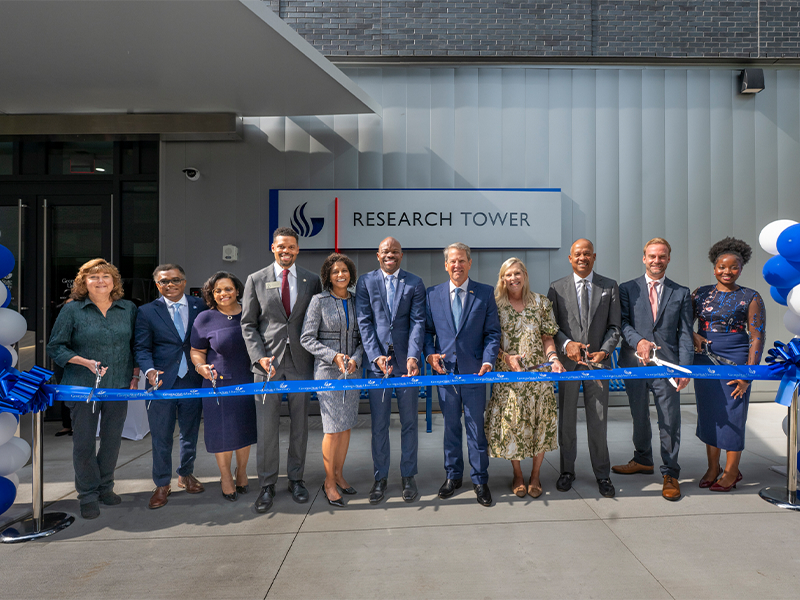
ATLANTA — Georgia State University officially opened its new Research Tower today with a ribbon-cutting ceremony attended by top officials from the state of Georgia as well as university leadership, students, faculty and staff. The opening of the nine-story, 155,000-square-foot facility marks a significant milestone in Georgia State’s continued investment in research, innovation and student success.
The Research Tower offers classrooms, a large lecture space and teaching labs on the first two floors, with the middle floors housing research space for faculty, including researchers from the university’s Institute for Biomedical Sciences. The top-most floors are currently set up for future expansion.
In his remarks at the ceremony, Gov. Brian Kemp highlighted the impact the new facility will have on both the university and the broader community.
“We’re very excited about this project and others at Georgia State because it helps contribute to a great workforce, which makes it easy for me to be able to sell this state to a lot of folks who want to hire new college graduates, and that is my main mission in life,” Kemp said. “It’s not just a new asset for GSU. It’s an asset for our entire state.”
Over the past decade, Georgia State has invested more than $2 billion in research expenditures, with annual research expenditures nearly tripling since 2010. This continued growth has increased demand for modern research facilities to support expanding academic programs, attract top researchers and students, and advance collaborative scholarship.
Georgia State President M. Brian Blake noted that the facility will help meet growing demand for modern research infrastructure while strengthening Georgia State’s ability to attract top faculty, researchers and students.
“This building represents another important chapter in the university’s growth as an urban research institution and, importantly, it creates new opportunities for the students who are at the heart of everything we do,” Blake said.
In addition to serving students and faculty, the Research Tower further strengthens Georgia State’s role as a driver of economic growth in the region. According to a study released by the University System of Georgia Aug. 13, Georgia State generated $3.48 billion in economic impact on metro Atlanta in fiscal year 2025, representing an 8.1 percent increase over the previous year. The new facility will help sustain that momentum by supporting further research activity, workforce development and innovation.
For 30 years, Georgia State has held the Carnegie Foundation’s highest ranking for research activity, a distinction shared by only a select group of universities in the nation. Through the Office of Research and Economic Development, the university continues to foster a research environment where collaboration thrives and researchers are empowered to translate and share knowledge that creates meaningful impact.
Provost and Executive Vice President for Academic Affairs Nicolle Parsons-Pollard emphasized the future impact of the work that will take place in the new tower.
“This building gives Georgia State something incredibly valuable: the space and the tools to imagine what comes next … and then to make it happen,” she said.
Government officials on hand for the event included Kemp, his wife First Lady Marty Kemp, state Rep. Phil Olaleye (D-Atlanta) and Regent and former Board of Regents Chair T. Dallas Smith (B.B.A. ’86), a university alumnus. Representatives from the university included Blake, First Lady Dr. Bridget Blake, Parsons-Pollard, Executive Vice President and Chief Operating Officer L. Jared Abramson and Vice President for Research and Economic Development Donald Hamelberg (Ph.D. ’01), among others.
After the ribbon-cutting ceremony, guests toured the facility and learned more about the teaching, research and collaboration spaces designed to drive innovation and discovery.
For more information about Georgia State University, visit www.gsu.edu. For more about Georgia State University research and its impact, visit research.gsu.edu.