

As she walked into the Georgia State University College of Law building for her first week of class, Rejess Marshall (B.B.A. ’10/MBA, ’20/J.D. ’26) suddenly felt out of place. For the first time, the expressive streetwear that had always reflected her personality and creativity did not seem to conform to a conventional legal environment. But at the same time, she wasn't sure if she wanted to fit in.
Rather than suppress her own style and culture, Marshall saw an opportunity to create something new.
That idea became Urban Juris, an apparel company with a vision to “blend the professionalism of the legal world with the creativity and individuality of streetwear.”
Created alongside co-founders Alayah Washington (J.D./MBA ’26) and Aliana Stanley (J.D./M.P.A.’26), Urban Juris is an effort to reimagine what the legal profession could look like culturally and aesthetically. Marshall, who serves as the brand’s founder, creative director, and day-to-day operator, drew on her interest in fashion and branding to build a company that merged legal academia with contemporary culture.
“In the early days, we bootstrapped everything ourselves,” she said of the team’s relentless work ethic. They created designs themselves, packed orders together, and spent countless hours discussing strategy, growth and the future of the brand.
Marshall still remembers a time she felt distanced from the world of advanced degrees and professional careers. Growing up, she did not have many examples of people pursuing graduate education within her immediate circle. Friends talked casually about parents who were doctors, lawyers and executives, but those paths felt like something meant for other people rather than herself.
“That world didn’t feel like mine at the time,” she said. “But I still put J.D./MBA as my objective on my resume. I didn’t fully get it yet, I just knew I wanted credibility in business.”
Over time, that vision came into clearer focus. Marshall earned her bachelor’s degree in business administration at Georgia State University and returned to pursue an MBA in human resources and behavioral management. She grew fascinated by how businesses operate behind the scenes, structuring business deals, growing strategically and building a scalable foundation.
In 2018, while still working on her MBA degree, Marshall took the LSAT, thinking she may pivot to the dual degree program at Georgia State Law. A global pandemic and a job relocation to Orlando, Fl. delayed those plans, but when Marshall eventually revisited the idea of law school, she chose to return home to Atlanta and become a Triple Panther.
“Georgia State just made sense. It was affordable, innovative and connected to the city I already call home,” she said. “The part-time program gave me the chance to chase a goal I’ve had for almost 20 years without pressing pause on my career."
Marshall attended classes four nights a week while continuing to work full-time, balancing professional responsibilities with the demands of legal education. Having already completed her MBA while working full-time, she understood the discipline required, but law school introduced an entirely different level of rigor.
“Law school raised the stakes to another level. It’s like learning to read and write all over again,” she said.
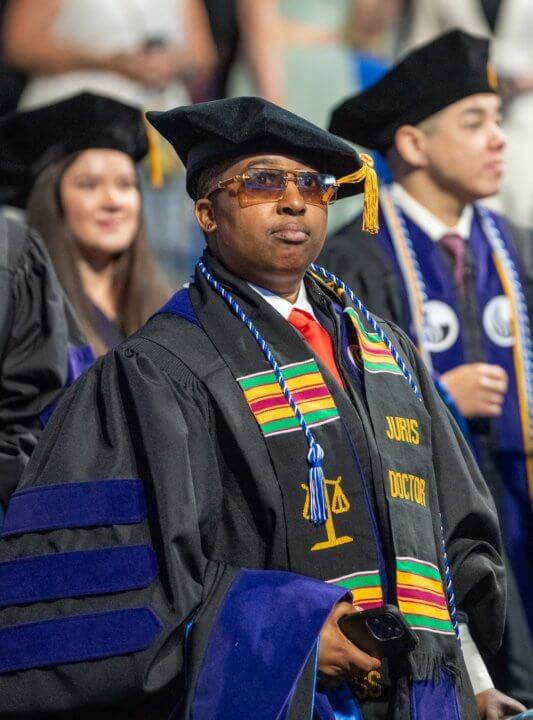
“Georgia State Law just made sense. It was affordable, innovative and connected to the city I already call home,” she said. “The part-time program gave me the chance to chase a goal I’ve had for almost 20 years without pressing pause on my career.”
Undeterred by the challenge, Marshall deepened her involvement in the law school. She completed dual concentrations in Entertainment, Media and Sports Law and Intellectual Property. Marshall also participated in the NBA Trade Deadline Competition, where she strengthened her understanding of salary cap management, collective bargaining agreements and the structural side of professional sports transactions.
For her hard work, she was selected as a recipient of the National Association of Minority and Women Owned Law Firms (NAMWOLF) Joel Stern Diversity, Equity & Inclusion Pipeline Scholarship and the Gate City Bar Association Scholarship. Beyond financial support, the scholarships presented opportunities to build her professional networks.
Marshall also sought opportunities to build on what she already knew about starting and running a business. She joined the Community Development and Entrepreneurship Law Clinic (CDELC), where she supported clients like small business owners and cooperatives, seeing examples in them that mirrored her own journey as a founder and entrepreneur.
Marshall helped small businesses organize their operating documents and foundational agreements and supported cooperatives drafting bylaws and governance matters.
“Working with the CDELC expanded my understanding of entrepreneurship itself,” she said. “As a business owner, I learned the importance of not just how to operate a business, but also the different legal structures and organizational models available."
Faculty members supporting the clinic quickly recognized the combination of business experience and practical perspective Marshall brought to the work.
“Rejess distinguished herself through her strong entrepreneurial mindset, professionalism and commitment to community and client service,” said Susan Chase, co-director for the CDELC. “What stood out most was her enthusiasm and ability to connect legal strategy with broader business goals: a skill that will serve her well as she continues to grow her business, Urban Juris.”
Today, Marshall’s professional interests center on transactional law at the intersection of business and technology. She focuses on startup formation, fundraising, operational strategy and intellectual property matters involving trademarks and copyrights. The work feels like a natural extension of the industries and creative spaces she already loves—fashion, music, technology and entrepreneurship.
Long term, Marshall sees Urban Juris growing beyond an apparel company. Her vision includes events, educational initiatives, media, and philanthropic work centered on increasing civic engagement and expanding access to legal careers for people who, like her, may not initially see themselves reflected in the profession.
“Our long-term mission is rooted in empowerment,” she said.
As Marshall continues building both her legal career and her business, she remains focused on creating a life that leaves room for ambition, creativity and personal fulfillment at the same time.
“I don’t believe in choosing between working hard and enjoying your life,” she said. “You can do both if you’re intentional.”