
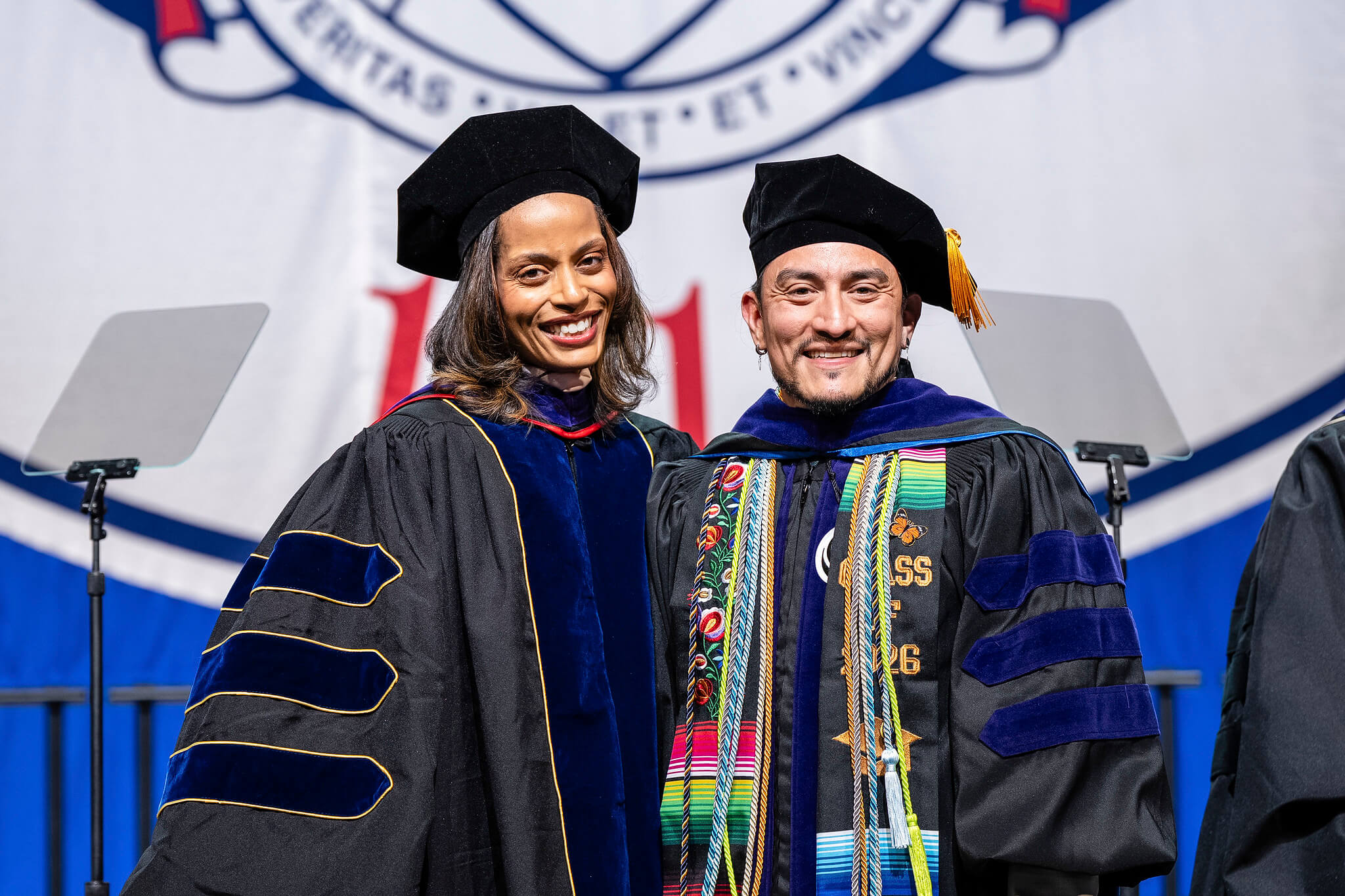
Some people know early on that they want to follow a career path focused on helping people through difficult times. For Elliot Lepe (J.D. ’26), he first believed that path would lead to medical school, but an unexpected brush with the legal system prompted him to study the law.
Lepe earned a Bachelor of Science degree in biology from Valdosta State University to prepare for a career in medicine. As he reflected on his path after graduation, his interest in legal advocacy grew stronger. “My brother's criminal legal case, and the uncertainty my family felt, confirmed for me that I wanted to learn about the law and help people in times of need,” he said.
Looking for practical experience in the legal field, Lepe began working as a paralegal for the Wallace Law Group in Valdosta, focusing on workers’ compensation and conducting legal research. He also worked for the Southern Poverty Law Center in Atlanta, where he supported multilingual client outreach.
“I am drawn to advocacy for people and organizations navigating complex legal systems where the stakes are high, and the outcome can meaningfully affect their lives,” he said.
When it came time to evaluate law schools, Lepe wanted to attend an institution where commitment to diversity was more than just a buzzword. At Georgia State University College of Law, he saw a clear alignment with his values reflected in college leadership and student life.
“I saw a genuine and intentional commitment to diversity,” he said. “The leadership demonstrated a sincere effort to cultivate an environment that values diversity of age, race and cultural background.”
Lepe found community through organizations including the Latin Caribbean Law Students Association, which created spaces where students from similar backgrounds could support one another and pursue shared interests. Lepe also joined the Student Trial Lawyers Association, National Lawyers Guild, American Constitution Society, Student Health Law Association and First-Generation Law Students Organization.
Lepe found his most significant leadership roles through the Criminal Law Society and Immigration Law Society. As vice president of both organizations, he poured his efforts into meaningful work aimed at educating fellow students about experiences they may have little familiarity with, such as incarceration and deportation risks.
Through the Criminal Law Society, Lepe and CLS President Raphaëla Áleman (J.D. '26) organized programming focused on the realities people face after incarceration. One event challenged participants to navigate simulations of reentering their community after serving a sentence. Participants had to make decisions involving transportation, housing, employment and post-sentence restrictions, such as house arrest, that continue to affect daily life long after release.
“The interactive format helped students better understand how difficult reentry can be, even after a person has completed their sentence,” he said.
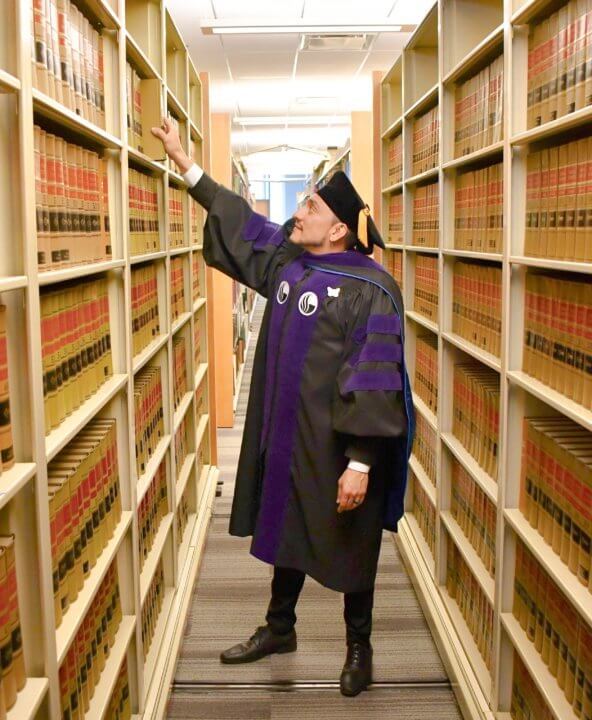
Lepe credits Professors Cortney Lollar, Emily Torstveit-Ngara and Carolina Antonini with influencing his commitment to immigrant justice work and community-centered advocacy. Photo courtesy of David Ramirez.
He placed a similar emphasis on practical advocacy and public education in his work with the Immigration Law Society. Lepe partnered with ILS President Nancy Ramirez (J.D. ’26) to organize “Know Your Rights” presentations open to all students on campus, familiarizing them with ways to safely exercise and articulate their constitutional rights in interactions with law enforcement personnel. Attendance reached 70 participants, making it the largest turnout in the history of both the Immigration Law Society and the student chapter of the National Lawyers Guild.
These efforts did not go unnoticed. In spring 2026, the Immigration Law Society was awarded “Student Organization of the Year," earning recognition for the kind of community-centered advocacy and collaboration that defines the organization's work. For Lepe, the award represented not only successful programming, but the kind of inclusive leadership environment that first drew him to Georgia State Law.
“Winning ‘Student Organization of the Year’ for the Immigration Law Society was a true honor,” he said. “I am proud to have witnessed, served and supported an institution where accomplished women of color were not only present, but leading.”
Beyond his presence across student organizations, Lepe also developed a reputation among faculty for approaching difficult issues with thoughtfulness and clarity.
“Elliot brings an openness and genuine curiosity to every conversation and interaction he has,” said Professor Cortney Lollar, director of the Center for Access to Justice. “He not only thinks creatively about how to engage with the law, he is always thinking about the practical impact a law will have on people’s lives.”
Faculty mentorship helped sharpen Lepe’s interests in “crimmigration”— the intersection of criminal and immigration law — and broaden his understanding of advocacy across legal fields. Lepe credits Professors Cortney Lollar, Emily Torstveit-Ngara and Carolina Antonini with influencing his commitment to immigrant justice work and community-centered advocacy.
“They collectively inspired me and equipped me with the tools to serve my community and pursue immigrant justice at a time when it is especially critical,” he said.
Even as criminal and immigration law remained central interests, Lepe began recognizing similar questions of accountability and human impact in other areas of practice. His experience in Torts and Constitutional Torts unexpectedly reshaped his professional trajectory. The field’s focus on addressing harm matched the same human-centered concerns that first drew him toward the law.
“What resonated with me most was how my professor, Kelly Timmons, connected doctrine to real-world cases, outcomes and human consequences,” he said. “Her classes helped me see that advocates, judges and juries do not make decisions in a vacuum.”
This new perspective led him toward a post-graduation role with Swift, Currie, McGhee & Hiers, LLP, but for Lepe, the transition does not feel like a departure from his earlier interests. “I became interested in the way tort law sits at the intersection of facts, people, institutions and accountability,” he said.
For faculty members like Lollar, that ability to connect legal doctrine with its real-world consequences consistently distinguished Lepe both in and outside the classroom.
“He is unfailingly kind, yet he never hesitates to speak the truth as he sees it, and to name individual and systemic injustices, even when others are reluctant to do so,” she said. “Elliot is a cornerstone of the GSU legal community, and I have no doubt he will be a moral anchor in whatever legal community he finds himself as he transitions into practice.”