
Media Contact
Sam Fahmy
Director of Communications
School of Public Health
[email protected]
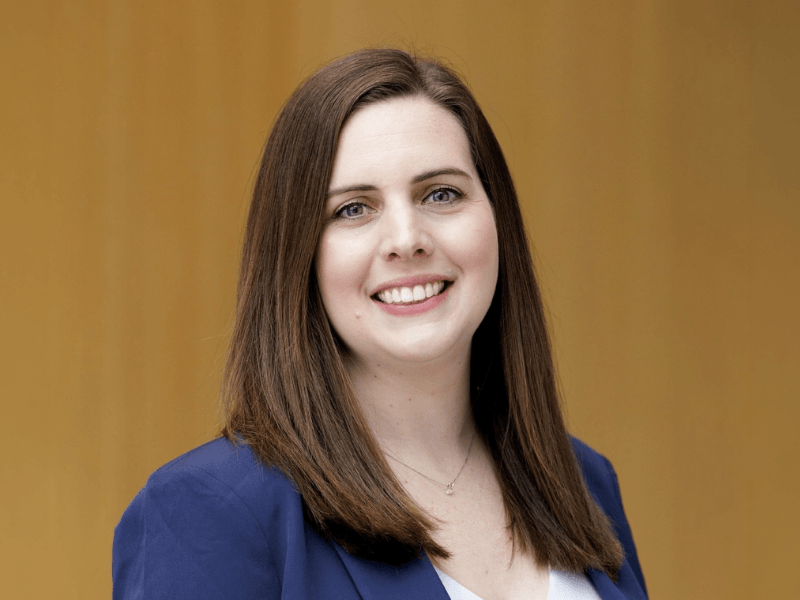
ATLANTA/BOSTON — Hayley Hamilton (MPH '17) found her path in public health while searching for a career that aligned with both her interests and values. As an undergraduate psychology major at the University of Georgia, she was still figuring out her next steps when she enrolled in an introductory public health course during her senior year.
The class — and an inspiring teaching assistant pursuing a Ph.D. in public health — sparked something new.
“Public health really stood out to me,” Hamilton said. “I’ve always been passionate about health, but I also knew I didn’t want to go into medicine or nursing.”
That realization eventually led her to pursue a Master of Public Health at Georgia State University’s School of Public Health, where she graduated in 2017 with a concentration in Health Promotion and Behavior. Today, Hamilton works in healthcare communications at Boston Medical Center in a role that blends public health knowledge with strategic storytelling and employee engagement. Her path is a reminder to prospective students that public health careers are rarely one-size-fits-all.
“I’ve never seen myself as someone with a completely linear career path,” Hamilton said. “And that’s one of the great things about public health. It can take you in so many different directions.”
Why Georgia State Stood Out
For Hamilton, choosing Georgia State came down to practicality and fit. Having grown up in metro Atlanta, she was drawn to the university’s urban location, affordability and flexible scheduling.
“Georgia State checked all my boxes,” she said. “I wanted the affordability of a state school, and I loved being in the city. The flexibility was also huge for me because I worked part time throughout the program.”
Evening classes allowed Hamilton to balance coursework with work responsibilities, which made graduate school financially and logistically manageable. But the biggest difference between graduate school and her undergraduate experience was the greater sense of purpose she felt.
“Grad school was a whole new world for me,” Hamilton said. “It was the first time I felt like my passion and education were fully aligned. I was excited to be there.”
Learning Beyond the Classroom
That enthusiasm translated into meaningful relationships with faculty and student support staff. Hamilton credits faculty members such as John Steward and Rodney Lyn, who later became dean of the school, with helping shape both her academic interests and career direction. She completed her capstone project with Steward, whose focus areas aligned with her interests in the built environment, chronic disease prevention and obesity prevention.
Building a Career at the Intersection of Health and Communications
Faculty connections helped introduce her to an ORISE Fellowship opportunity at the Centers for Disease Control and Prevention after graduation, where she gained hands-on experience in both research and communications. That role helped shape her professional interests and later led to a contractor position supporting digital and social media for the CDC’s Office on Smoking and Health.
“That experience solidified my desire to really focus on marketing communications,” she said. “I found there is this world in which I can bring together my public health background with the creative side of my personality.”
Since then, Hamilton’s career has continued to evolve. After relocating to Boston with her husband in 2021, she transitioned into healthcare communications roles, first with Mass General Brigham and later with Boston Medical Center.
At Boston Medical Center, Hamilton supports internal communications and employee engagement, helping tell stories about organizational initiatives and new technologies that support patient care.
“A lot of what I do is helping build employee culture and organizational reputation,” she said. “It’s making people feel good about coming to work so they can better serve patients.”
Though her day-to-day work may not look like a traditional public health job, Hamilton said the mission remains deeply aligned with her values. “Even if I’m not in the weeds of public health every day, I’m still supporting organizations that are improving population health and health equity,” she said.
Staying Connected and Giving Back
Beyond her professional work, Hamilton remains closely connected to Georgia State as a member of the School of Public Health Alumni Board. She mentors students, participates in panels and continues supporting the school through philanthropy.
“I had such a great experience that I wanted to give back and help current students see where their public health degree can take them,” she said.
Her biggest advice for prospective students? Don’t limit your view of what a public health degree can do. “Don’t be afraid to think outside the box,” Hamilton said. “There isn’t one linear career path in public health, and there are a lot of opportunities to go in many different directions.”
She also emphasizes the importance of networking — something she says played a major role in launching her career. For Hamilton, networking meant getting to know professors, attending events, speaking with professionals after panels and being intentional about building relationships.
“Getting close with one or two professors and building that network completely changed my experience when looking for jobs,” she said. “Those connections can support you years down the road.”
For students considering an MPH, Hamilton’s story offers reassurance that public health is bigger than any single employer, title or career track. Whether working in policy, nonprofits, healthcare systems or communications, the skills developed in an MPH program can travel far.
Across every interview and industry she has explored, Hamilton says one thing has remained consistent: “Having an MPH has always been viewed as a major positive.”