
Media Contact
Kenya King
Director
Public Relations and Marketing Communications
Perimeter College
[email protected]
Empowering Students Through Research and STEM
For more than three decades, Margaret Major has quietly transformed the educational landscape for students at Georgia State University’s Perimeter College—not only through her teaching, but by expanding what students at a two-year institution can imagine for themselves.
Now, her impact is recognized beyond campus.
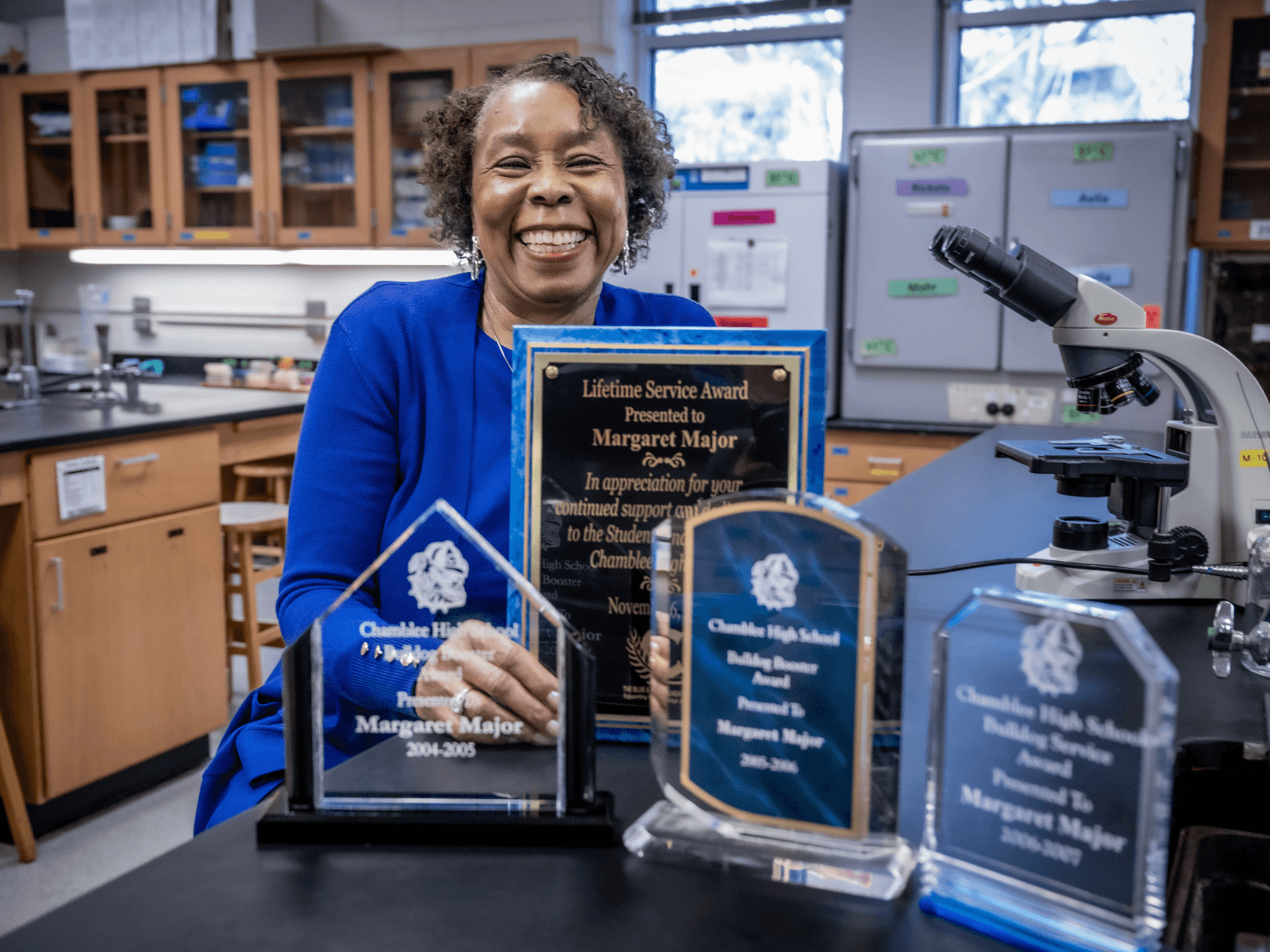
The Chamblee High School Blue & Gold Foundation recently honored Major with its Lifetime Service Award and inducted her into their hall of fame, recognizing decades of volunteerism and dedication to the school community where her children once studied.
“Margaret Major is a legend at Chamblee High School,” said Cheryl Finke, former school principal and current director of the school’s Blue & Gold Foundation.
“Her contributions span decades and touch nearly every corner of our school, from chair of the Chamblee Charter High School Governance Board to the President of many booster clubs, to volunteering wherever the school needed her.
“She was everywhere—quietly, consistently [and] wholeheartedly supporting our students, staff and families. Her legacy is woven into the very fabric of Chamblee High School. The school will be forever grateful for her legacy of service, leadership and unwavering dedication.”
For Major, the recognition reflects a lifetime devoted to helping others grow—whether in the classroom, the lab or the broader community.
A Career Rooted in Possibility
Major joined Perimeter College in 1990, originally hired to teach biology. But even then, she carried with her a deep appreciation for the power of research. Before coming to Perimeter, she served as a senior research associate at Morehouse College and taught and conducted research at Howard University.
Those experiences shaped how she viewed scientific discovery—not as something reserved for large research universities, but as a powerful educational tool.
At Perimeter, however, the institutional focus was different.
“As a two-year institution, the emphasis was on teaching effectiveness, professional development and community service,” Major said.
Yet she sensed an opportunity to give students something more.
“I know the impact that research had on my career,” she said. “So, I never got away from it.”
One formative experience remained especially vivid in her mind.
“My senior year in college, I had an opportunity to spend a month at the Woods Hole Oceanographic Institution,” Major recalled. “That experience was a lasting one, because I got a chance to work with researchers and students from other institutions.”
The experience changed the trajectory of her own career—and sparked a vision.
“And so, I said to myself, if that experience had that kind of impact on you, imagine what this could do for a student at a two-year institution.”
Bringing Research to a Community College
Major believed research could transform the student experience at Perimeter.
“If this worked for me and created a pathway for me, then perhaps we could do a similar kind of thing as a two-year institution,” she said.
But bringing research opportunities to a community college presented challenges. Most two-year institutions historically focus exclusively on classroom instruction.
Major began asking how research could shape students’ careers, what opportunities they missed without it and how those opportunities could be integrated into a community college setting.
“There were some things that we needed to do that would have a greater impact on the lives of the students at the institution that we weren’t already doing,” she said. “Research is a proven way for students to get hands-on experience in their program of study, so I had to figure out a way to weave research into some of the things we were already doing.”
Her opportunity came in 2005 through the Peach State Louis Stokes Alliance for Minority Participation (LSAMP) Scholars Program, funded by the National Science Foundation. The statewide coalition, led by the University of Georgia and six partner institutions including Perimeter College, was designed to increase the number of underrepresented students pursuing degrees in science, technology, engineering and mathematics.
But Major saw a deeper challenge. Recruiting students into STEM was only the first step. Keeping them engaged and helping them succeed was the real work. She believed research experiences could be the key to retention.
Opening Doors to Opportunity
Under Major’s leadership, research became a defining component of Perimeter’s LSAMP program.
One of its signature initiatives was a three-week student-focused, faculty-mentored research training Transfer Summer Bridge engagement program, which prepared students with comprehensive research skills and confidence needed to apply for cutting-edge research opportunities at universities and laboratories across the country.
Students who participated in the program later conducted research at institutions such as Georgia Institute of Technology, Dartmouth, Emory and the University of Pennsylvania.
As a result of their participation, many LSAMP scholars transferred to leading universities—including Georgia State, Georgia Tech and the University of Georgia—and progressed into professional and graduate schools to further their careers in STEM fields.
The results, Major said, have been extraordinary.
“It’s just amazing to me what these students have been able to accomplish through their research experiences,” she said.
A Lasting Impact
Although funding for the LSAMP coalition was terminated nationally last year by the federal government, the impact of the program—and Major’s vision—continues to resonate through the lives of countless students.
For more than 35 years, Major has demonstrated that innovation and opportunity don’t belong exclusively to large research institutions. With creativity, persistence and a deep belief in students’ potential, she proved that transformative experiences could happen anywhere.
And through it all, her mission has remained simple: open doors.
Whether guiding students into their first research experience or serving her community beyond campus, Margaret Major’s career reflects the power of dedication, imagination and a willingness to think beyond the expected.
It’s the kind of impact that lasts far beyond the classroom—and one that continues to shape the future of Perimeter College students every year.
- Story by Kysa Anderson Daniels
- Photo by Bill Roa