

“The FDA can hardly go a single day without an investigation, a negative news story or a scholarly critique,” said Dr. Daniel Aaron, associate professor of law at the University of Utah. “The agency does really important work, but it is also under a lot of stress.”
Aaron delivered the prologue to the second annual Charity Scott Endowed Lecture at Georgia State University College of Law, setting the stage for his mentor and the keynote speaker, I. Glenn Cohen, the James A. Attwood and Leslie Williams Professor of Law at Harvard Law School.
Professors Cohen and Aaron have extensive scholarship between them at the intersection of health law, regulation and bioethics. Their joint presentation explored the Food and Drug Administration’s (FDA) evolving role in drug approval and regulation, with a particular focus on psychedelics and what those debates reveal about law, politics and institutional power.
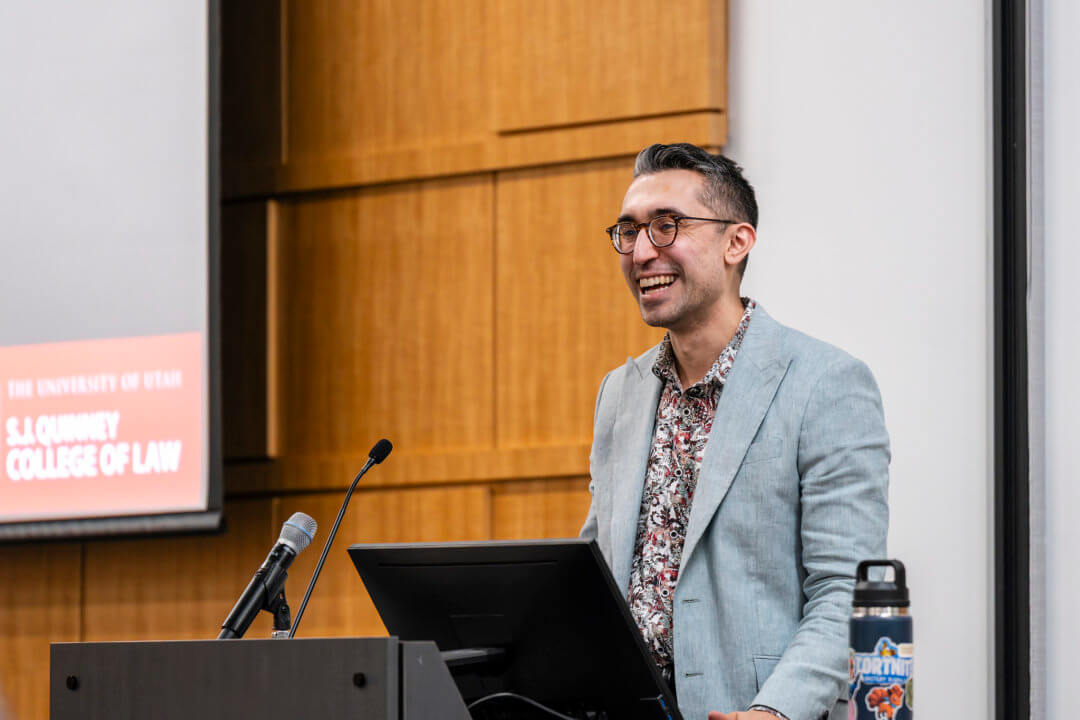
Dr. Daniel Aaron, associate professor of law at the University of Utah, delivered the prologue to the second annual Charity Scott Endowed Lecture.
Aaron framed the discussion by examining how the law shapes the relationship between politics, economic markets and democratic values. “Politics and the economy are inextricably connected,” he explained, arguing that law often serves as the connective tissue between the two. This framework, he suggested, is a useful way to understand growing concerns about FDA governance and its capacity to uphold its own historical standards.
Citing recent reports, investigations and scholarly critiques, Aaron outlined areas where the FDA faces increasing strain, from food safety and tobacco regulation to drug approvals. While emphasizing the agency’s central role in protecting public health, he urged careful examination of how political pressure, industry influence and shifting economic dynamics affect regulatory decision-making.
Building on those institutional concerns, Cohen turned the audience’s attention to the main substance of the lecture: the impact of competing interests on regulation and use of psychedelics. As Cohen explained, there are multiple pathways to the regulation of psychedelics: religious, pharmaceutical and recreational. These pathways pose distinct challenges when thinking about how these substances should be regulated.
“Each of these three pathways lives in its own culture and its own cosmology and difference of self-understanding about what people want to get out of [psychedelics]. To me, that’s a wonderful thing, because they meet very different needs,” he said.
For people who use psychedelics in their religious practice, the pathway to approval relies on the First Amendment protection of the free exercise of religion. For approval as a pharmaceutical therapy, however, the FDA has a responsibility to thoroughly evaluate the safety and effectiveness of experimental therapies before they are approved for use.
Even within the pharmaceutical pathway, psychedelics present challenges to conducting the randomized controlled trials that FDA relies on in the approval process. For example, a recent drug application for the use of Methylenedioxymethamphetamine (MDMA) in PTSD therapy was rejected in part because the advisory committee was concerned that there is not a reliable way to keep participants in control and placebo groups from knowing which arm of the study they are in, a practice known as “blinding,” a claim Cohen interrogated in his talk.
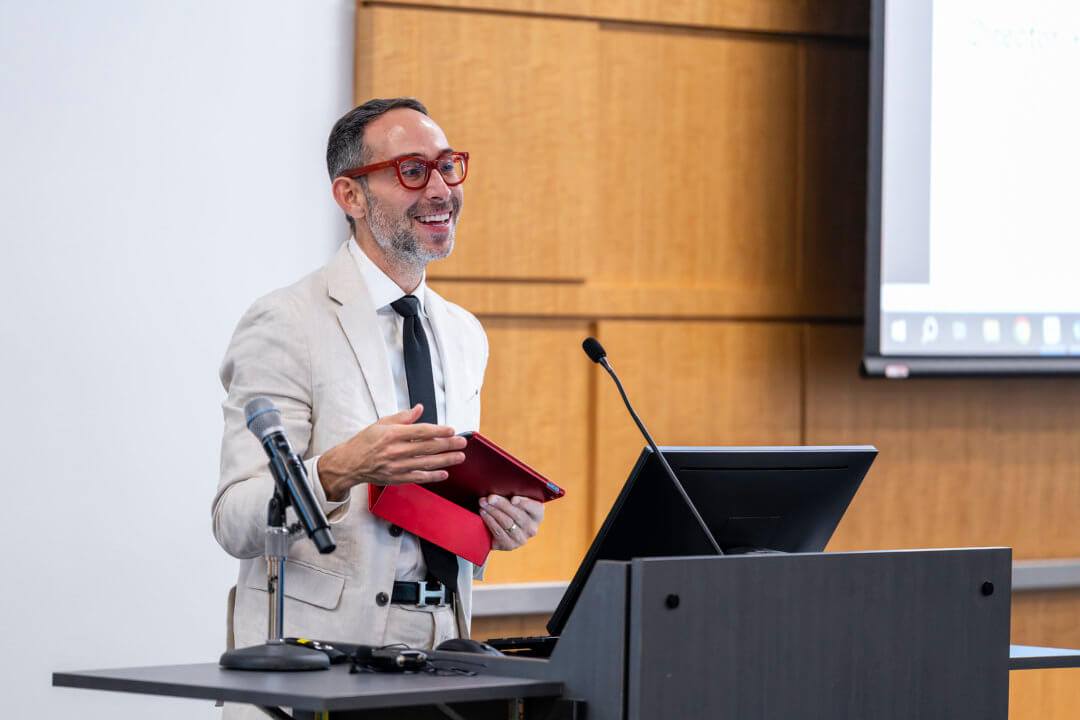
I. Glenn Cohen, the James A. Attwood and Leslie Williams Professor of Law at Harvard Law School and senior scholar mentor to Aaron, delivered the keynote of the Charity Scott Endowed Lecture.
Cohen also acknowledged that some people using psychoactive substances may be susceptible to various forms of coercion or abuse once in an altered state. He emphasized that these debates raise persistent questions about how laws and regulations will navigate these competing pathways in the future.
“The more you want to make this clinical, the more you want to make this medical, the more you want to take away the experiential,” Cohen said. “Is that a triumph of scientific purity, or… does it show us that the boundaries between spirituality and therapy are much more porous than we like to talk about?”
The lecture series honors the late Charity Scott, professor emerita and founding director of the Center for Law, Health & Society who launched the health law program at Georgia State Law, and reflects her lasting commitment to rigorous scholarship, mentorship and community engagement in health law.
Leslie Wolf, the director of the Center for Law, Health & Society, Ben F. Johnson Jr. Chair in Law and Distinguished University Professor, reflected on the deeper significance of the evening, emphasizing that the tandem lecture was a deliberate tribute to Charity Scott’s legacy as a mentor.
“This lecture series allows us to keep Charity’s vision and memory alive,” Wolf said, explaining that the decision to invite a junior scholar to share the lecture stage with a longtime mentor mirrored Scott’s own commitment to nurturing emerging voices in health law. In the same spirit, the visiting scholars mentored members of the Student Health Law Association at an informal breakfast, Professor Aaron presented a paper and received feedback from faculty on it, and Professor Cohen spoke to students in Professor Wolf’s Human Subjects Research course.
Recalling Scott’s extraordinary reach, Wolf noted that at virtually any health law gathering, nearly everyone in the room could claim her guidance. “They would have all thought that she loved them best,” she said. “And they would have been right.”
The Charity Scott Lecture Series is endowed by a generous gift from Professor Emerita Scott’s family to honor her life and contributions to health law. Through this annual program, the College of Law is able to attract leading scholars and rising stars in health law, presenting their research and expertise directly to Georgia State Law students, faculty, alumni and the broader community.
-Written by Lauren Allred