

Earlier this month, Jonathan Todres, Distinguished University Professor and Catherine C. Henson Professor of Law, presented testimony at the United Nations in Geneva, Switzerland, on why an expansion of children’s right to education is necessary.
Professor Todres spoke about the need for new international law on the right to education at the Second Session of the United Nations open-ended Intergovernmental Working Group (IGWG), which is exploring whether to develop a new law on the right to education. He addressed the need for a consistent legal standard on free education from pre-school through secondary education and implications that new law would have on existing international law.
Today, millions of children confront both direct and indirect financial barriers to accessing education. The IGWG was established by a U.N. Human Rights Council resolution explore the possibility and benefits of expanding children’s rights by expressly recognizing the right to free pre-primary education and free secondary education through the adoption of a new optional protocol to the Convention on the Rights of the Child, the most widely ratified human rights treaty.
The current legal standard under international law mandates free education only at the primary school level currently, Todres explained. It does not expressly recognize -free pre-primary education and only recommends free secondary education as a goal to be achieved over time.
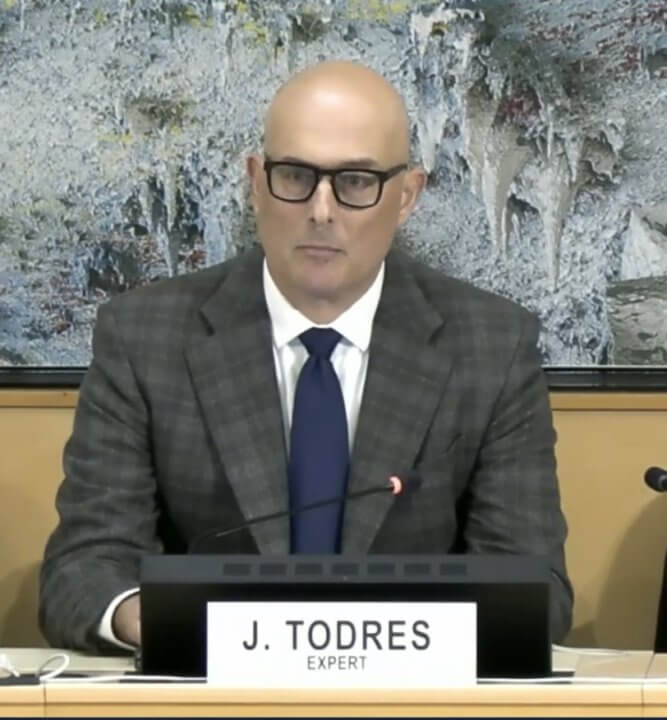
Professor Todres addressed the need for a consistent legal standard on free education from pre-school through secondary education and implications that new law would have on existing international law.
“The world has changed dramatically since the adoption of the Convention on the Rights of the Child, as has our knowledge of child and adolescent development,” he explained. “We know that it is critical that children have access to more than just primary school education to succeed in today’s world. Both early childhood education and secondary schooling are vital too.”
A large part of Todres’s research and scholarship explores how governments, non-governmental organizations and other stakeholders can safeguard and better prioritize the rights and wellbeing of children.
“I think children are frequently overlooked and marginalized in law and policy discourses,” said Todres. “For example, in the U.S. context, children constitute more than 20 percent of the population, yet typically less than 10 percent of the federal budget addresses children’s issues.”
According to Todres, a significant barrier for children’s access to education globally stems from the cost burden of education. These challenges include both direct costs like school fees as well as hidden costs including books, uniforms, and transportation.
“Professor Todres' work embodies the best of what Georgia State stands for: it is innovative and intellectually rigorous scholarship that is successfully operationalized in the outside world,” said Anthony Michael Kreis, associate dean for Faculty Research and Development.
Professor Todres’ commitment to advancing the rights of children is his guiding star. “In all my work, I ask myself whether my work elevates children and helps to advance their rights and wellbeing,” said Todres. “If so, then I think I’m on the right track.”
“Georgia State is renowned for its high-quality teaching. Professor Todres is among our finest teachers in the classroom,” said Kreis. “Research, such as developing international legal standards, enables us to stay ahead of the latest legal developments at the national and international levels. That means our students get gifted teachers who can also provide them with an education that's cutting-edge.”
Todres’ experience in Geneva will influence his time in and out of the classroom at the College of Law, especially as it pertains to his children’s rights courses. “The current U.N. process offers students an opportunity to learn about and understand how international law develops in practice,” said Todres. “So, it is a great case study that is evolving in real time.” Throughout his teaching, Professor Todres strives to have his students engage with the real-world context in which the law operates.
“There is no shortage of ways to get involved. For law students, almost any area of law they would want to pursue has a connection with children’s rights,” said Todres. Following the second session, which was attended by more than 80 governments, the Chair-Rapporteur's recommendations were drafted and adopted by the IGWG. The finalized recommendations will be submitted for review at a subsequent session of the UN’s Human Rights Council.
-Written by Laura Osnard (J.D.’27)