

See Yourself at GSU is a special Honors College series that uses real student stories to understand common student experiences — for example, how to contribute to your community through service. In this article, one Honors student reflects on how joining and rebuilding the Student PIRG chapter transformed their college experience, shaping their leadership, advocacy skills and commitment to public‑interest work.
By: Caleb Gustavson
ATLANTA—When I started college in GSU’s Honors College in Fall 2023, I was very unsure of what I wanted to do long-term. One thing I knew: ever since taking AP Government in high school, I had become interested in social movements and all the ways our government affects daily life, so I decided to major in Political Science (without even knowing specifically what that meant). But did I want to go to law school, run for office, or work for an NGO? The possibilities for my future were frankly daunting.
In September of my freshman year, I was connected to an opportunity through Dr. Chris Brown, the internship director of the poli-sci department, an opportunity that defined my college experience. The email was simple enough: volunteer and internship opportunities to register students to vote with an organization called Student PIRG.
Student PIRGs stands for Student Public Interest Research Groups. The Student PIRGs are a national nonprofit founded by Ralph Nader in the 70’s with some pretty simple values: students are not second-class citizens and should be involved in policy, students should have more control over their student fees and students should be involved in public interest issues. Now, Student PIRG has chapters across the country at universities and community colleges that all aim to involve students in advocacy in issue-based campaigns. Advocacy is any interaction that one has with a policymaking branch of government. This could be collecting petitions, getting local business sign-ons, donating to a PAC or voting.
Not thinking much of it, I put my name down. Three years later, I have personally raised $60,000 from door-to-door donations for environmental campaigns, gotten hundreds of young people at GSU and beyond involved in advocacy, been elected twice as an SGA Senator for the Andrew Young School and lobbied at two state capitols as well as Washington, D.C. for public interest issues. I now serve as a National Spokesperson for the Student PIRGs national organization, where I represent the organization at conferences across the country and sit on the board of directors for the oldest and largest non-partisan youth civic engagement group in the United States.
None of that would have happened, however, without Georgia State and the Honors College.
A Day in the Life: Follow Honors student and Student PIRGs National Spokesperson Caleb Gustavson as he he champions public‑interest issues that matter to students.
Getting Started
I first got into community organizing and advocacy by starting a Student PIRG chapter at GSU.

Honors student Caleb Gustavson briefs the Georgia State Student Government Association in his role as Bylaws Committee Chair, outlining the committee’s work and priorities for fall 2024.
Before my interest in the volunteer opportunity, there had not been a PIRG chapter at Georgia State since the 2020 election. At first, I was a bit overwhelmed, thinking I had just signed up for some volunteer opportunities. I quickly realized that this would involve restarting the Georgia State PIRG chapter.
Despite feeling overwhelmed, I knew that starting a PIRG chapter at GSU would be valuable for students. There is a wealth of student orgs at GSU, seemingly something for everyone; however, a Student PIRG chapter would fill a different niche. The issues that Student PIRG works on are not partisan; they are public-interest issues. Public interest issues are issues that around 70 percent of people agree with, issues that are not defined by a political party. Clean air and water, protection of our wild spaces, expanded consumer rights, removing chemicals from our water and the right to vote are all public interest issues and all issues that I have worked on.
By my sophomore year, through the GSU Student PIRG chapter, I was managing 20 interns and helping run our three campaigns. The GSU PIRG chapter has worked on protecting the Okefenokee swamp from mining by collecting public comments, protecting the Atlantic right whales by getting small businesses to commit to not using non-whale-safe caught seafood and running a campaign fighting fast fashion. GSU students may remember this latter campaign from our “Waste is out of Fashion” fashion show hosted in Hurt Park last spring, which featured dozens of Atlanta models, designers and more than 200 student attendees. In my role as President, I was responsible for assisting the campaign coordinators and building the skills of everyone in the organization to be the next generation of organizers. These trainings included how to host a successful event, how to plan effectively and how to plan a lobby day.
Building Out a Skill Set
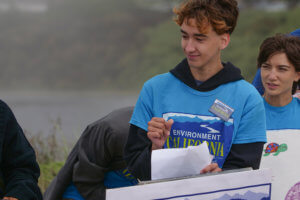
In Summer 2024, Caleb Gustavson took the mic at a Santa Barbara press conference—an event he helped pull together—to share the meaningful results of the canvass office’s efforts.
I learned a lot about organizing and being a leader by having my boots on the ground, but the Honors College helped push me even further. In my sophomore year, I joined the Honors College’s Social Change Leadership Cohort. This cohort works toward a certificate,offered by GSU’s Honors College to teach leadership skills and a social justice framework to young leaders. This cohort takes a series of classes together that develop one’s understanding of leadership, the history of organizing, theories of change and how to effectively move in spaces. Taking these classes has given me so much context for my work. Having an academic, historical and practical context for the advocacy work that I am doing has made me a much better storyteller and leader.
Final Thoughts
When I came to GSU, I fell in love with the open campus and the amount of freedom for students to make their own way at GSU. I was struck by the sense of individuality that permeated the campus – not just from the campus, but from the students themselves. I do not think you can pin down any one aspect that defines a GSU student because there is such a distinct culture of individuality here. The way I chose to define myself here was to get involved with student organizing.
Academic learning is certainly not required to get involved in advocacy; in fact, we need organizers from every education level. A diversity of educational backgrounds will help innovation within the field and create more opportunities for all. That said, the Honors College community has given me a wealth of conversations, mentors and a community of peers to lean on in this work. Despite all of this, I still am unsure where my future is going to lead! I can say for sure, however, that the Honors College and my experiences as a youth organizer have made me sure that whatever I do, I will keep advocating for issues that I care about and continue to ensure that students are involved at every level of the decision-making process.
Tips for Getting Started in Community Organizing
- Check out the Student PIRGs Activist Toolkit to learn how to organize your peers on any issue! (Activist Toolkit - Student PIRGs)
- Lobby your state legislators about issues that you care about. Anyone can go to the Capitol and speak with their elected official. Legislators need to hear from students, and the Capitol is only two blocks away from GSU!
- Have a good understanding of government and policy. To be effective, you need to understand who you hope to influence or convince. Know whose job it is.
- Identify groups and communities that you are a part of that you could make a positive change in. Advocacy is much more enjoyable when done with your friends.
- Social change starts small. It is better to get involved in doing something small now than to be paralyzed by inaction and do nothing.
Check out our other See Yourself at GSU articles:
The Honors College at Georgia State University is a destination for high-achieving students who embody curiosity, take pride in their work and dream about how they can make an impact through their studies and careers. Its mission is to serve students in a welcoming space by engaging students’ curiosity, empowering them to achieve their highest potential and inspiring them to find their place in the world. Its students form life-long friendships, participate in community service, perform research, excel academically, explore their interests and chart their career paths.