
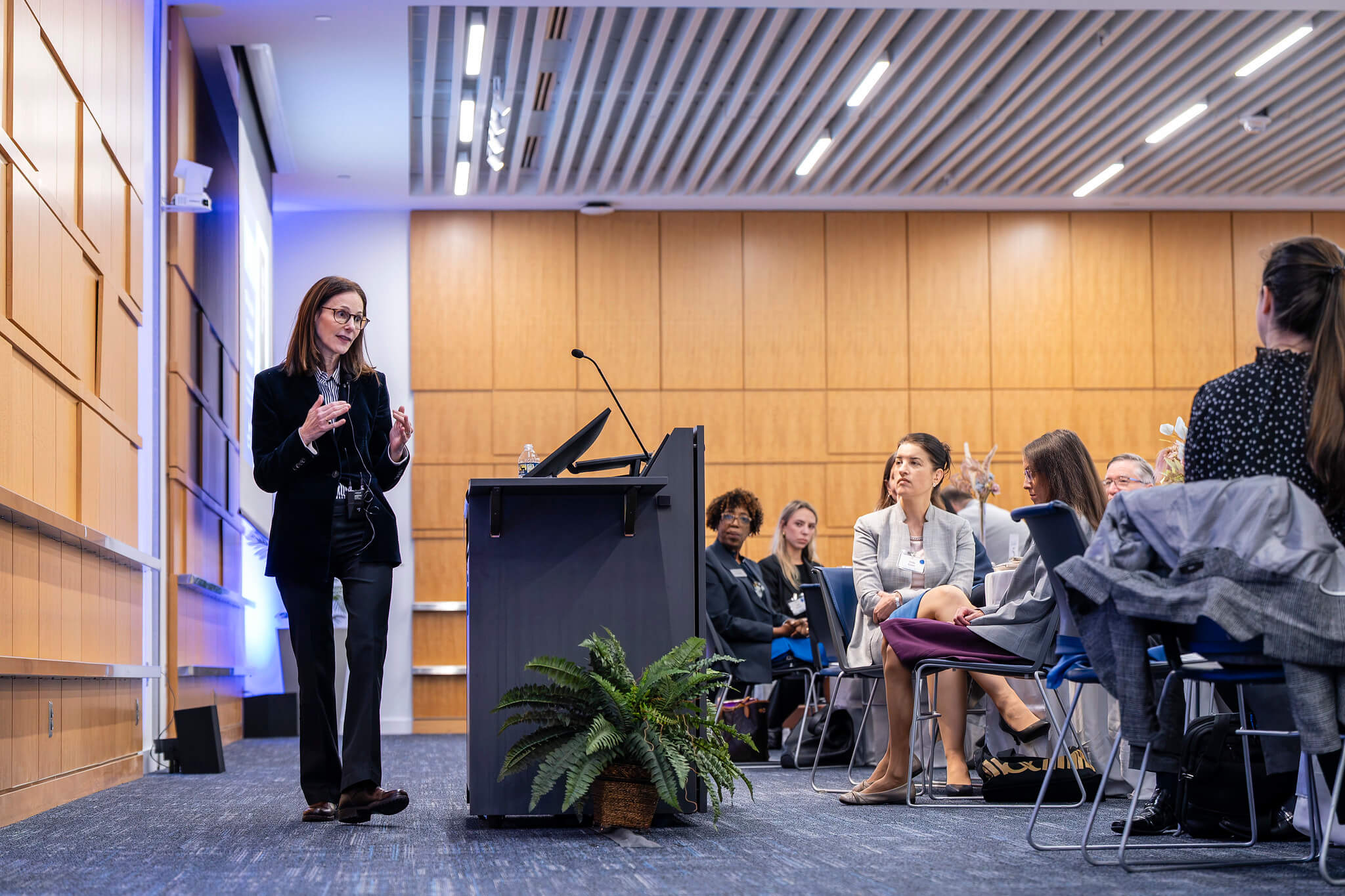
“Privacy for me and my friends, and not for you,” was the central message of the 70th Henry J. Miller Distinguished Lecture on Wednesday, Nov. 19, 2025. Professor Danielle Citron offered the Georgia State University College of Law community a frank assessment of the current state of digital privacy practices in the United States.
Citron is a 2019 MacArthur Fellow and current Jefferson Scholars Foundation Schenck Distinguished Professor of Law at the University of Virginia. Citron is one of the nation’s most influential scholars in privacy, civil rights and free expression.
In her lecture, Citron gave an in-depth look at how privacy, technology and democratic norms intersect in the current political landscape. She examined the ways political actors either apply or weaponize privacy respectively according to their ideology for dominant political in-groups who deserve legal protections, and out-groups who do not.
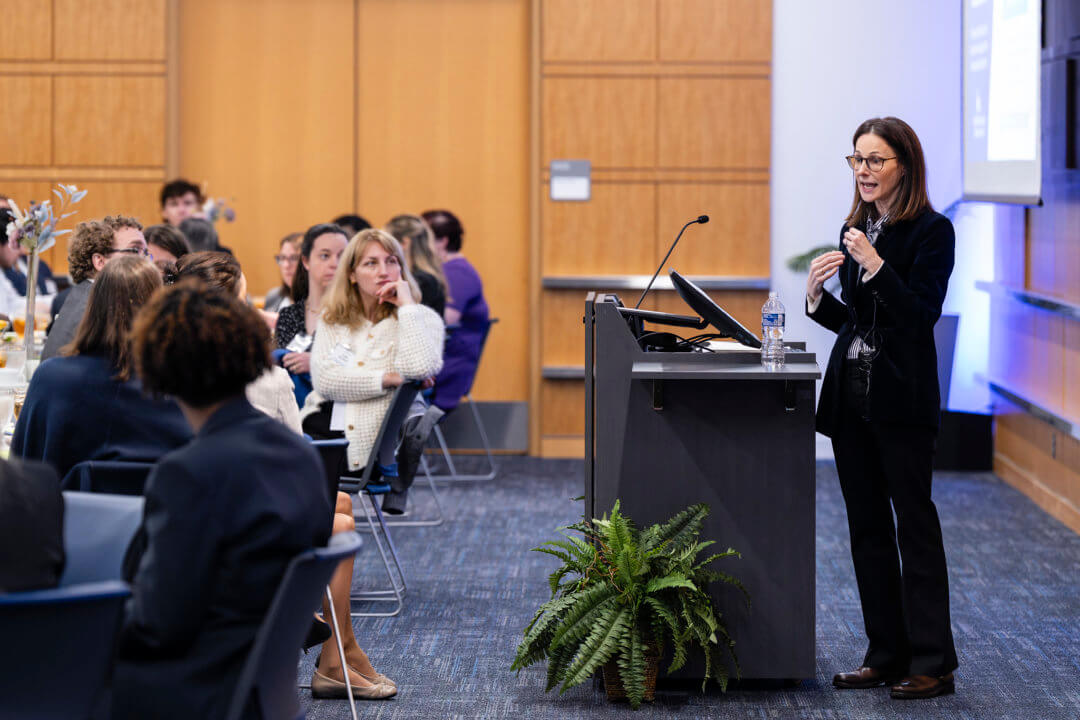
“Traditionally, in legal literature, authoritarianism and privacy are antithetical,” Citron explained. “But in the United States, our version is the selective protection of privacy. Privacy for those in power and their friends. Not for other marginalized groups.”
“Traditionally, in legal literature, authoritarianism and privacy are antithetical,” Citron explained. “The more authoritarianism creeps, the less privacy people have, except those in control. But in the United States, our version of creeping authoritarianism is the selective protection of privacy. Privacy for those in power and their friends. Not for other marginalized groups.”
Of particular concern to Citron is how political leaders intentionally misuse the concept of digital privacy to consolidate their own political power, protecting themselves and their interests from public visibility, while exposing others to real risks of tactics like online harassment and doxxing. Definitions of these tactics, typically used to protect vulnerable people, are now sometimes invoked by political leaders to restrict public oversight.
This exploitation of digital technologies, she explained, intentionally undermines traditional democratic norms, institutions and political freedoms.
To illustrate, Citron described recent coverage of Immigration and Customs Enforcement (ICE) personnel. Although recording the activity of law enforcement officers in public is protected by the First Amendment, she noted measures to shield them from identification and even suggestions from the administration that videotaping may amount to criminal harassment.
“Customs and Border Patrol and ICE employees, as a matter of [Department of Homeland Security] policy, wear masks, have uniforms without badges and drive unmarked vehicles. The justification, according to Secretary Kristi Noem, is privacy and their personal safety,” she said.
To contrast these protections, she highlighted the new Department of Government Efficiency (DOGE) and reports of personal information about American citizens that quickly became available to its employees, such as records from the Office of Personnel and Management, from the U.S. Department of the Treasury and others.
“They get access to millions and millions of sensitive, personal data about each and every one of us, including if you’ve ever had a security clearance, as I have,” she cautioned.
Citron outlined similar resistance from Silicon Valley tech giants to privacy reform in social media platforms compared to the ease with which they are able to deflect public scrutiny in their own private lives.
Working to even this playing field for ordinary individuals, Citron’s scholarship has shaped national policy debates and informed major legal reforms across government agencies, congressional hearings and technology platforms, and she stressed the important responsibility lawyers hold in shaping the digital future we will all inhabit.
“I did a lot of work with [then] Attorney General Kamala Harris, helping teach California peace officers about nonconsensual intimate imagery laws and cyberstalking laws,” she said, calling out the need to redouble efforts around education about the law. “It’s helped a little. It’s not fruitless, but it’s hard.”
She encouraged students to carefully consider how their legal education would enable them to become thoughtful architects of future laws that will safeguard privacy while honoring the values of the First Amendment.
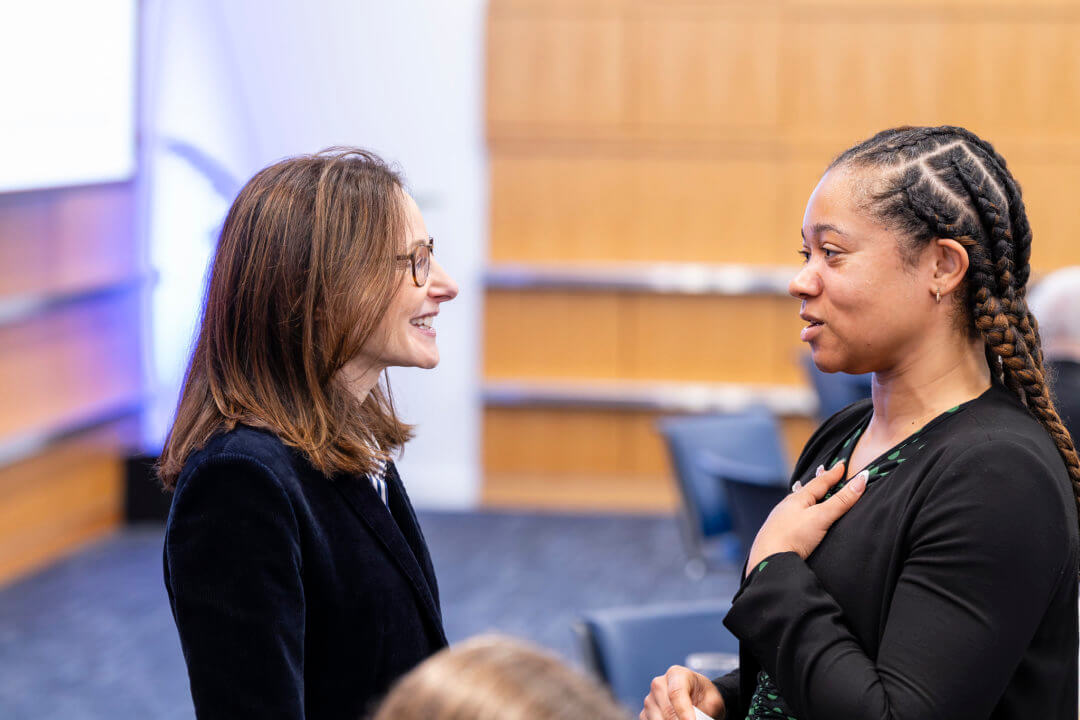
Camile Jones (J.D. ’28), right, said the lecture was an invaluable opportunity to hear directly from a scholar whose work has shaped national conversations about privacy, technology and civil rights.
One student in attendance, Camile Jones (J.D. ’28), said the lecture was an invaluable opportunity to hear directly from a scholar whose work has shaped national conversations about privacy, technology and civil rights. For Jones, this emphasized the strength of the Georgia State Law community and the connections students build through its faculty.
“Her relationship with the professors here at Georgia State Law reaffirms what I know about the power and influence of the Georgia State network,” she said.
After the lecture, she shared with Citron how the discussion resonated with themes she had recently explored in her Constitutional Law course with Professor Eric Segall, where students are encouraged to examine the development of constitutional doctrine with a critical eye.
"The more I know about what rights we have and do not have, and the precedents that have refined that knowledge, the more tools I have as an advocate for my clients, community and self,” she said.
The Henry J. Miller Distinguished Lecture Series is supported by the Charles Loridans Foundation Inc. and named for the late Henry J. Miller, a partner in the law firm of Alston & Bird for more than 50 years. Miller garnered an extensive list of achievements through his legal career, including being designated as the amicus curiae of the Supreme Court of Georgia for his distinguished service and contribution to the improvement of the administration of Justice.