
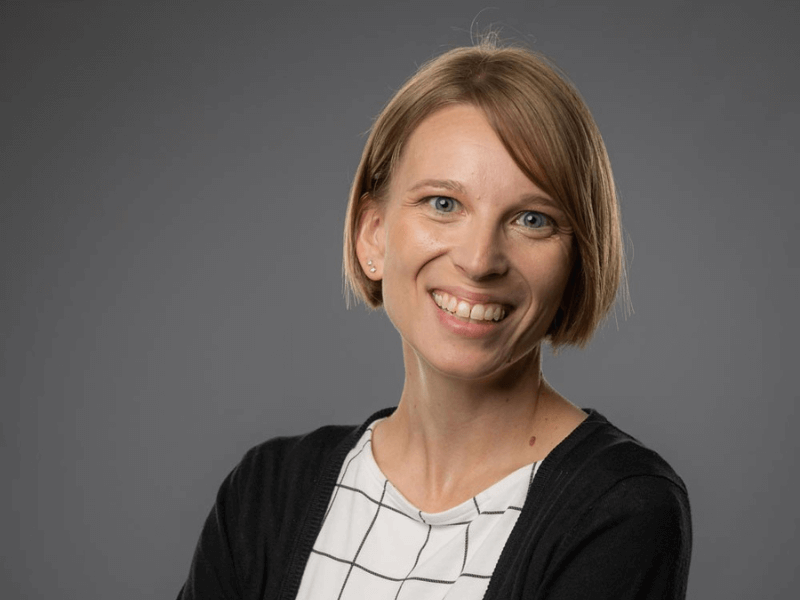
ATLANTA—For Melissa Osborne (MPH ’12, Ph.D. ’18), the path to her career in public health began at home. Growing up, she watched her mother pivot from nursing to community health education, working on grant-funded projects that promoted folic acid awareness among women of childbearing age and childhood obesity prevention in schools. Those early glimpses into public health work planted a seed that would eventually bloom into a career dedicated to protecting children and families.
“My mom was a major influence in my decision to pursue a career in public health," Osborne said. “I saw her work, and that really ignited the spark in me to pursue public health. I kind of got the bug early on and then carved out my own path.”
That path led Osborne to the Georgia State University School of Public Health, where she would earn both her MPH and Ph.D. while gaining hands-on experiences that have shaped her career as an educator and researcher who uses cutting-edge technology to prevent childhood injuries.
Finding Her Place at Georgia State
After completing her undergraduate degree in sociology, Osborne spent several years working directly with families as a child welfare worker. Conducting home visits to address allegations of child abuse and neglect was often challenging, but her role also involved connecting families with crucial resources—which she found especially rewarding. She saw that she could make a difference in the lives of children and wanted to expand her impact even further with a public health perspective that extends beyond individual cases to larger populations.
Osborne said that as she was considering options for pursuing an MPH, Georgia State University stood out for several reasons. Beyond the School of Public Health’s reputation as a leader in public health education, Osborne heard first-hand accounts from her mother’s colleagues who had graduated from the program and spoke highly of the real-world experience and support they received from renowned faculty. There was also a family connection, as both her parents were Georgia State graduates; her father earned a degree in chemistry and her mother earned a degree in nursing.
At her MPH orientation, Osborne’s career trajectory truly crystallized. Listening to Professors John Lutzker and Dan Whitaker speak about their work in child maltreatment prevention from a public health perspective, she knew she had found her niche.
“I remember making a note that I needed to talk to them because they were working in child maltreatment prevention from a public health perspective,” she recalled. “I thought, ‘this is where my path is going to go.’”
Mentorship and Growth
Through Lutzker and Whitaker, Osborne connected with Professor Shannon Self-Brown, who became a longtime mentor and is now a collaborator on research projects. Osborne said her relationships with faculty exemplify one of the School of Public Health’s greatest strengths—the emphasis on mentorship and hands-on research experiences that complement classroom learning.
Osborne found herself drawn to formulating her own research questions and hypotheses as she gained experience as a research coordinator on federally funded child maltreatment prevention projects led by Self-Brown. The desire to carve out her own area of research within the field led her to pursue her Ph.D. at the Georgia State School of Public Health.
From CDC to Academia
After earning her PhD, Osborne completed a fellowship at the Centers for Disease Control and Prevention through the ORISE program, working in the Division of Viral Hepatitis. While she valued the experience of contributing to work with broad public health impact, she found herself missing the academic environment’s emphasis on mentorship and teaching alongside research.
This realization led her to her current position as an assistant professor in the WellStar College of Health and Human Services at Kennesaw State University, where she educates students and conducts research in child injury prevention.
“Being in the academic environment, it’s really centered around these elements of teaching, research and service,” she said, “and that really encompasses the things that got me excited about being part of public health.”
Innovation in Injury Prevention
Osborne’s current research represents an exciting fusion of public health and technology. Her lab focuses on child injury prevention in home environments, incorporating virtual reality to create engaging safety programs for parents.
The program addresses common childhood injury risks including falls, lacerations, burns, drowning and firearm-related injuries. The virtual reality modules can help parents create safer home environments for their children by combining hazard identification and mitigation strategies with proper supervision techniques.
“So far, we've had some good feedback from parents, and they've been excited to learn about home safety in a different way, rather than just reading materials or getting pamphlets,” Osborne said.
Advice for Future Public Health Professionals
For students considering public health careers, Osborne emphasizes the importance of experiential learning and faculty interaction. Her own success stemmed largely from the hands-on research experiences she gained at Georgia State’s National SafeCare Training and Research Center, which taught her about program implementation and policy-level issues crucial to getting public health interventions to communities.
“I felt like I really left Georgia State with a more well-rounded education because I had that additional hands-on experience,” she said.
Her advice to prospective students is straightforward: “Be open to different opportunities and be on the lookout for areas where you can get some of that experiential learning. Interact with your professors to build on what you’re learning in the classroom.”
She also reminds students of the crucial role they can play in creating healthier futures for individuals and communities: “Welcome and thank you for joining such an important workforce,” she said. “Your talents and your energy are really needed.”
As Osborne looks toward expanding her research program, her journey from child welfare worker to an innovative public health researcher illustrates the transformative power of graduate education combined with mentorship and hands-on experience. Her story demonstrates how Georgia State’s School of Public Health doesn't just educate students—it nurtures them, challenges them and prepares them to tackle some of society’s most pressing problems with a combination of scientific rigor and human compassion.