

Last month Georgia State Law hosted a luncheon honoring the 20th anniversary of the Health Law Partnership (HeLP), a medical-legal partnership (MLP) among Atlanta Legal Aid Society, Children’s Healthcare of Atlanta and Georgia State University College of Law. MLPs are collaborations between law and health care professionals to address the legal needs of patients and their families to improve their health and well-being.
Attendees included past and present HeLP attorneys and staff, students and faculty at Georgia State Law, health care providers and local health law attorneys, joined by MLP attorneys and others online. Pam Kraidler, director of HeLP at Legal Aid, opened with a welcome, recognizing several esteemed guests, Georgia State Law Clinical Professor Emerita and founding co-director of HeLP Sylvia Caley, Children’s founding medical director Dr. Bob Pettignano and Legal Aid’s former Executive Director Steve Gottlieb, whose dedication and perseverance HeLP, coupled with those of founding center director Charity Scott, were responsible for HeLP’s launch
“Lawyers in the hospital?” HeLP’s founders repeatedly heard this question from incredulous doctors and health care administrators when first approached about starting an MLP in Atlanta. Finally, Children’s then General Counsel Dale Hetzler understood the potential and helped pave the way for HeLP.
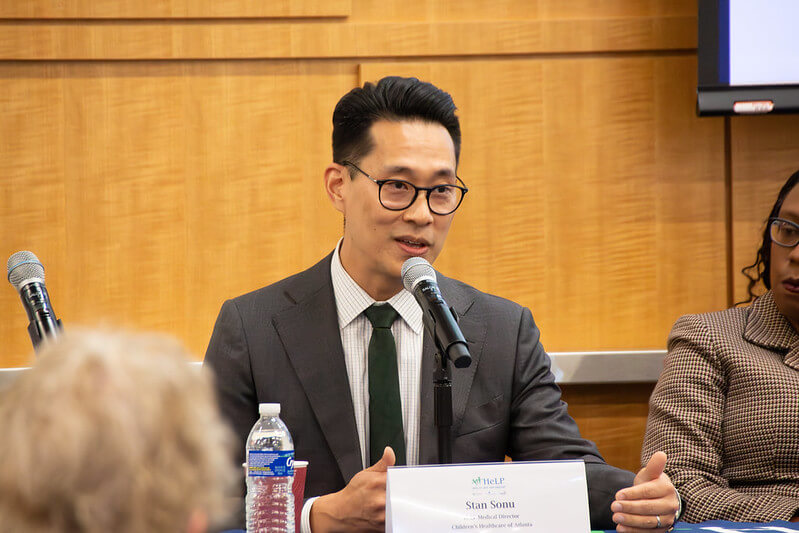
Dr. Stan Sonu, medical director of HeLP at Children’s Hospital of Atlanta.
However, since HeLP’s founding in 2004, more than 6,000 low-income patients at Children’s and their families have benefited from lawyers being an integral part of the care team. HeLP offers an interdisciplinary, holistic approach to address the social factors that impede improvement of children’s health. One of the first ten MLPs in the country, HeLP has become a national model. Today, there are more than 450 MLPs across the country, including three more in Georgia. Although the original leaders of the MLP have retired, a new generation are carrying out the mission of HeLP, including the first panelist, Dr. Stan Sonu, the new medical director of HeLP at Children’s. He acknowledged that, back in 2004, physicians did not necessarily understand how social factors could impact health.
“Past physicians were skeptical that social needs of patients impact their health. Today’s doctors have seen the data - we know these are preventable problems. But we aren’t all aware of interventions or solutions to address the problem,” said Sonu. “It doesn’t matter how passionate or committed you are as a physician, or a nurse, or a social worker, there are things we just can’t do. That’s when lawyers can help.”
Sonu illustrated this point with a story of a child suffering from sickle cell disease. A Children’s physician tried to obtain approval for a bone marrow transplant that could provide life-long relief from the debilitating pain the disease inflicted but lacked the knowledge to successfully navigate the process. With a referral to HeLP and the “lawyering magic” of HeLP attorneys, the transplant was approved and the child successfully treated.
That kind of collaboration is facilitated by the HeLP attorneys having offices in each of the Children’s hospitals and the Center for Advanced Pediatrics. By being integrated in the health care setting, attorneys are able to meet patients and their families where they are. Families can focus on their children’s medical needs and access legal services without needing to take time off work, find transportation or rely on childcare to meet with an attorney, reducing stress on caregivers. The next panelist, Professor Christina Scott, associate director of the HeLP Legal Services Clinic at Georgia State Law, learned this firsthand. Scott has the unique perspective of having been a student in the HeLP Clinic, a HeLP attorney at Children’s Center for Advanced Pediatrics and now a clinical professor in the HeLP Clinic.
The HeLP Legal Services Clinic opened in 2007 at Georgia State Law as the educational arm of HeLP. Law students develop legal skills, such as client interviewing, counseling and representation, negotiation, research, drafting and case management. Law students are joined by medical students from Morehouse School of Medicine and Emory University School of Medicine, as well as graduate students in social work, public health and other programs across Georgia State and other institutions.
Scott shared the impact the clinic has on students and clients. “Law school and legal practice often feels disconnected from other disciplines,” said Scott. “The clinic is a powerful opportunity for law students to work with students of other professions. The clinic helps students learn that they are more as a team than the sum of their parts.” The students develop their professional skills and respect for others’ professional skills, while positively impacting clients’ lives.
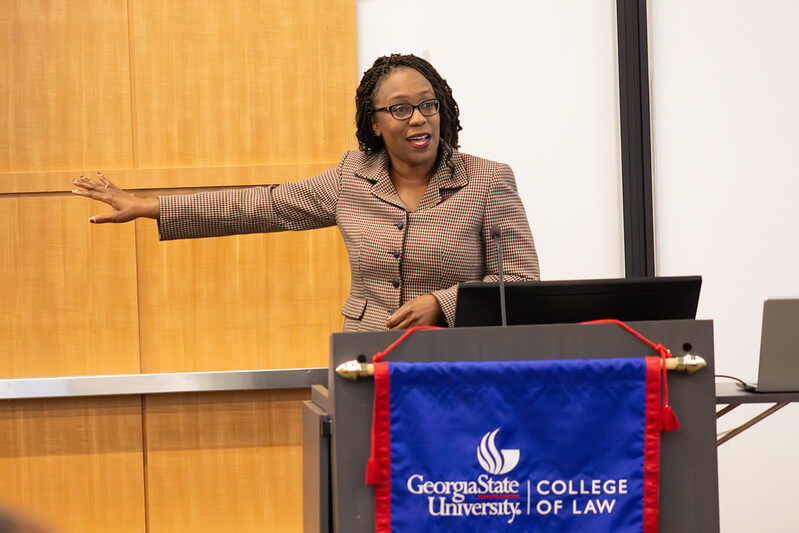
Keegan Warren, executive director of the Institute for Healthcare Access at Texas A&M University, shared her expertise in MLP funding.
The final panelist, Keegan Warren, executive director of the Institute for Healthcare Access at Texas A&M University, was invited to share her expertise in MLP funding. Research demonstrates that MLPs save health care systems money, reduce re-admissions and improve the well-being of patients and families. For example, over the past two decades, HeLP has helped to secure outcomes worth more than$10 million for clients as a conservative estimate.
Despite the value that HeLP brings, identifying sustainable funding for to expand the impact of HeLP and other MLPs is needed.
Warren described a path toward paying for the kinds of legal services HeLP and other MLPs provide as health care. “Health care is about insurance reimbursement and disease management, so we have a clear path for how to have legal services covered as part of health care services,” said Warren. “We have evidence of the impact of MLP on health outcomes. But for MLPs to be successful in the long term, we have to identify the mechanism for Medicaid reimbursement.”
Warren explained that consistent coding can lead to reimbursement. Health care professionals code patient diagnosis and encounters to be paid. Similarly, Legal Services Corporation, the legislative agency that provides funds for state civil legal services, has a coding system for tracking attorneys’ work on cases. Health care professionals can be trained to use an existing coding system they routinely use to consistently code potential health hazards related to socioeconomic circumstances that warrant a referral to the MLP. Consistent coding can also provide more in-depth information for research on the impact of MLPs.
“It was wonderful to bring together so many people to celebrate HeLP and its impact over the last 20 years, while also envisioning its future,” said Leslie Wolf, Ben F. Johnson Jr. Chair in Law and center director. “I heard from multiple attendees that they were inspired to operationalize the lessons shared to grow and sustain the work of HeLP and new MLPs.”
HeLP’s founders recognized that the prescription to better health may not always be medication, but rather sometimes patients need legal intervention. After 20 years, more health care providers acknowledge the importance of addressing the social drivers of health to improve patient outcomes, and MLPs are positioned to do just that.
View the event recording here.
Written by Stacie Kershner (J.D. ’08), Deputy Director, Center for Law, Health & Society