

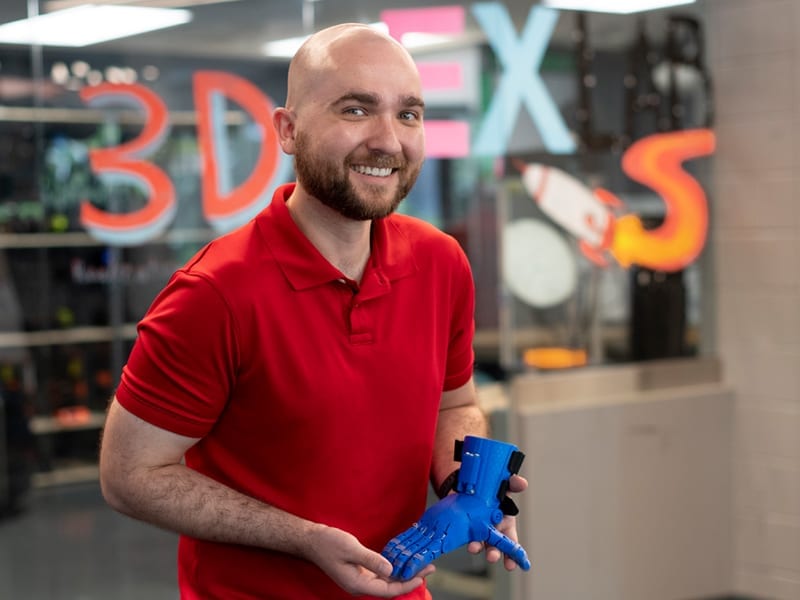
The first time he saw an image of a prosthetic hand made with a 3D-printer, Michael Nelson knew he wanted to get one to children in need.
Made from plastic with free designs downloaded from the Internet, these devices can be made for about $20. That’s a fraction of the cost of traditional prosthetics, making the custom-fabricated 3D versions an option for low-income people and specifically for children, whose bodies grow quickly.
“This is one of the most meaningful things I’ve ever tried to do,” said Nelson, 29.
Nelson founded the student group We are Human Machines, and partnered with international nonprofit E-NABLE to make the prosthetic hands using 3D printing equipment at Georgia State University’s EXLAB maker space.
Nelson and his team have manufactured prosthetic hands for three children, including a 10-year-old boy from Brazil named Eduardo.
“He didn’t have fingers to grab things with, so this was good use of this technology and these resources,” he said. “Now he can ride a bike.”
During his time at Georgia State, the physics major has taught science classes in high schools and middle schools around Atlanta through a teacher training program in the Physics & Astronomy Department. He has also worked in a university lab helping with photosynthesis research.
Before he enrolled at Georgia State, Nelson co-owned a pawn shop. When business started drying up, he knew he needed a new path that would bring more meaning into his life.
“I decided that studying physics and astronomy would be the best way to learn more about the universe,” he said. “I mean, physics is actually the language of the universe, so it made sense to me.”
With plans to study physics in grad school, Nelson said he’s sure he’s on the right track.
“All I’ve ever wanted to do,” he said, “was to create businesses and make a difference in this world.”
Story by Randy Trammell
Photos by Meg Buscema