
A Push Toward Safety
Senior Annmarie Stockinger is putting an alert system at your fingertips with her startup, GoSafely
A Push Toward Safety
Senior Annmarie Stockinger is putting an alert system at your fingertips with her startup, GoSafely
written by Monica Elliott | published on September 28, 2017
Who knew that calling for help could be as quick and convenient as ordering groceries? Annmarie Stockinger did, and she is building a business around her idea and making the world safer in the process.
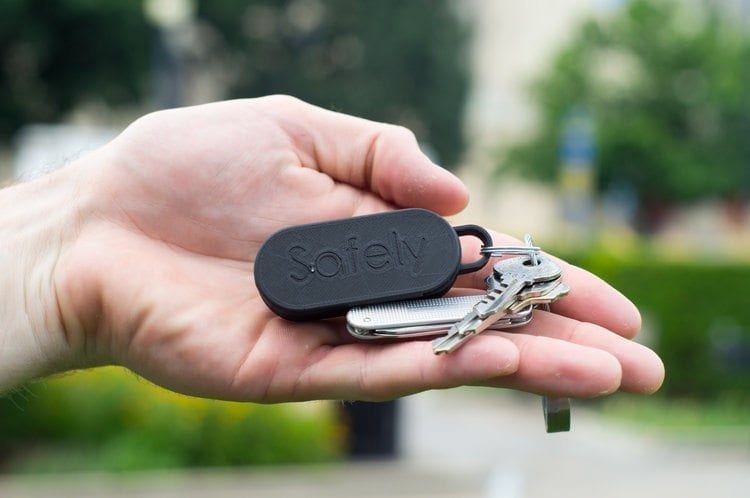
Stockinger is the co-founder and CEO of GoSafely, a startup that makes wearable hardware that notifies the police when the user needs help with just the push of a button. The product, called a SafelyTag, provides the user’s accurate location with no need for Bluetooth or Wi-Fi connectivity and no need for a cell phone.
Stockinger, a senior mathematics major, was inspired by how Amazon dash buttons work, sending a signal to place an order for groceries or other household products. She realized the concept could translate into other uses, a button that could be programmed to, say, contact the police.
“I did a lot of research on geolocation technology,” Stockinger said. “It’s really important to get an accurate location. Wi-Fi and Bluetooth are useful, but the locations that come from those devices aren’t always as accurate as they could be.”
It became clear that cellular data would most accurately pinpoint a location. With that big piece of the development puzzle in place, Stockinger and her team created a prototype for the HackATL competition and won.
HackATL was the first of several entrepreneurial competitions GoSafely has won. In June, GoSafely received $18,000 for winning the Incubate Award in the WeWork Creator awards program.
“At every event I go to there’s at least one person that comes up to me and says, ‘I really wish that this existed when I was in school,’” Stockinger said. “I’m really overwhelmed by the support the community has given me."
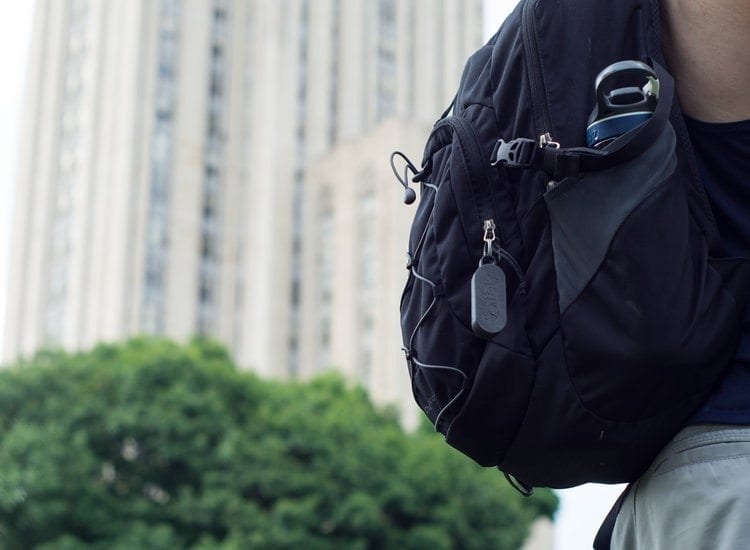
The sleek devices are about the size of a thumb drive and were originally conceived to be attached to a keychain, something most people have with them whenever they leave their homes. But Safely Tags can also be attached to backpacks, clothing — whatever the user keeps handy.
Stockinger says the question she hears most often when pitching the tags is, “Well, why wouldn’t you just take out your phone?”
And her first response is always based on safety.
“The main reason I built this product the way I did is because it’s discreet and nonverbal. I don’t want to build something that escalates the violence of a situation,” she said.
The other problem with cell phones, she said, is they are not always within easy reach, and they can be unreliable — no signal, dead battery, no Wi-Fi or Bluetooth access. But with a SafelyTag, the authorities are contacted immediately with the push of a button.
The company is personal to Stockinger because its origin is rooted in her own experience. When she was a freshman at the University of Pittsburgh, she was sexually assaulted.
“I didn’t have my phone with me. I didn’t think that I was in a dangerous situation,” she said. “What I learned from my experience is there’s no status quo attack or event. It’s not something like where someone grabs you and pulls you into an alley.”
When Stockinger formed GoSafely with her friends Kobe Schmetterling, chief technology officer, and Rahul Sane, chief operating officer, she envisioned it as a tool for college campuses that would not only give students a practical and safe way to contact campus police, but also allow universities to conduct predictive policing by gaining knowledge about when and where crimes are happening on campus in real time.
As a data science intern at MailChimp, Stockinger knows the importance and value of having accurate data to make better decisions, and those analytics are built into the GoSafely product.
Widening the consumer base gives the tags even more of a social impact. It’s just the kind of business Georgia State’s Social Entrepreneurship program is trying to prepare its students to create, visiting instructor Chris Markl said.
“Students today are looking for a career that offers the ability to create positive change in the world,” Markl said. “Georgia State’s social entrepreneurship program empowers a student to build a career innovating solutions that solve social problems.”
Markl says the program looks forward to finding ways to support Stockinger and other Georgia State student social entrepreneurs.
The social aspect of her company is a guiding principle for Stockinger.
“Social impact is still something that’s kind of a new area of technology," she said, "and I want to make sure that the people I work with understand this isn’t just a financial goal. It’s also a social goal and a community goal.”
On Sept. 22, Stockinger introduced GoSafely on the crowdfunding platform Indiegogo.
Stockinger is forging ahead with what she considers a movement, not just a company.
“There’s an equal value if not a greater value," she said, "in helping colleges be safer and helping students feel safer than just that financial goal.”
Monica Elliott is a freelance writer and editor in Atlanta.