
In the Shadow of the Moon
written by Jennifer Rainey Marquez | photography by Bill Roa
To put themselves in the path of the total eclipse of the sun, 10,000 people inched along two-lane roads leading to the picturesque campus of Rabun Gap-Nacoochee School, the site of the OutASight Eclipse Festival co-hosted by the Georgia State University Astronomy Department and the Rabun Gap Tourism Development Authority. They traveled from nearby cities like Atlanta and from distant states like Texas and California to this small, mountainous corner of Georgia.
“When we first started planning this event we thought we might get 1,000 people,” said Dr. Ben McGimsey, astronomy lecturer at Georgia State. “We had no idea.”
In front of a large screen broadcasting live footage from Oregon, Wyoming, Kansas and Kentucky, spectators watched and waited as the solar eclipse raced eastward from the Pacific Coast at more than 1,000 miles per hour. To pass the time, they peered into Georgia State’s solar telescopes, ate tomato sandwiches and ice cream cones, listened as university astronomers answered questions from the crowd and made pinhole cameras from cardboard tubes.
Georgia State alumnus Tiffany Smith left her Atlanta home before 6 a.m., driving with her daughter Tahira, who is in second grade.
“If there was a chance to see the totality, we had to take it,” she said. “I still remember seeing a partial eclipse as a child, and I want my daughter to remember this for the rest of her life.”
Though partial eclipses are more common, the last total solar eclipse visible in the United States was in 1979, when the moon’s shadow swept across a swath of northwestern states from Washington to North Dakota. At any given spot on Earth, the phenomenon occurs just once every 375 years, McGimsey said. Earth is the only planet in the known universe to experience such an event.
“The odds of the sun and moon being the exact right size, the exact right distance—it’s infinitesimal,” McGimsey said.

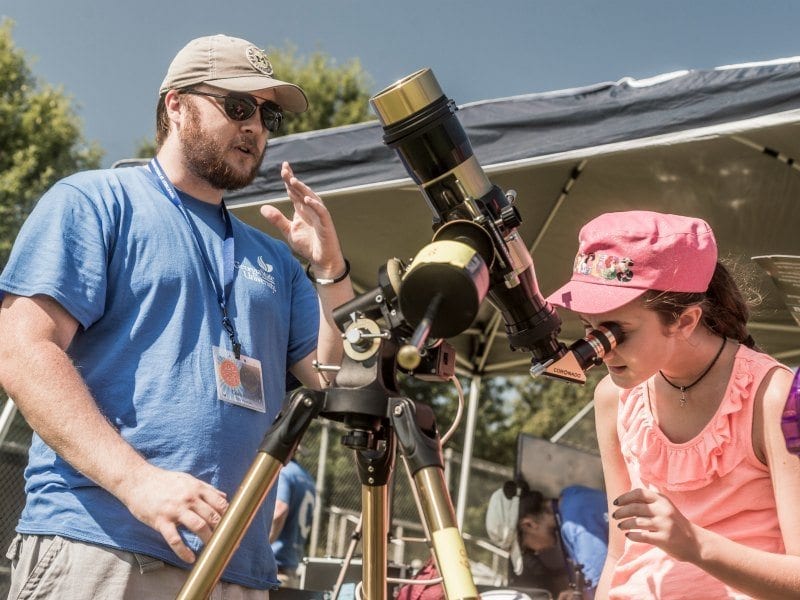



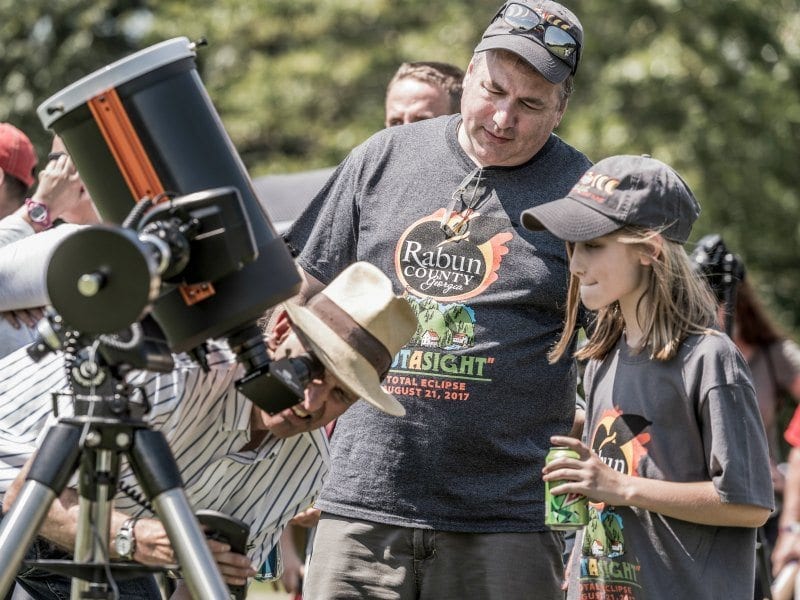




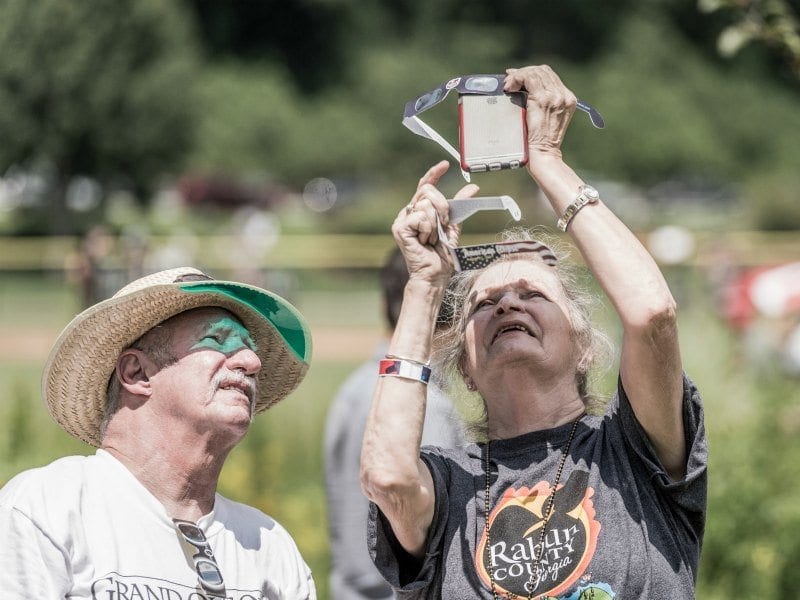
Alan Bier, chief medical officer at Gwinnett Medical Center, arrived from Duluth with his daughter Maxine, a Georgia State graduate. He, too, recalled viewing a partial eclipse in the 1980s, when he and his colleagues viewed the sun through sheets of X-ray film. This time he brought binoculars and camera equipment fitted with solar filters to capture images of the totality.
Randy Prosser and his wife Bobette, photography buffs from Milledgeville, Ga., brought multiple cameras and purchased a Celestron Astromaster telescope for the occasion.
“We wanted to make the most out of this moment,” he said. “It’s a once-in-a-lifetime experience.”
As the countdown clock ticked, attendees streamed to the Georgia State astronomy tents, where students and professors exhibited live images of the sun. They explained that the tiny black dots visible were sunspots, magnetic storms on the surface of the sun, each larger than the Earth itself.
At 1:06 p.m., cheers erupted when the moon finally took a tiny bite from the solar disk. The minutes passed and the sun gradually shrank. Attendees stopped fanning themselves and moved out of the shade as the hot August air noticeably cooled. Sharp crescent-shaped shadows scattered across the ground.
Then at 2:14 p.m., a mass of thick clouds that had been gathering since lunchtime rolled right over the sun. A collective groan broke out. One small boy wiped away heavy tears as his father patted his shoulders. A woman clasped her hands in prayer. Still, the crowd stayed put, heads tilted back.
Finally, at 2:28 p.m., just seven minutes before totality, light broke through. There was loud applause as the clouds fell away and the sun, now a mere sliver, became visible again. The sky quickly began to darken, deepening to cobalt, then navy, then indigo, the horizon rimmed with sunset pink and orange. The little remaining light took on a strange metallic quality.
“Oh my God,” a woman shouted. “Oh my God, it’s happening!”
Dr. Ben McGimsey
At 2:35:42, the sky abruptly fell into near-darkness as the moon obliterated the last fragment of sun. An announcement was made that it was safe to remove protective eclipse glasses. As attendees gaped, Georgia State astronomers described the phenomenon, pointing out a flare of bright light known as the “diamond ring” and the glowing corona.
The sun was a black hole backlit in silver, and for two minutes and 38 seconds, people shouted, cried, stared open-mouthed and laughed in disbelief. Parents held their children, whispering in their ears, fingers pointed upward. Even the astronomers struggled to articulate their emotions, several times resorting to a simple “Wow!”
As the period of totality ended, people again screamed as a shard of brilliant white light suddenly emerged and the eclipse began in reverse. In a moment, the light of day returned and attendees slipped on their eclipse glasses once more. The spell of totality broke like a fever, replaced by excited chatter.
“That was the most incredible thing I’ve ever seen,” a husband said to his wife. “I could not have imagined. I could not have imagined.”