

Georgia State Law students tour Medgar Evers’s home in Jackson, Mississippi.
It’s a little after 3 p.m. Tuesday, March 14, the first Tuesday of spring break. The Fulton County Magistrate Court clerk just read the dispossessory calendar call. Her instructions: “when your name is called, answer ‘plaintiff, defendant, landlord or tenant.’”
A woman runs in after the call. She is out of breath and proceeds to sit next to a man on one of the cold wooden benches occupying the courtroom. She’s late, but it’s OK because the man answered “tenant” on her behalf a few moments earlier.
The judge begins his speech, a speech he has given in some form numerous times. He asks those whose names were just called to please stand up. Other than a group of 12 Georgia State Law students, almost everyone in the room rises. The judge informs those standing that they failed to provide a legally sufficient defense in their answer to the eviction notice they received.
The woman who came in late looks over at her partner — her eyebrows raised, she appears afraid of what the judge will say next. The judge proceeds to read excerpts from the tenants’ answers: “my mother was sick, but I will have rent next week;” “I lost my job and am trying to find a way to pay rent;” “my sister and her kids moved in with me, and I have to buy more food.”
The judge then proceeds to say that, while the court sympathizes with people’s difficult circumstances, the law does not make exceptions. These tenants have no legal defense to eviction.
“You have seven days,” the judge states. All those standing have seven days to move out or await the marshal to force them out, leaving their belongings on the curb. The crowd disperses.
A few brave souls linger to ask questions. Every Tuesday and Thursday at 3 p.m., dozens of people are told they no longer have a home. They have seven days to pack up their lives and move out.
Jackson, Mississippi
Meanwhile, two states away, a Mississippi court judge calls the court to order. The Jackson municipal courtroom is dark and imposing. The air is stuffy. The seats are hard and uncomfortable, like church pews. Dim fluorescent lights buzz up above. Voices echo from the front, where black marble columns stand as barriers to the seated crowd.
A man in a jumpsuit utters one word, “Guilty,” and is ushered away. The next man takes the podium. His attorney, a public defender, steps away from his side. He has to take a phone call. The second prisoner is ushered away.
A third man takes his place at the podium. He tries to explain himself to the judge, but is silenced by his public defender. “You shut your mouth.” This is what passes for justice in Jackson, Mississippi. In the back of the courtroom sit five Georgia State Law students from Atlanta, watching wordlessly.

Georgia State Law students engaged in criminal court observation at the municipal court in Jackson, Mississippi.
The students crossed state lines with a purpose: to spend spring break in Mississippi courtrooms, investigating constitutional violations against those accused of crimes. Specifically, the group was documenting whether low-level offenders, often people of color living in poverty, were given access to legal representation.
The Sixth Amendment guarantees the right to counsel, and later cases, including Gideon v. Wainwright, make clear that right applies equally to those who cannot afford to pay for an attorney. As the law students learn, however, these laws are often subverted by prosecutors, judges and public defenders faced with untenable caseloads, many of whom appear to sacrifice integrity for pragmatism.
“The trip to Jackson opened my eyes to issues that many of us never have to deal with but definitely exist,” said Nick Nesmith (J.D. ’18). “We witnessed people in poverty, the disabled, and the elderly representing themselves in court and almost always pleading guilty. I became aware that the right to counsel is essentially only made available to a narrow group of people, and even then is often trampled upon by those in positions of power.”
The Mississippi Spring Break experience revealed to the students something many already know and others might be surprised to learn: that the kind of justice you receive is often based on your skin color, your ability to speak English, your age and your income.
“I would highly recommend this trip to my fellow law students,” said Virginia McMillan (J.D. ’19). “It provides an immersive experience in the Mississippi justice system, and an opportunity to form deep bonds with your fellow law students, all within the boundaries of a city with a rich civil rights history.”
The law students were tasked with observing municipal and county courts in the Jackson area. What they saw were predominantly low-income people of color being herded through an assembly line, often without a lawyer. Half of the courts they visited had no public defender present at any time during their observation. Each day, the students witnessed dozens of defendants enter guilty pleas, often negotiated one-on-one with a prosecutor. The defendants were placed in a powerless position.
Although the reality the students observed was disheartening, they gained a great deal from the experience. The hospitality of Mississippians, the collegiality and openness of many of the judges and lawyers, and the firsthand observations of the inner workings of a variety of courtrooms were invaluable.
The students’ documentation of Mississippi court proceedings is part of a larger project intended to bring awareness to these issues, and will hopefully bring about much needed change. Heartened by the dedication and resolve of people working to ensure and increase access to justice, the students returned to campus with a newfound awareness all their own.
Alternative Law Spring Break
While most law students spent spring break relaxing or catching up on schoolwork, the 17 students who participated in the Center for Access to Justice’s inaugural Alternative Law Spring Break devoted their week to learning about a new area of law, either landlord-tenant law in Atlanta, or criminal law in Jackson, Mississippi. Many undergraduate students participate in alternative break trips, and several law schools across the county organize pro bono service trips, but this was the first year the college offered the opportunity.
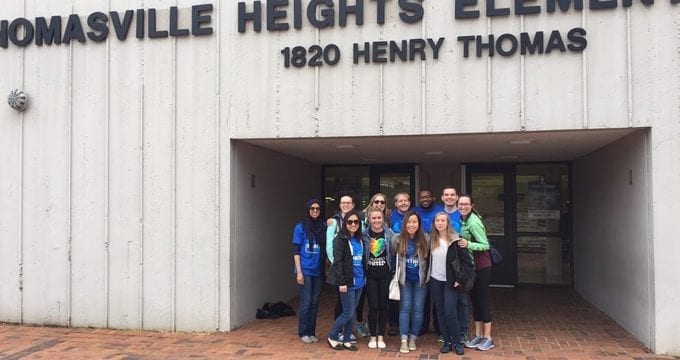
Atlanta participants engage in a 'Know Your Rights' Clinic at Thomasville Heights Elementary School.
“I participated in two Georgia State sponsored trips last year, but they were geared toward undergraduates,” said Atlanta trip co-leader Andrew Navratil (J.D. ’18). “We wanted to create an opportunity specifically for law students to do pro bono legal work.”
Through the Center for Access to Justice and Georgia State’s Office of Civic Engagement, Atlanta trip co-leaders McKinley Anderson (J.D. ’18) and Navratil, along with 10 fellow students from every class year and the LL.M. program, worked with the Atlanta Volunteer Lawyers Foundation (AVLF) to provide free legal services to low-income tenants.
“The participants worked closely with clients,” Anderson said. “As law students, we often forget the cases we read are about real people—people who deserve empathy and compassion.”
Atlanta
The Atlanta students began the week by volunteering at AVLF’s Saturday Lawyer Program, where volunteer lawyers meet with potential clients facing eviction or sub-standard conditions. Throughout the week, students followed up on the clients’ cases, conducting interviews, documenting housing conditions, researching legal issues and drafting demand letters under AVLF lawyers’ supervision.
“It was disheartening to see the coldness and at times uncompromising rigidity within our legal system, which seems to land the hardest on those in most need of reprieve,” Charles Theodore (J.D. ’17). “But I was also encouraged, as we had the opportunity to learn and work alongside organizations, such as Atlanta Volunteer Lawyers Foundation and Legal Aid Society, that are dedicated to helping those less fortunate navigate a legal system that can be costly and intimidating.”
Students also spent significant time in Magistrate Court observing mediations and hearings and helping clients answer their dispossessory notices at the Georgia Law Center for the Homeless Answer Clinic.
The Atlanta students also met with a Magistrate Court judge, talked to volunteer attorneys and heard from the Atlanta Legal Aid Society about the unique challenges facing tenants in public housing. Over lunches and dinners, the students discussed what they were experiencing and learning.
“No one should have to live in subpar conditions because they are poor, or have a criminal record, or are part of a minority group,” said Katelyn Stadtlander (J.D. ’19). “There is no excuse for making someone live in conditions that are dangerous to their health or put their safety in jeopardy.
“This trip opened my eyes to the large community of individuals working to help people every day. This trip was inspiring on so many levels, and I truly recommend that everyone apply, whether you want to pursue a career in public interest or not. Everyone can benefit from this eye-opening experience.”
The Mississippi trip students had a similarly immersive week, observing criminal proceedings in a variety of state courts, documenting what they witnessed and meeting with public defenders to learn about low-income defendants’ experience in criminal court. The students also visited the home of Civil Rights activist Medgar Evers and toured some of the sites making up the rich history of the Civil Rights Movement in Jackson.
“The inaugural group of Alternative Law Spring Break participants seems to have been profoundly impacted by their experience, whether in Atlanta or Jackson,” said Darcy Meals, the center’s assistant director. “Not only were they able to deepen their understanding of a particular area of substantive law, but they also saw how legal principles operate to impact clients’ lives. That insight is an invaluable part of a complete law school education.”
The Center for Access to Justice plans to organize another pro bono service trip over spring break 2018.