
The Bone Keeper
Honors College student William Anderson curates Georgia State's skeletal remains collection. His skeletal studies recently led him to investigate a mass grave in Transylvania possibly left by Vlad the Impaler.
By Jeremy Craig
William Anderson hangs with the dead. As curator of the university's skeletal remains, the Presidential Scholar in the Honors College oversees an enormous inventory of bones – nearly 3,000 of them — used to teach anthropology.
Anderson’s expertise in skeletal systems goes far beyond the anthropology labs in Kell Hall and Sparks Hall where all those bones are kept — he has traveled around the world working with ancient skeletons.
“I've worked everywhere from the jungle to the European countryside to China,” Anderson said. “Generally, I supervise and participate in the actual excavation of remains, as well as doing lab analysis and curation. It's not all Indiana Jones and thrilling discoveries though, I regularly spend hours digging in the sun armed with no more than a toothpick.”
This summer, Anderson trekked to Transylvania in eastern Europe to research what was presumed to be a mass grave left by Vlad the Impaler, the brutal ruler who provided inspiration for the fictional Count Dracula by author Bram Stoker.
When Anderson arrived to that region of Romania, he found a beautiful place with welcoming people to a foreigner doing the sensitive work of investigating human remains.
“They were happy we were interested in their history,” said Anderson, an anthropology and chemistry double major. “The pastor from the nearest village even told the congregation that they needed to bring us desserts and drinks.”
The excavation of human skeletal remains — only of people whose lineage and identity were unknown, and were older than 500 years — produced a result different from what researchers thought.
It was a mass grave, but not one from a battle led by the real Dracula, who lived in the 15th century. Some of the remains were actually centuries older.
“The site turned out to be a sort of mass grave on top of a medieval cemetery that had been highly disturbed, possibly dug up, and reburied,” Anderson said.
Though the results contradicted the theory of a mass grave with victims of a ruthless prince, he said, it was still a fascinating adventure.
“Bones tell stories, especially with the advent of DNA analysis and other techniques,” he said. “You can tell so much about a person’s life, and often it really needs to be told.”
Photos by Steven Thackston
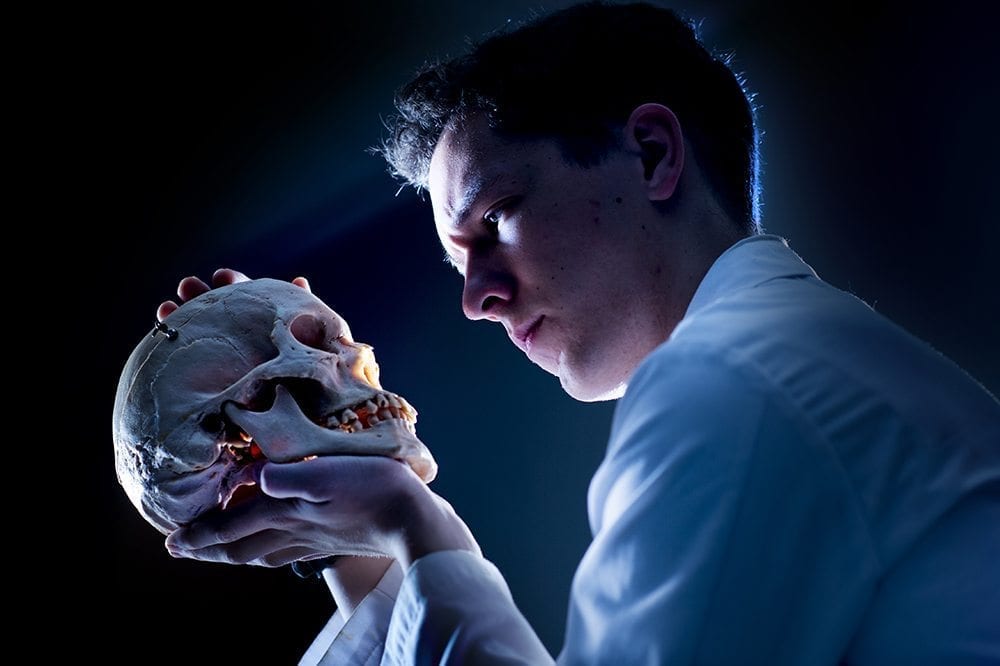
The bones used in these photos are not real. They are replicas based on actual human remains.