
At mile 83, Kat Schuller (J.D. ’13) almost gave up. She had been running more than 20 hours in the ultramarathon Thunder Rock 100 in Tennessee. Between her and the 100-mile finish line was a chest-deep, rapid river and a steep, four-mile incline. The early morning air was chilly, and she was exhausted — so exhausted that she was hallucinating.
“I thought I saw a shark in the trees,” she said. “I sat down and was very cranky.”
But one thing ultrarunning has taught her is not to give up on herself. So she took a deep breath, got up and pushed forward, crossing the finish line 26 hours after she started.
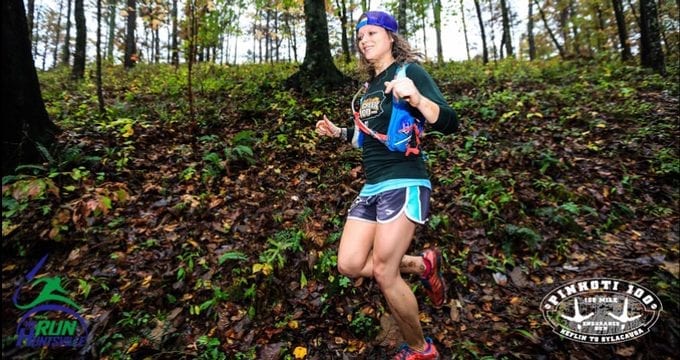
Kat Schuller (J.D. '13) competed in the Monument Valley 50-mile ultramarathon in Arizona in March (top photo) to celebrate her birthday. Above, Schuller ran in the Pinhoti 100 ultramarathon, a 100-mile race in Alabama, in Nov. 2015.
Ultramarathons — technically anything longer than a 26.2-mile marathon, but typically 30 to 100 miles — require a huge dose of willpower and perseverance, especially when unpleasant conditions arise: a blistering sun beating down as you scramble up a slippery hill. Stumbling over rocks and roots in the dark. The gnawing ache of fatigue after miles of constant motion. Chilly rain drops showering you with the threat of hypothermia. (Which Schuller suffered from while running the Pinhoti 100 in November 2015, one of the few races she didn’t finish. The other two were due to sprained ankles.)
For Schuller, who has participated in about 20 ultramarathons, ultrarunning is fulfillment — a weekly regimen that is vital to her wellbeing. She spends most weekends trekking through the North Georgia forest, often with golden retriever Gracie at her heels. To get in as many miles as possible, she cooks a hearty meal over a fire, sleeps in a hammock and begins at daybreak, sprinting 30 or so miles. On average, she runs 40 to 45 miles each week, and supplements training with weight lifting, rock climbing and yoga.
Schuller, who won first place for women and third place overall in the H9 Dragon 50-miler in August, was introduced to long-distance running while in law school. Inspired by the book Born to Run, she joined the Georgia Ultrarunning and Trailrunning Society (GUTS). Running helped take the pressure off the intensive workload and career focus of law school.
“Having something that I could identify with, that wasn’t related to my career, helped me to stress less about what job I would have or where my career was headed,” said Schuller, an attorney at Paul Hastings. “Careers are important — I love my profession. But if that’s the only focus, you can lose sight of who you are without your career.”
In 2012 she entered her first ultramarathon, the 50-mile Cruel Jewel. It was a cathartic experience.
“It was like a boot camp for emotions. You feel excitement and happiness, and you connect with people on the trail. You’re also alone a lot and may experience sorrow, pain and grief. But you have to keep putting one foot in front of the other,” she said.
Ultrarunning became her therapy. The long periods of solitude and being in nature lend themselves to deep thinking and self-reflection. It also teaches how to cope with pain, whether physical, emotional or spiritual, Schuller said.
“Sometimes people look for an escape from the difficulty of just sitting with their feelings, and trail running gives you a lot of alone time to learn about who you are when you’re not escaping,” she said.
Many people, especially those in high-intensity professions such as the legal field, tend to keep their feelings bottled up, said Schuller. “People feel that you’re not supposed to be vulnerable in the workplace … or in relationships,” she said. “Being alone in nature gives you the chance to really experience those stagnant emotions and then let out whatever you are feeling — you can literally scream at the top of your lungs — and know that it’s going to be fine.”
Ultrarunning can also be a spiritual experience, she said, which has made her calmer and more grounded.
“You’re breathing clean air and not focused on the minutiae of daily life, which for many of us involves computers, cell phones and cars,” she said. “It’s like a reconnection when you get away from those things that seemingly control our lives.”
Running through the night is especially conducive to deep meditation, she said. “All you have is your headlamp and what’s right in front of you. You’re not distracted by the world around you — it’s just one foot in front of the other.”
Nature inspires you to see things differently, too.
“On one trail there was a fallen tree. Out of its roots, other plants were growing. Its bark was covered in moss. So, although it had fallen, the tree repurposed itself and is supporting the environment around it, helping other things grow,” she said.
She applied that metaphor to struggles in her own life, along with countless other lessons learned while going the distance.
“Running long distances makes me feel like I have unlimited potential, and it has taught me not to limit myself in other ways,” she said. “And that is a really powerful thing.”