
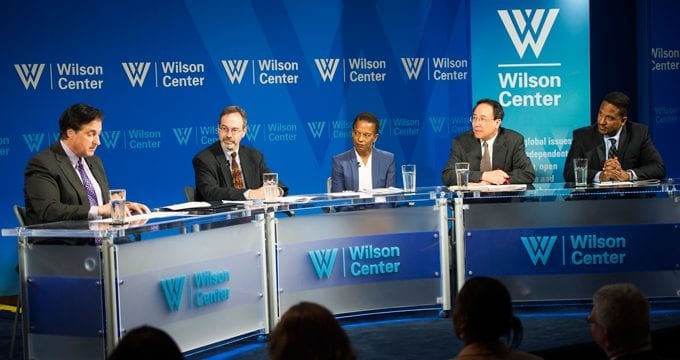
Leon Jaworski panelists, (left to right): John Milewski, director of digital programming at the Woodrow Wilson International Center; Russell Dean Covey, professor of Law at Georgia State University; Angela J. Davis, a professor of Law at American University Washington College of Law; Yue Ma, associate professor at the John Jay College of Criminal Justice at the City University of New York and Ronald C. Machen, partner at Wilmer Hale. (photo credit: Lisa Helfert, American Bar Association)
Russell Dean Covey, professor of law, participated in the 2016 American Bar Association (ABA) Leon Jaworski Public Program series as part of Law Day 2016.
In recognition of the 50th anniversary of the U.S. Supreme Court ruling in Miranda v. Arizona, the 2016 Law Day theme was “Miranda: More than Words.” Covey participated on a panel, which discussed whether Miranda is still “part of our national culture,” as declared in a 2000 case, Dickerson v. United States, upholding the Miranda ruling.
“Each panelist gave their perspective on the current state of Miranda and the concern about how effective it is in its current incarnation,” Covey said. “The Supreme Court has handed down many decisions since the 1970s that has watered it down since the initial ruling, which sought to improve how people stay informed of their legal rights and balance the needs of the legal system while enforcing criminal law.”
The ABA series organizers invited Covey to participate on the panel because of his ideas and findings presented in his article, “Miranda and the Media: Tracing the Cultural Evolution of a Constitutional Revolution,” which was published in Chapman Law Review. For the article, he traced the evolution of police interrogation depicted in TV shows from the 1940s through present day and how the introduction of Miranda shifted perspective on interrogation and the role of the suspect and police.
Covey considers the prevalence of Miranda in pop culture as an important topic for legal professionals to discuss in high profile forums, such as Law Day.
“Miranda is unique among Supreme Court cases. It reflects a major moment in development of criminal procedure. Not only did it impact police practices and status of criminal procedure, it became known by the general public in a way more so than any other,” he said. “We use Miranda as a symbol of the rule of the law and processes police should follow during interrogation.”
Covey acknowledges that TV and film producers don’t often depict Miranda accurately—they use it merely as a symbol to communicate to the audience that the suspect has been arrested. As a result, many people don’t fully understand the importance of evoking their Miranda rights. “People who are being interviewed by police don’t take it seriously, and they should,” he said. “The purpose of the Miranda warnings was not only to tell the individual that they had the right to be silent and to consult an attorney, so that the attorney could inform them better about their right to silence, but also to communicate to them that anything they say can and will be used against them, which is a significant moment that has legal consequences, potentially.”
Covey hopes that by addressing Miranda at Law Day and other events, the broader population will learn more about their rights and exercise them more vigorously, especially young people.
“Educating young people about what Miranda stands for will help them better understand what rights they have when they are first confronted with police questioning—before they end up in the back room of the police station.”
Since 2001, the ABA Division for Public Education has conducted the Leon Jaworski public program series to commemorate Law Day. The Jaworski public programs examine themes of law, politics and culture. Learn more about Covey’s perspective in the ABA Law Journal podcast.