
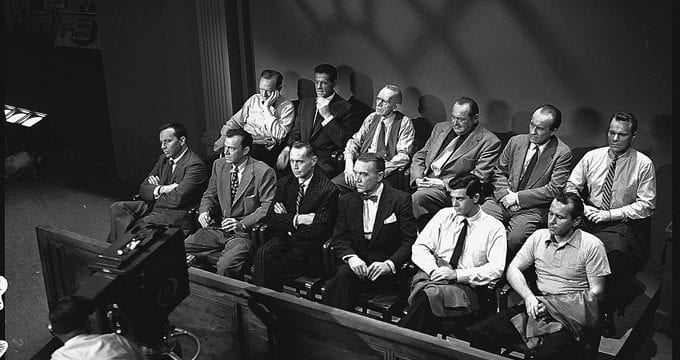
A movie still from Twelve Angry Men shows an all-white jury. In a 7-1 opinion in Foster v. Chatman written by Chief Justice John Roberts, the U.S. Supreme Court reversed the conviction and death sentence of Timothy Tyrone Foster, who was convicted in 1987 by an all-white jury for the murder of Queen Madge White, a retired white schoolteacher.
In a 7-1 opinion in Foster v. Chatman written by Chief Justice John Roberts, the U.S. Supreme Court reversed the conviction and death sentence of Timothy Tyrone Foster, who was convicted in 1987 by an all-white jury for the murder of Queen Madge White, a retired white schoolteacher.
For nearly 20 years, Foster’s attorneys argued that his trial was unfair because prosecutors had unlawfully systematically jettisoned African-Americans from the jury on the basis of race (a practice that the Supreme Court ruled unconstitutional in 1986 in Batson v. Kentucky). At every turn in the appellate process, Georgia state courts—including the Supreme Court of Georgia — denied Foster’s claims. The courts concluded there was not enough evidence that the strikes were racially motivated.
Rarely is evidence of racial motivation in jury selection so substantial and obvious, so most litigants face an uphill battle in proving that jurors were dismissed in a racially discriminatory manner. But in Foster’s case, the evidence of racial bias was overwhelming, and the Roberts Court agreed. In fact, the prosecution painstakingly documented (and preserved) its efforts in a methodical and detailed manner. Examples include circling the word “BLACK” next to the “Race” question on juror questionnaires; highlighting names of black jurors in green; noting African-Americans in the jury pool as “B#1,” “B#2” and "B#3;" ranking them against one another in case, as noted, “it comes down to having to pick one of the black jurors.”
Ultimately, the prosecution struck each of the prospective black jurors, providing race-neutral reasons that were enough to mollify the Georgia courts. That Foster’s defense team secured these records is an impressive feat. Because of those records, the U.S. Supreme Court dug into the merits of the case—the conduct, excuses and outcomes of the prosecution’s jury selection process.
The opinion itself crucifies the prosecution in Foster’s case. Roberts notes that similarly situated white jurors remained on the jury but when it came to black jurors, the prosecution presented “shifting explanations” and “misrepresentations of the record” to justify the peremptory challenges.
Roberts got it right (though the call was obvious). He found that at least two of the jurors were removed because they were black, and he put it simply: “Two peremptory strikes on the basis of race are two more than the Constitution allows.”
The predictable dissent belongs to Doubting Justice Clarence Thomas. While this perhaps seemed like the one-in-a-million criminal case that cried out for a unanimous opinion from the Supreme Court, Thomas was perturbed that his colleagues would not defer to the factual findings of years of litigation that found no bias. “In few other circumstances could I imagine the Court spilling so much ink over a factbound claim arising from a state postconviction proceeding.”
An unfair trial is worth spilling ink over. At first glance, the opinion is a promising one-two punch that helps in post-conviction relief. First, the opinion notes that the Supreme Court had jurisdiction to hear despite at attempt by Georgia to argue procedural bars under state law. Second, the opinion addresses the merits of the juror discrimination present in this case.
At the same time, Justice Samuel Alito’s concurrence hints that you basically have to have a slam dunk to win a Batson challenge. Foster’s case is a standout from what is usually a subtler and more discreet form racial bias that permeates and infects other cases. A quieter bias is also unconstitutional, but far more difficult to prove. I worry that the extraordinary nature and detail in the files uncovered by Foster’s attorneys creates an artificial and impossibly high burden of proof for future cases.
Jessica Gabel Cino, incoming associate dean for academic affairs and associate professor of law, teaches courses on forensic evidence, forensic medicine, bankruptcy and contracts. While in law school, she co-founded and served as the executive director for the Wrongful Convictions Project, which assisted defendants with claims of actual innocence at the University of Miami's School of Law. Professor Cino continues to work on these cases with students at the College of Law.