
Media Contact
LaTina Emerson
Director of Communications
Institute for Biomedical Sciences
Georgia State University
[email protected]
ATLANTA — A new laboratory skills course in the Institute for Biomedical Sciences (IBMS) at Georgia State University is equipping graduate students with hands-on experience with common techniques practiced in biomedical science research labs.
The new course requirement for IBMS master’s and Ph.D. students, Experimental Approaches in Biomedical Research: Practicum (BMSC 4110/6110), is a partner course to Experimental Approaches to Biomedical Science (BMSC 4100/6010). Well-qualified undergraduate students can register for the course with instructor permission.
The course expands upon the theoretical foundation developed in BMSC 4100/6010 with practical, hands-on laboratory experience. Students will learn to perform important cell and molecular biology techniques that are routinely used in biomedical science research and clinical environments. They will also be taught to use the principles of good experimental design to answer basic scientific questions.
“This course was envisioned to give all students an even baseline of laboratory skills when entering our program and allow the professional track master’s students to acquire more laboratory skills,” said Cynthia Nau Cornelissen, associate director of the Institute for Biomedical Sciences. “The course goes over the basic techniques used in most of the institute’s labs. It benefits all of the students to have the theoretical knowledge behind the techniques, which will aid them when troubleshooting techniques are needed to resolve issues in the lab.”
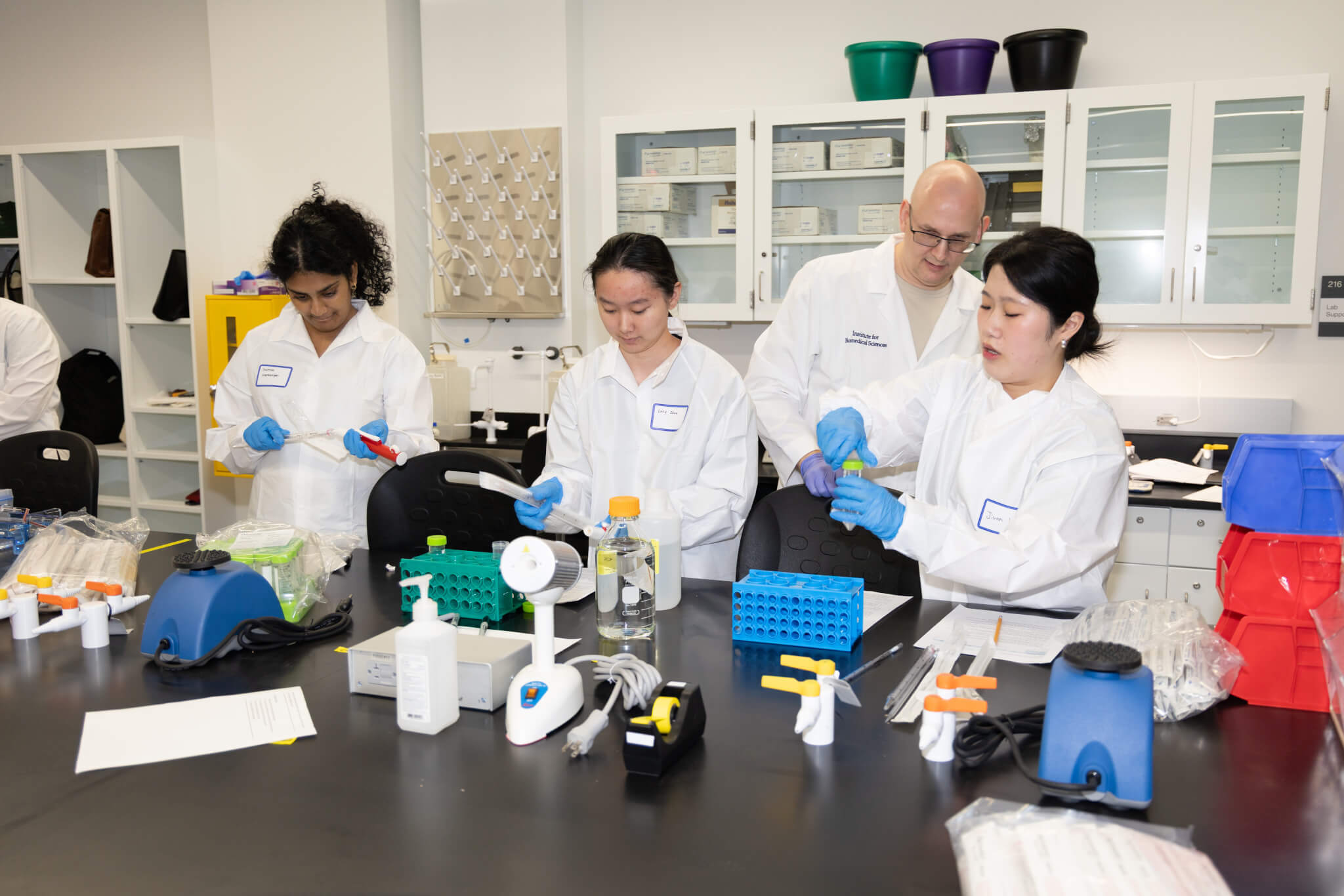
In August, the institute held a three-hour student bootcamp for all incoming Ph.D. students and any interested master’s students to test basic molecular biology techniques used in most of the laboratories in IBMS. The students practiced pipetting small and large volumes, making and loading agarose gels, making solutions, visualizing samples under a microscope and adhering to sterile techniques. At each station, students were evaluated by a faculty panel, explained Julie Stoudenmire, a research assistant professor in the Institute for Biomedical Sciences.
“This bootcamp offered the students an opportunity to exempt a required course (BMSC 4110/6110) and take a course of their interest if they were sufficiently proficient at all of the stations,” Stoudenmire said.
All students who participated in the lab bootcamp, more than a dozen, were able to exempt the BMSC 4110/6110 course. Graduate students who chose not to participate in the bootcamp were automatically enrolled in the laboratory course.
— Photo by Michael Daniel